There is much that is interesting about Bhopal. The period between 1890 and 1926, for example, when it was ruled by a succession of Begums, or its sobriquet of 'city of lakes'.
If Benaras is known for its exquisite silks, Bhopal was famous for its
zari
work. All that changed on the intervening night of December 2-3, 1984.
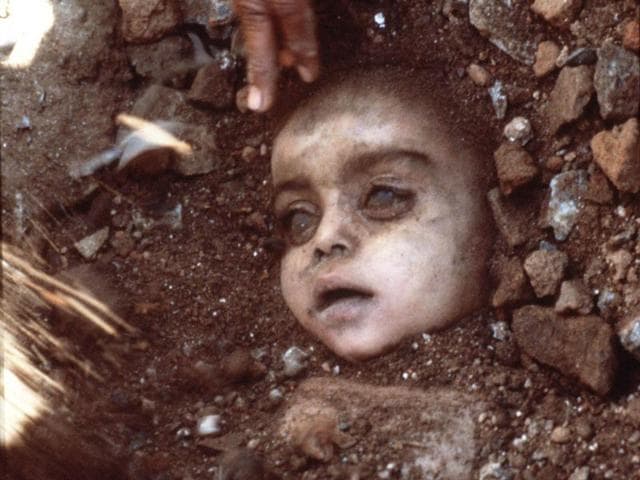
Fans of the 1975 screen classic, Sholay, may still associate the city with the character of Surma Bhopali - today, the city has a restaurant named after him - but in the collective consciousness, Bhopal has come to be associated inextricably with the gas tragedy. Thirty years on, the incident continues to cause agony, both physical and emotional, to victims. It has also divided the city in two. In the more recently-built quarters, the shadow of 1984 has almost dissipated. Here, there is no pain blazing in the eyes long after the tears have dried; you do not hear the repeated refrain of 'khatam ho gaya' uttered in a voice that has lost its grief in the struggle to survive, to take care of the ones that remain. In every house in the bylanes around the ruins of the Union Carbide India Ltd. (UCIL) plant, you hear of parents, spouses and children who died, khatam ho gaye, either in the days or months that followed the disaster, or of lingering health issues in the years since. "My mother died that night. She choked in her sleep. My father and I survived but we continue to suffer from breathing trouble, failing vision and weakness," says Sunita (35). When Union Carbide came to Bhopal in 1969, all that we knew was that it was a plant that was making pesticide. Local MLAs belonging to the Communist parties had always opposed the setting up of the plant within the city. But then prime minister Indira Gandhi said that the Union Carbide plant in Bhopal would give a boost to the Green Revolution in the country," recalls Abdul Jabbar, who has been fighting for the rights of victims since immediately after the event. Jabbar himself lost his parents and brother in the disaster. TR Chouhan, former MIC (Methyl Isocyanate) plant operator at Union Carbide's Bhopal facility, says, "The management had told the workers that the Bhopal plant had been designed and built on the basis of the company's 20 years of experience in manufacturing MIC at the company's West Virginia plant. However, after the accident, I came to know that there had been many differences between the two plants, which made the one in Bhopal dangerous." He adds, "Also, in case of an accident, the company had made evacuation plans only for the workers and not for the people living around the plant. Even the siren to warn people was switched off after five minutes, as per the company's revised policies. Only a muted alarm to alert plant personnel continued to ring." Conspiracy theories, scandals, allegations, blame games, protests and litigations - the years since 1984 - have seen them all, ensuring that Bhopal never quite slipped out of the headlines. When Warren Anderson, who was Union Carbide CEO in 1984 (he came to the country four days after the accident, was detained, and was subsequently allowed to leave), died in the US on September 29, Bhopal erupted in anger. Anderson never faced punishment. On November 10, victims and activists will gather at New Delhi's Jantar Mantar for a waterless hunger strike by five women survivors. They are demanding additional compensation for all survivors and a correction of figures of death and the extent of injury in the curative petition filed in the Supreme Court by the central government. They contend that the event physically weakened many victims, robbing them of their ability to work. "Doctors are still treating victims with symptomatic drugs. And because of the indiscriminate use of psychotropic drugs, painkillers and steroids, the victims are developing a fresh set of problems such as kidney damage. All this is because of Union Carbide not disclosing the nature of MIC, which has resulted in doctors not being able to find the correct antidote," says activist Satinath Sarangi. In 2000, The Bhopal Medical Hospital and Research Centre (BMHRC) was set up under the Supreme Court's directive. The hospital has not been without its share of scandals. In 2011, 279 victims were allegedly illegally tested for new drugs without their knowledge. The matter is subjudice. The current director of the hospital, Manoj Pandey, shied away from commenting on that scandal but was more forthcoming on the health of victims. "The most common ailments are chronic respiratory and pulmonary diseases and cataract," he says. Psychological disorders are also prevalent. While Sarangi mentions increased incidences of tuberculosis and cancer among the survivors, Pandey is less willing to attribute the cause of these disorders to toxic gas exposure. In one of its reports on Bhopal, the Indian Council of Medical Research (ICMR) admitted to "higher incidence rates of cancer in the gas affected areas." However, it concluded that the spread of cancer was "in anatomical sites that are associated with use of tobacco..."The horror seems to pass down the generations. When Mohd. Altamash (8) was born with crippling disabilities, the family was convinced it was because his father had been exposed to the toxic MIC fumes as a five-year-old. Families claim congenital malformations are common in the affected areas. An ICMR report based on clinical studies conducted between 1985 and 1994 records that "the incidence of congenital malformations per 1,000 births was 14.2 in affected areas and 12.6 in control or unaffected areas." In the same study to record pregnancy outcome in women exposed to MIC/toxic gas, the number of abortions recorded in the affected areas was 24.2 per cent. It was just 5.6 per cent in the control areas. Dr NP Mishra, who was dean of Gandhi Medical College and one of the main doctors to treat the gas victims at the time, denied that one-term exposure to MIC by the people of Bhopal has had any long term residual effect. Dr NP Mishra was on the ICMR review committee that studied the effect of MIC exposure on the people. Mishra's verdict contradicts the findings of activist and academician Anil Sadgopal. In a report filed in the Supreme Court in August 1988, Sadgopal and Dr Sujit K. Das said, "evidence emerging from a number of Indian research projects has established that MIC enters the bloodstream and reacts with various tissue components, thereby persisting and causing multi-systematic disorders." It's an argument, which like the suffering of the victims, looks set to go on.Meanwhile, leftover toxic chemicals from the plant continues to contaminate the soil and ground water here. A Centre for Science and Environment (CSE) report says "tests have showed widespread contamination of soil and groundwater with heavy metals, organic chemicals and pesticides". Studies have shown that the effects of the contamination vary from allergic skin reactions, to kidney problems, damage to the nervous system, cancer and damage to reproductive health. Alarmingly, the site itself seems to double up as a playground for the neighbourhood's children who sneak in through holes in the boundary wall. Last year, the CSE, Delhi, invited experts to come up with an action plan for Bhopal. But it's clear that legal and official hurdles continue to delay the cleaning up of 30-year-old chemical trash.
I can't work now. Who will look after my daughters?Remembers the night of December 2, 1984, like it was yesterday. "I was only 20 years old then, but I was married and already had three children. That night, I was visiting my parents, who lived in the same area. I had gone to bed but woke up with a burning sensation in my eyes. I couldn't breathe," she recalls. With a child in each arm, Noor Jahan ran out. Her brother carried her youngest child, Afroz. Though, their lives were spared, the next day, Afroz and his sister had to be taken to the doctor. "My daughter's eyes were swollen. She couldn't see. Afroz had inhaled so much of the toxic fumes, that his stomach had swollen. Though, he was released after preliminary medication, little did Afroz and his family know that his travails were far from over. "He would keep falling ill. He had frequent stomach aches and would often vomit. We took him to the government hospitals but the doctors kept sending us back with medicines that would dull the pain for a while. Then he started vomiting blood. It was then that the doctors told us that his kidney was damaged," says Noor Jahan. By then, Afroz had married and had three children. "I used to work in the welding industry. But now, after frequent dialysis and surgery, I have been told not to do any heavy physical labour. I have three daughters. How will I look after them?" frets Afroz. The government doesn't even recognise him as a gas victim. His treatment at the BMHRC is being done on his mother's victim card. "The compensation court asked for his age proof. We are illiterate people. When we were putting Afroz in school, the teacher said that he had crossed the admission age and suggested that we reduce his age in the form. We agreed. We had no idea that this document would later be used to prove that he had been born after the tragedy," says Noor Jahan. Afroz is not the only member of the family with health problems. "My eldest son has been married for 10 years, but has no children. People say he has become infertile because of his exposure to the toxic fumes. My youngest son Iqbal, born a year after the tragedy, developed a tumour on his shoulder as a child. We feared it might be cancer, but thankfully, there were no problems after it was removed. However, he too has been complaining of stomach aches and vomiting," says Noor Jahan. The 50-year-old herself has trouble walking. She and her husband both have breathing difficulties.With Afroz unable to work, and his father and brothers earning a meagre salary as labourers, the family hopes the Supreme Court and the government will review the compensation package and come up with one that is more favourable for the victims, and also make better healthcare available to them.  My son (45) cannot work; he's been ailing since '84In 1990, Chirounji Bai, 70, got a house in what goes by the name of Gas Widows Colony in Bhopal. Open drains, potholed roads and a general air of neglect gives the place a dismal air. Residents complain that, in the monsoon, when the drains begin to overflow and the roads are waterlogged, life becomes unbearable here. "I was among the first ones to be allotted a house here. These houses were given in three phases. Over the years, many of the widows sold them or gave them on rent and moved away," says Chirounji Bai, who lost her husband nine months after the disaster. "He had inhaled a lot of the toxic fumes. We took him to the hospital immediately but his internal organs had been affected. He never recovered," she says. She herself has to cope with frequent chest pains, cough and breathlessness. "I can't even walk a few steps without beginning to pant," she says. The disaster killed her daughter and ruined the lives of the entire family. "My daughter was married to a man who lived outside Bhopal but had been visiting us that night. My grandson was born with complications. He has breathing trouble and can't do heavy physical work. My 45-year-old son can't work. He has been ailing since the gas tragedy. My husband had a shop. We had to sell it because there was no one to look after it," she says. Chirounji Bai did receive `10 lakh as compensation, but with no steady income, the family still has to face financial constraints. "This colony has such poor infrastructure. Drinking water and drainage are big problems," she says. On November 10, Chirounji Bai will be in Delhi with the other victims in their struggle for justice. Event DiaryThe Bhopal gas disaster took place on December 3, 1984.In February 1989, the Bhopal Settlement awarded the victims a total compensation of $470 million.In 2010, the CJM, Bhopal, prosecuted the accused but restricted punishment to two years imprisonment and Rs 1 lakh fine.
I can't work now. Who will look after my daughters?Remembers the night of December 2, 1984, like it was yesterday. "I was only 20 years old then, but I was married and already had three children. That night, I was visiting my parents, who lived in the same area. I had gone to bed but woke up with a burning sensation in my eyes. I couldn't breathe," she recalls. With a child in each arm, Noor Jahan ran out. Her brother carried her youngest child, Afroz. Though, their lives were spared, the next day, Afroz and his sister had to be taken to the doctor. "My daughter's eyes were swollen. She couldn't see. Afroz had inhaled so much of the toxic fumes, that his stomach had swollen. Though, he was released after preliminary medication, little did Afroz and his family know that his travails were far from over. "He would keep falling ill. He had frequent stomach aches and would often vomit. We took him to the government hospitals but the doctors kept sending us back with medicines that would dull the pain for a while. Then he started vomiting blood. It was then that the doctors told us that his kidney was damaged," says Noor Jahan. By then, Afroz had married and had three children. "I used to work in the welding industry. But now, after frequent dialysis and surgery, I have been told not to do any heavy physical labour. I have three daughters. How will I look after them?" frets Afroz. The government doesn't even recognise him as a gas victim. His treatment at the BMHRC is being done on his mother's victim card. "The compensation court asked for his age proof. We are illiterate people. When we were putting Afroz in school, the teacher said that he had crossed the admission age and suggested that we reduce his age in the form. We agreed. We had no idea that this document would later be used to prove that he had been born after the tragedy," says Noor Jahan. Afroz is not the only member of the family with health problems. "My eldest son has been married for 10 years, but has no children. People say he has become infertile because of his exposure to the toxic fumes. My youngest son Iqbal, born a year after the tragedy, developed a tumour on his shoulder as a child. We feared it might be cancer, but thankfully, there were no problems after it was removed. However, he too has been complaining of stomach aches and vomiting," says Noor Jahan. The 50-year-old herself has trouble walking. She and her husband both have breathing difficulties.With Afroz unable to work, and his father and brothers earning a meagre salary as labourers, the family hopes the Supreme Court and the government will review the compensation package and come up with one that is more favourable for the victims, and also make better healthcare available to them. My son (45) cannot work; he's been ailing since '84In 1990, Chirounji Bai, 70, got a house in what goes by the name of Gas Widows Colony in Bhopal. Open drains, potholed roads and a general air of neglect gives the place a dismal air. Residents complain that, in the monsoon, when the drains begin to overflow and the roads are waterlogged, life becomes unbearable here. "I was among the first ones to be allotted a house here. These houses were given in three phases. Over the years, many of the widows sold them or gave them on rent and moved away," says Chirounji Bai, who lost her husband nine months after the disaster. "He had inhaled a lot of the toxic fumes. We took him to the hospital immediately but his internal organs had been affected. He never recovered," she says. She herself has to cope with frequent chest pains, cough and breathlessness. "I can't even walk a few steps without beginning to pant," she says. The disaster killed her daughter and ruined the lives of the entire family. "My daughter was married to a man who lived outside Bhopal but had been visiting us that night. My grandson was born with complications. He has breathing trouble and can't do heavy physical work. My 45-year-old son can't work. He has been ailing since the gas tragedy. My husband had a shop. We had to sell it because there was no one to look after it," she says. Chirounji Bai did receive `10 lakh as compensation, but with no steady income, the family still has to face financial constraints. "This colony has such poor infrastructure. Drinking water and drainage are big problems," she says. On November 10, Chirounji Bai will be in Delhi with the other victims in their struggle for justice. Event DiaryThe Bhopal gas disaster took place on December 3, 1984.In February 1989, the Bhopal Settlement awarded the victims a total compensation of $470 million.In 2010, the CJM, Bhopal, prosecuted the accused but restricted punishment to two years imprisonment and Rs 1 lakh fine.