As India celebrates Kailash Satyarthi's Nobel, a look at the child labour crisis that has condemned millions of children to toil ceaselessly. Children continue to labour as families, too poor to feed their young, send them out to work.
As the traffic signal near Masjid Moth in Delhi changes to red and cars start pulling up, ten-year-old Raina (name changed) stops playing with the other children waiting at the lights, and arranges her face in her trademark expression of distress. Slowly, she begins weaving her way between the cars, peering into the rolled-up windows, coaxing commuters to buy an angry bird or chhota bheem balloon. Behind her, other children peddle their various wares of toys, flowers and pens. When one glass window lowers, Raina begins to hand out a ballon. But out comes a hand holding a large box of pizza and a bottle of coke. The mysterious benefactor wins a whoop of delight and a face-splitting grin from Raina. As India and the world celebrates Nobel Peace Prize, child labour - which the child rights activist has been working to eradicate - continues to hold millions of children like Raina in its grasp. In its annual report for 2012-13, Bachpan Bachao Andolan, that Satyarthi founded, mentions 4,936 cases of child labour that it has identified. The organisation claims to have rescued 976 child labourers and filed complaints in 72 cases. Sixty-three First Information Reports were registered against employers. In a research paper on its website, the organisation reports that, as per Census 2011, 11.7 million children are employed in India. Non-Government Organisations working in this field estimate that there are 60 million child labourers. According to the Ministry of Human Resource and Development, 8.15 million children are currently out of school in India, says the report.
Much Ground To Cover"Our focus has to be on out-of-school children. All out-of-school children are potential resources for the labour market. There has to be better implementation of the Right to Education Act," insists Kushal Singh, former chairperson of the National Commission for Protection of Child Rights. India is not the only country with a child labour problem. According to UNICEF, the Asia-Pacific region (ILO regional classification) had the most child labourers aged 5-17 (77.7 million) in 2012 as compared with 59 million in Sub-Saharan Africa and 12.5 million in Latin America and the Caribbean. Sub-Saharan Africa has the highest incidence of child labour, with one in five children involved. However, "India does have one of the highest numbers of child workers in the world," confirms Vandana Kandhari, Child Protection Specialist, UNICEF (India). According to the 2013 edition of UNICEF's the State of the World's Children, 12% of children aged 5 to 14 in India are child workers (i.e. 28 million children). There is no one figure to establish the number of child labourers in the country as different organisations have their own ways of computing. Also, organisations treat 17 ,18 or 14 variously as the cut-off age for child labour. What many activists find difficult to accept, however, is that, even after years of having legislations in place, there is still so much ground to cover in India. The Child Labour (Prohibition and Regulation) Act of 1986 bans the employment of children up to the age of 14 in hazardous occupations. The National Policy on Child Labour declared in August, 1987, contains an action plan to tackle the problem of child labour. The Supreme Court, in a judgement passed in December 1996, directed the authorities to conduct a survey to identify working children, withdrawal of children working in hazardous industries, and ensure they are educated in appropriate institutions. It also directed them to provide help and rehabilitation to the childrens' families. In 1992, India was the first country to join The International Programme on the Elimination of Child Labour, a global programme launched by the International Labour Organisation a year before. India has also signed and ratified the UN Convention on the Rights of the Child. Yet, despite years of efforts made by government and non-government bodies, lakhs of children continue to be drafted into the country's labour force. In 2013, Childline India Foundation received a total of 15,636 calls from victims of child labour, up from 10,574 in 2012 and 5,805 in 2011. "Our research has shown that 11 per cent of India's workforce consists of children below 18 years of age," says Nishit Kumar of Childline. He adds, "The statistics on Child Labour are hopelessly outdated resulting in faulty evaluation of the situation and planning. The Comptroller and Auditor General [Audit Report (Civil)] routinely under-report the true numbers of working children, or it simply does not bother to conduct the surveys needed to properly identify these children." That poverty is the prime reason pushing these children to work at an early age is a no-brainer. But there are other reasons that compound the problem. "Child labourers are drawn from the most socio-economically marginalised communities, such as those from minorities and the Scheduled Castes (SCs) and Scheduled Tribes (STs). Traditionally deprived of access to quality and age-appropriate education, health facilities, employment, and developmental initiatives such as those for poverty alleviation, they are often discriminated against. The low levels of skills and unemployment or underemployment of adults, combined with the discrimination that children may face in schools, pushes many of these children to work. Urban children are more vulnerable due to increasing work opportunities," explains Vandana Kandhari of UNICEF. Legal and bureaucratic malfunctions and loopholes worsen the situation. "There are no systems to help reintegrate or rehabilitate the children," says Soha Moitra, regional director-North, Child Rights and You (CRY). Often, those rescued from labour return to work in the absence of a family livelihood. Adds Nishit of Childline, "Child labourers fall within the ambit of not just the child labour law and certain other labour laws but also the Juvenile Justice law as they are children in need of care and protection. However, the rate of conviction under the child labour laws is poor, clearly pointing to weak enforcement of laws." The present Child Labour (Prohibition and Regulation) 1986, itself is restricted in its impact. It is also in conflict with other regulations relating to children. The Act does not prohibit child labour but only restricts their employment in jobs deemed to be hazardous, as at firework-making factories, for example. Also, it talks of children only up to the age of 14. This is in contradiction to the Juvenile Justice Act, which defines children as those under the age of 18. An amendment to the Child Labour Act is pending in Parliament. The Child Labour (Prohibition and Regulation) Amendment Bill, 2012 proclaims that it "is proposed to prohibit employment of children below the age of 14 years in all occupations and processes to facilitate their enrolment in schools in view of the Right of Children to Free and Compulsory Education Act, 2009 and to prohibit employment of adolescents (persons who have completed fourteenth year of age but have not completed eighteenth year) in hazardous occupations and processes and to regulate the conditions of service of adolescents in line with the ILO Convention 138 and Convention 182, respectively." What Needs To Be DoneRights activists, however, want a blanket ban on the employment of children up to the age of 18. "Legislation should not divide children into child and adolescent as both are equally vulnerable. The Law should not allow a child below 18 years of age to be engaged in any employment. A large amount of work in which girls are engaged does not even figure as child labour," says Moitra, adding, "It is well established that girl children are largely engaged in running the household from a very early age, even before they are capable of wage-earning activities. The government must consider all children in the workforce whether the work done is paid or unpaid, part of family labour or for an outside employer." Proper and accurate data collection on child labour is imperative for effective policy making and programming. Society too plays a role. "If we stop patronizing employers and products that use child labourers, it will help in eliminating child labour from," points out CRY's regional director-North. Unless we do, children like Raina will continue to be a common sight at traffic signals, at middle class homes (taking care of children who are only a little younger than themselves), at farms and brick kilns, at the mechanics where we have our cars repaired and at factories that manufacture our Diwali sparklers. Case Studies
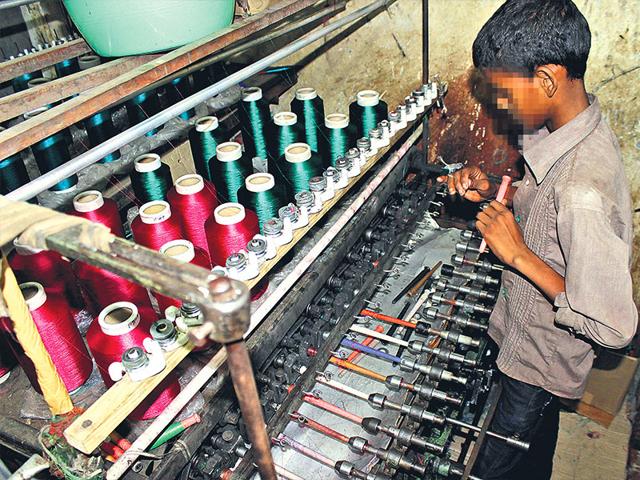
'I have learnt nothing else in life'Child labour is more of a norm than an exception in the Banarasi silk industry. In hundreds of power loom units operating in narrow lanes across the city, children as young as 11 years of age work tirelessly from 8am until 7pm, with just an hour-long lunch break in between. They earn as little as Rs 2,000-2,500 a month. A few generous employers pay an extra Rs 100 for food. The only respite is on Sundays. For Mehboob (12) of Lallapura, working at a power loom has become a way of life. His neighbours Ahmad (12) and Rizwan (11) also work at the same power loom. Ask Mehboob about his dreams and he reveals that weaving is his only skill. "I have learnt nothing else in life. For the past one-and-a-half years, I have been working at this power loom. I want to become a skilled weaver and own a power loom when I grow up," he says. Ahmad and Rizwan share his ambition. Power loom owners and even the parents of the children insist that kids working in the silk industry must not be equated with other child labourers. These children are learning the rare skill of weaving, which will help earn a livelihood when they grow up, says Atiq Ansari, a weaver leader. Besides, the weavers' families are not in a position to invest in books, school fees and uniforms for their children. "No well-off parent will send his child to work on a loom. All child weavers come from poor families," says Ansari. "If they do not work, who will feed them?" -Pawan Dixit
{{^htLoading}} {{/htLoading}}
{{^usCountry}}
'I would like to study'Narendra was rescued from a construction site in Noida recently where he had been working as a bonded labourer along with his parents. The family had been working there for the past four months without any remuneration and were also being stopped from leaving the site. "I started working when I was 12. The thekedar (labour contractor) would beat me up and threaten me and tell my parents that they would not get any money unless I too worked with them. My parents didn't want me to work, but they had no option. We are so poor," says the boy, who has studied till class VIII. "When I started working, I used to work as a labourer assistant and get Rs 50-60 a day. This was the first time that I was working as a proper construction labourer but they didn't pay us anything. I would like to study, but where is the money?" he wonders. Age comes sooner to those with responsibilities. Ask Narendra whether he would like to go back to school now that he has been rescued from bondage and might expect rehabilitation from the government and he says, "I am too old to go to school now." The family ekes out a difficult living in the village with his parents rolling bidis in the season, or harvesting soyabean and other crops when needed in other people's fields. For the most part, they work as migrant labourers on construction sites. His parents have no Below Poverty Level or MGNREGA (job) cards. "We have to move around so much for work, that often we are not there in the village when these forms are filled," explains Gulab, Narendra's father. Narendra's only dream now is to find some work to earn enough to support his family and have a secure future for himself. "I have four younger siblings. I want them to study," he says. Poulomi Banerjee
'Dream of being a teacher'His feet in worn slippers, his legs marked by injuries from unending hours of walking buffaloes through rough terrain, and his body laden with dust, Bipin Chero, is the true face of India's child labour problem. All of eight years old, the tribal boy from Badalgarh village in the Kaimur hills of Rohtas district in western Bihar supplements his family's income by working long hours grazing buffaloes that belong to the village head. So poor are the people in this part of Bihar that owning a few buffaloes, which Bipin grazes for a small consideration, makes the village head, Basgit Chero, one of the richest local tribals. "If I don't do this, my family won't have enough to eat," Bipin says. He also wields an axe, locally known as 'tangi', to clear the bushes for the buffaloes to move. He also helps his father Mahendra Chero, a woodcutter. Bipin's elder brother, Arvind (13) works as a farm labourer in Punjab to contribute to the family's meagre income. His younger brother Ankit (5) and sister Tetar (3) have to be home with their mother Hemvati, who doesn't keep well. So keen is Bipin to make something of his life that despite the financial hardship, he forced his father to enroll him in the village school, working hard to balance work and study. His mother helps him continue at school by minding the buffaloes for him during study hours. As soon as school is over, Bipin is back to the grazing fields so his mother can go home and cook for her husband and children. "I want to become Sirji someday," says the boy, revealing his dream to become a teacher at the lone school in the village. Bipin earns `1,000 a month, which he hands over to his mother. "All the free time I have is about an hour in the evening to play," he says. Playing usually involves chatting with his mother and younger siblings. There is no electricity, television or radio, so the family retires to bed early. The same grind resumes at the crack of dawn the next day.Prasun K Mishra
'Someday, I hope to play more'Hanif is paid based on how much plastic he can collect from the heaps of dry waste he handles every day. There are no fans in the godown where he works from 9 am to 6.30 pm. His only break is half an hour for lunch. His duties also involve buying the heaps of waste and carrying them from a larger godown in the sprawling slum of Dharavi, to the smaller godown where he works. "It's a tough job. I get paid `14 per kg of plastic, so sometimes I make as much as Rs 150 a day, and sometimes - if the batch has only paper and cardboard - I make nothing at all," he says. The story of how Hanif went from a school-going boy to a child labourer is an all-too-familiar one. "I dropped out in Class 5. My father died and I had to find work to help support the family. I've been working ever since," he says. The youngest of three siblings, Hanif's two brothers work as manual labourers. Together, they support their mother, grandmother, the married brother's wife and their two children. "I liked school. I liked studying. English and Maths were my favourite subjects," Hanif says. "I want to go back. But I doubt I will ever return to regular school." Instead, Hanif is planning to enroll in night school. "But the only night school in my area is an English-medium one and I am scared I won't be able to keep up," he says. So, for now, he attends free study classes conducted by NGO Acorn Foundation, which works specifically with children and adults in the informal waste-recycling - or rag-picking - industry. "I can't go every day, because sometimes I have to work late. But I go as often as I can, especially for the English and Maths classes, and the football sessions," he says, smiling. "I want to grow up and be a footballer because playing football with my friends is the best part of my week. I just hope that someday I can spend more time playing than working." Riddhi Doshi
'I'm working to buy new clothes'Barely ten kilometres from the state secretariat, where policy makers plan the state's future, Sheela Kumari (11) works beside her mother at a stone-crushing plant in Tupudana. Covering her face with a thin towel to shield herself from the dust, she stands waiting next to the machine which processes small rocks. She has been working at this plant for the past two weeks and sees it as an opportunity to earn some money of her own. As both her parents are engaged in working at the stone crushing plant, this seemed almost an obvious choice for her. "I am working here for a few days to earn some money so that I am able to buy some new clothes for myself," she says shyly. Kumari lives nearby with her parents. Interestingly, she also goes to the neighbourhood school where she studies in standard V. She has been, however, missing school to work at the plant. Her job requires her to spend long hours in the dust carrying the processed rocks on her head in a tin basket. She then transfers these rocks into another machine which further processes and crushes these rocks into a fine powder. Kumari spends more than nine hours working at the plant each day for which she receives Rs 600 per week. "I come to the plant at 8 in the morning and leave when the work finishes around 5.30 in the evening," she says. After returning home in the evening, she likes to play with her friends in the meager leisure time that she gets. "I will resume going to school from next Monday," she says. Her humble background, however, does not stop her from dreaming big. She says that she wants to complete her studies and plans to become a doctor in the future. Saumya Mishra
{{/usCountry}}
{{#usCountry}}
'I would like to study'Narendra was rescued from a construction site in Noida recently where he had been working as a bonded labourer along with his parents. The family had been working there for the past four months without any remuneration and were also being stopped from leaving the site. "I started working when I was 12. The thekedar (labour contractor) would beat me up and threaten me and tell my parents that they would not get any money unless I too worked with them. My parents didn't want me to work, but they had no option. We are so poor," says the boy, who has studied till class VIII. "When I started working, I used to work as a labourer assistant and get Rs 50-60 a day. This was the first time that I was working as a proper construction labourer but they didn't pay us anything. I would like to study, but where is the money?" he wonders. Age comes sooner to those with responsibilities. Ask Narendra whether he would like to go back to school now that he has been rescued from bondage and might expect rehabilitation from the government and he says, "I am too old to go to school now." The family ekes out a difficult living in the village with his parents rolling bidis in the season, or harvesting soyabean and other crops when needed in other people's fields. For the most part, they work as migrant labourers on construction sites. His parents have no Below Poverty Level or MGNREGA (job) cards. "We have to move around so much for work, that often we are not there in the village when these forms are filled," explains Gulab, Narendra's father. Narendra's only dream now is to find some work to earn enough to support his family and have a secure future for himself. "I have four younger siblings. I want them to study," he says. Poulomi Banerjee
'Dream of being a teacher'His feet in worn slippers, his legs marked by injuries from unending hours of walking buffaloes through rough terrain, and his body laden with dust, Bipin Chero, is the true face of India's child labour problem. All of eight years old, the tribal boy from Badalgarh village in the Kaimur hills of Rohtas district in western Bihar supplements his family's income by working long hours grazing buffaloes that belong to the village head. So poor are the people in this part of Bihar that owning a few buffaloes, which Bipin grazes for a small consideration, makes the village head, Basgit Chero, one of the richest local tribals. "If I don't do this, my family won't have enough to eat," Bipin says. He also wields an axe, locally known as 'tangi', to clear the bushes for the buffaloes to move. He also helps his father Mahendra Chero, a woodcutter. Bipin's elder brother, Arvind (13) works as a farm labourer in Punjab to contribute to the family's meagre income. His younger brother Ankit (5) and sister Tetar (3) have to be home with their mother Hemvati, who doesn't keep well. So keen is Bipin to make something of his life that despite the financial hardship, he forced his father to enroll him in the village school, working hard to balance work and study. His mother helps him continue at school by minding the buffaloes for him during study hours. As soon as school is over, Bipin is back to the grazing fields so his mother can go home and cook for her husband and children. "I want to become Sirji someday," says the boy, revealing his dream to become a teacher at the lone school in the village. Bipin earns `1,000 a month, which he hands over to his mother. "All the free time I have is about an hour in the evening to play," he says. Playing usually involves chatting with his mother and younger siblings. There is no electricity, television or radio, so the family retires to bed early. The same grind resumes at the crack of dawn the next day.Prasun K Mishra
'Someday, I hope to play more'Hanif is paid based on how much plastic he can collect from the heaps of dry waste he handles every day. There are no fans in the godown where he works from 9 am to 6.30 pm. His only break is half an hour for lunch. His duties also involve buying the heaps of waste and carrying them from a larger godown in the sprawling slum of Dharavi, to the smaller godown where he works. "It's a tough job. I get paid `14 per kg of plastic, so sometimes I make as much as Rs 150 a day, and sometimes - if the batch has only paper and cardboard - I make nothing at all," he says. The story of how Hanif went from a school-going boy to a child labourer is an all-too-familiar one. "I dropped out in Class 5. My father died and I had to find work to help support the family. I've been working ever since," he says. The youngest of three siblings, Hanif's two brothers work as manual labourers. Together, they support their mother, grandmother, the married brother's wife and their two children. "I liked school. I liked studying. English and Maths were my favourite subjects," Hanif says. "I want to go back. But I doubt I will ever return to regular school." Instead, Hanif is planning to enroll in night school. "But the only night school in my area is an English-medium one and I am scared I won't be able to keep up," he says. So, for now, he attends free study classes conducted by NGO Acorn Foundation, which works specifically with children and adults in the informal waste-recycling - or rag-picking - industry. "I can't go every day, because sometimes I have to work late. But I go as often as I can, especially for the English and Maths classes, and the football sessions," he says, smiling. "I want to grow up and be a footballer because playing football with my friends is the best part of my week. I just hope that someday I can spend more time playing than working." Riddhi Doshi
'I'm working to buy new clothes'Barely ten kilometres from the state secretariat, where policy makers plan the state's future, Sheela Kumari (11) works beside her mother at a stone-crushing plant in Tupudana. Covering her face with a thin towel to shield herself from the dust, she stands waiting next to the machine which processes small rocks. She has been working at this plant for the past two weeks and sees it as an opportunity to earn some money of her own. As both her parents are engaged in working at the stone crushing plant, this seemed almost an obvious choice for her. "I am working here for a few days to earn some money so that I am able to buy some new clothes for myself," she says shyly. Kumari lives nearby with her parents. Interestingly, she also goes to the neighbourhood school where she studies in standard V. She has been, however, missing school to work at the plant. Her job requires her to spend long hours in the dust carrying the processed rocks on her head in a tin basket. She then transfers these rocks into another machine which further processes and crushes these rocks into a fine powder. Kumari spends more than nine hours working at the plant each day for which she receives Rs 600 per week. "I come to the plant at 8 in the morning and leave when the work finishes around 5.30 in the evening," she says. After returning home in the evening, she likes to play with her friends in the meager leisure time that she gets. "I will resume going to school from next Monday," she says. Her humble background, however, does not stop her from dreaming big. She says that she wants to complete her studies and plans to become a doctor in the future. Saumya Mishra
Poulomi Banerjee is assistant editor at Hindustan Times.A journalist with over a decade’s experience, Poulomi has reported on varied subject, but human rights and gender issues are her preferred areas of work
Get the latest India News, breaking headlines, and real-time updates from across the nation. Stay informed on politics, government policies, crime, weather, and CEC Gyanesh Kumar row Live.
Get the latest India News, breaking headlines, and real-time updates from across the nation. Stay informed on politics, government policies, crime, weather, and CEC Gyanesh Kumar row Live.
 "When I started working, I used to work as a labourer assistant and get Rs 50-60 a day. This was the first time that I was working as a proper construction labourer but they didn't pay us anything. I would like to study, but where is the money?" he wonders. Age comes sooner to those with responsibilities. Ask Narendra whether he would like to go back to school now that he has been rescued from bondage and might expect rehabilitation from the government and he says, "I am too old to go to school now." The family ekes out a difficult living in the village with his parents rolling bidis in the season, or harvesting soyabean and other crops when needed in other people's fields. For the most part, they work as migrant labourers on construction sites. His parents have no Below Poverty Level or MGNREGA (job) cards. "We have to move around so much for work, that often we are not there in the village when these forms are filled," explains Gulab, Narendra's father. Narendra's only dream now is to find some work to earn enough to support his family and have a secure future for himself. "I have four younger siblings. I want them to study," he says. Poulomi Banerjee
  His younger brother Ankit (5) and sister Tetar (3) have to be home with their mother Hemvati, who doesn't keep well. So keen is Bipin to make something of his life that despite the financial hardship, he forced his father to enroll him in the village school, working hard to balance work and study. His mother helps him continue at school by minding the buffaloes for him during study hours. As soon as school is over, Bipin is back to the grazing fields so his mother can go home and cook for her husband and children. "I want to become Sirji someday," says the boy, revealing his dream to become a teacher at the lone school in the village. Bipin earns `1,000 a month, which he hands over to his mother. "All the free time I have is about an hour in the evening to play," he says. Playing usually involves chatting with his mother and younger siblings. There is no electricity, television or radio, so the family retires to bed early. The same grind resumes at the crack of dawn the next day.Prasun K Mishra
 The story of how Hanif went from a school-going boy to a child labourer is an all-too-familiar one. "I dropped out in Class 5. My father died and I had to find work to help support the family. I've been working ever since," he says. The youngest of three siblings, Hanif's two brothers work as manual labourers. Together, they support their mother, grandmother, the married brother's wife and their two children. "I liked school. I liked studying. English and Maths were my favourite subjects," Hanif says. "I want to go back. But I doubt I will ever return to regular school." Instead, Hanif is planning to enroll in night school. "But the only night school in my area is an English-medium one and I am scared I won't be able to keep up," he says. So, for now, he attends free study classes conducted by NGO Acorn Foundation, which works specifically with children and adults in the informal waste-recycling - or rag-picking - industry. "I can't go every day, because sometimes I have to work late. But I go as often as I can, especially for the English and Maths classes, and the football sessions," he says, smiling. "I want to grow up and be a footballer because playing football with my friends is the best part of my week. I just hope that someday I can spend more time playing than working." Riddhi Doshi
  Kumari lives nearby with her parents. Interestingly, she also goes to the neighbourhood school where she studies in standard V. She has been, however, missing school to work at the plant. Her job requires her to spend long hours in the dust carrying the processed rocks on her head in a tin basket. She then transfers these rocks into another machine which further processes and crushes these rocks into a fine powder. Kumari spends more than nine hours working at the plant each day for which she receives Rs 600 per week. "I come to the plant at 8 in the morning and leave when the work finishes around 5.30 in the evening," she says. After returning home in the evening, she likes to play with her friends in the meager leisure time that she gets. "I will resume going to school from next Monday," she says. Her humble background, however, does not stop her from dreaming big. She says that she wants to complete her studies and plans to become a doctor in the future. Saumya Mishra