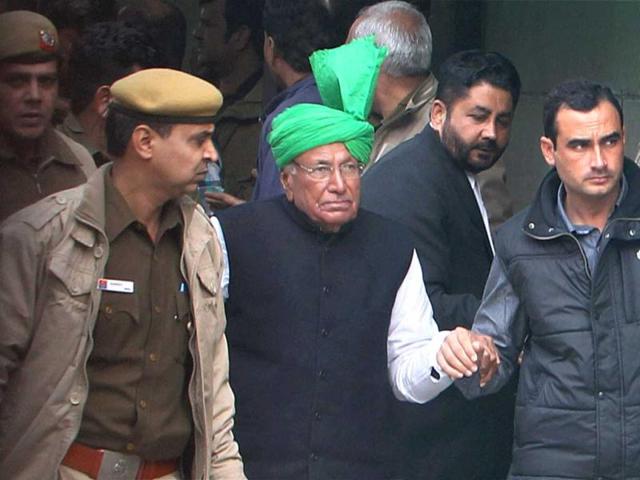
Attorney of former Haryana chief minister Om Prakash Chautala and his son Ajay Singh - both convicted along with 53 others in the JBT teachers' recruitment scam on Wednesday -- had tried to unsuccessfully convince the CBI court that financial gain was not the motive behind the alleged illegal appointments.
The ingredient of pecuniary (monetary or financial) advantage as mentioned in section 13 (1) (d) of the Prevention of Corruption Act was missing in the trial, their lawyer contended. But special CBI judge Vinod Kumar, however, refused to accept this contention, saying in his January 16 order that enough evidence was on record to show the scam was committed with this object (pecuniary gain) in mind.
"Had the genuine lists been implemented, a large number of persons who got appointment on basis of fake lists would have failed. Salary, of course, is given in lieu of the performance of duties but it must be kept in mind that government job offers one of the finest pecuniary advantages in terms of salary, stability and security… if government job is provided to undeserving candidates, it is a sure pecuniary advantage to him. Had the genuine lists been implemented, such undeserving candidates would have never got this salary," ruled the trial court, quoting a judgment of the Himachal Pradesh high court.
The judge further said: "I may compare it to a situation where the government gives a mining contract to a person ignoring the better bidders. The person getting such contracts cannot be allowed to say that he would earn money because of the work he would doing in the mines, and that he has not got any pecuniary advantage from the government."
{{/usCountry}}The judge further said: "I may compare it to a situation where the government gives a mining contract to a person ignoring the better bidders. The person getting such contracts cannot be allowed to say that he would earn money because of the work he would doing in the mines, and that he has not got any pecuniary advantage from the government."
{{/usCountry}}The trial court added that the observation of the Delhi HC in a related matter was an apt answer to the point of pecuniary advantage raised by the counsel of the accused. "The words 'pecuniary advantage' used in Section 13 (1)(d) are of wide amplitude. It may not every time mean and have reference to taking of money in physical form. Providing employment to someone favourably against merit, due to relation of some other tangible or intangible consideration, would also be a case of pecuniary advantage to both employee and also the wrongdoer. Both would in one way or the other be making pecuniary advantage, tangible or intangible," the Delhi HC had observed.
Section 13 (1) (d) of the Prevention of Corruption Act deals with criminal misconduct by a public servant, who is said to commit the offence if he illegally obtains for himself or for others any valuable thing or pecuniary advantage.
The special CBI judge also observed that the government of Haryana, for instance, was an entity that must be seen as "distinguished from the persons manning it": "I am of the opinion that state of Haryana has been dishonestly induced by such acts of forgery of awards list and by their implementation due to which jobs were given to undeserving candidates and deserving candidates failed to get the same. I may add here that the Government of Haryana must be distinguished from the persons manning it. A person occupying a constitutional chair may come and go but the state and its government continue forever."
Cheating charge tweaked
However, the trial court accordingly reduced the charge of cheating against the accused from section 420 of the IPC to section 418. While section 420 of the IPC deals with 'cheating and dishonestly inducing delivery of property', section 418 deals with 'cheating with knowledge that wrongful loss may ensue to person whose interest the offender is bound to protect'.
The Chautala father and son, two IAS officers and several others were convicted on Wednesday under sections 13 (1) (d) and 13 (2) of the Prevention of Corruption Act and sections 418, 467, 471 and 120B of the IPC.
THE SECTION IN QUESTION
Section 13 (1) (d) of the Prevention of Corruption Act deals with criminal misconduct by a public servant. It says that a public servant is said to commit the offence of criminal misconduct if he by corrupt or illegal means, obtains for himself or for any other person any valuable thing or pecuniary advantage, or by abusing his position as a public servant obtains for himself or for any other person any valuable thing or pecuniary advantage or while holding office as a public servant obtains for any person any valuable thing or pecuniary advantage without any public interest.
The judge in the Chautala case cited a Delhi HC ruling: "The words 'pecuniary advantage'… may not every time mean and have reference to taking of money in physical form."
Question: What should be the fate of JBT teachers selected through the tainted process?
Write to us at letterschd@hindustantimes.com