Only a month ago, Arvind Kejriwal had come to our office, wearing the trademark topi. "We will win Delhi,'' he had declared cockily, displaying a trait that so marks the man. We had mocked him then, even if silently.
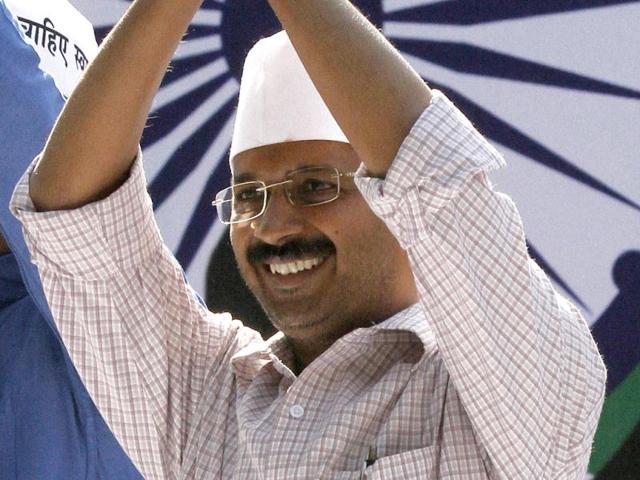
The cocky outsider, known more for civil disobedience than for wily politics, can afford to smile, and be smug. He has emerged not just as a giant killer who may well have put a full stop to outgoing chief minister Sheila Dikshit's political career. Today, it is his turn to say - I told you so.
He may not yet sit in the chief minister's chair; nor be the one holding cabinet meetings in Jantar Mantar, but Kejriwal's determination - dare I say cockiness - has led a fledging, one-year-old party to what can only be called a stunning and sensational debut.
The bureaucrat-turned-activist turned-politician, who defeated Delhi chief minister Sheila Dikshit in New Delhi constituency, was far more tuned in to the pulse of the population. Fed up with scam after scam and the ever escalating cost of the humble onion--a staple in every household--the voter went for the jhadoo, a symbol that Kejriwal chose well.
In the end, Kejriwal's broom swept both tradition and convention aside. The Congress underestimated him and the BJP failed to formulate a strategy on how to effectively counter him. In particular, the BJP ended up aping him - releasing a manifesto for each of Delhi's 70 constituencies. The BJP was also forced to showcase Dr Harsh Vardhan and hoped that the Narendra Modi chant would bolster its case. It did, to some extent but failed to break the wall, built brick by brick by Kejriwal's sheer determination.
In the end, Kejriwal's broom swept both tradition and convention aside. The Congress underestimated him and the BJP failed to formulate a strategy on how to effectively counter him. In particular, the BJP ended up aping him - releasing a manifesto for each of Delhi's 70 constituencies. The BJP was also forced to showcase Dr Harsh Vardhan and hoped that the Narendra Modi chant would bolster its case. It did, to some extent but failed to break the wall, built brick by brick by Kejriwal's sheer determination.
Determination has been built into Kejriwal's DNA from his early years. The 1968-born, who had to shift schools between Haryana and Uttar Pradesh, owing to his father's transfers, learnt the true meaning of the word challenge early on. Always a topper at school, he was a 'bookie' who hated being disturbed. Even then, he simply locked himself up in the bathroom, to avoid being distracted from his text books.
The bureaucrat, who chose the revenue service, after he twice failed to make it to the IAS, was not satisfied just being a babu in a government office. He first engaged with grass-root level activism through 'Parivartan and then set his eyes on pushing the Right to Information Act.
His push for transparency earned him the Magsaysay award for 'Emergent Leadership' in 2006. He quit his cozy job the same year to turn full time activist and formed an NGO, Public Cause Research Foundation, with the award money.
"RTI did bring in revolutionary change in public discourse. But soon it became clear that the act can only help dig out information about corruption but not punish the guilty. There in lay the roots of India Against Corruption (IAC)," Kejriwal had told HT in 2011. The IAC - with Anna Hazare as its face -- kept the government on tenterhooks
through 2011 and half of 2012 with its public agitations that prompted the common man to hit the streets demanding a strong Janlokpal.
Kejriwal was always there, sharing the stage with Anna and many thought that the elder's disapproval of a political route, when the two finally parted ways, would dent his ascent to political power. But the counting of votes on December 8 may have surprised not just the Congress and the BHP, but Anna as well.
Kejriwal was mocked when he asked Delhiites to tear up their electricity bills. 'This is the height of civil disobedience' and 'gimmickry won't work' were two arguments thrown at him, but on hindsight, the 29 seats that AAP appears to be winning (counting is still on) are testimony to one simple fact: the trouser and shirt politician stands ahead of his kurta-pyjama clad political colleagues mainly because he read the deep anger of not just the slum dwellers but the urban class as well.
The anger was so widespread and so deep-seated, it was sweeping not just through the Capital's jhuggi-jhopdi clusters but through the tastefully decorated drawing rooms of south Delhi as well. The jhadoo became such a potent symbol of that anger, it even overshadowed Kejriwal's little-known candidates. In so many constituencies across the Capital, people hadn't heard of Kejriwal's faceless candidates; but they'd all heard of the jhadoo and they associated with it.
Kejriwal pointed to everything that the middle class was angry about: that the politician was getting more security than the aam aadmi and that power needs to return to the people and not lie restricted to those who win it and then wield it from their own bungalows in Lutyens Delhi.
All through the campaign, Kejriwal was asked which party the AAP would support if it failed to win a majority. Perhaps the question should have been - whose support will the AAP take? The fact that this question has become a possibility is a testimony to Kejriwal's determination. And yes, his cockiness too.