Fifty years ago, on October 19, close to midnight, China attacked India’s forward posts in the North-East Frontier Agency (now Arunachal Pradesh) and put to rest Jawaharlal Nehru’s misconceived ‘forward policy’.
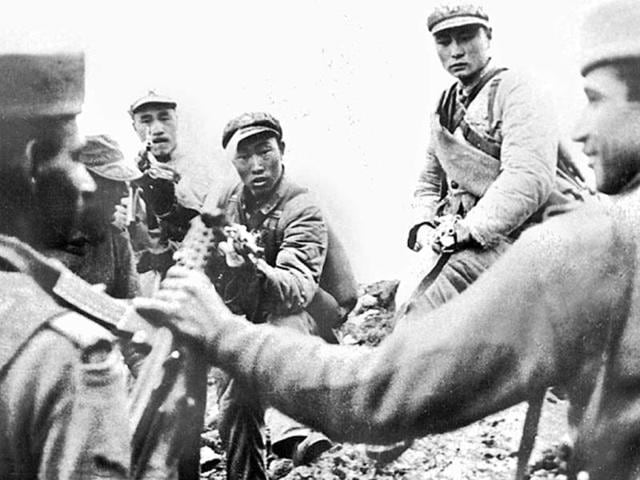
The humiliation of that military defeat shattered Nehru’s idealism and half a century later it still rankles India’s military pride. In that month-long conflict — clearly India’s darkest hour — post after post fell to the Chinese, as India’s political and military leadership failed the country, even though our junior officers and our troops, who were pushed to the frontline in cotton uniforms and canvas shoes, fought back with their bare hands and stones when their ammunition ran out. In retrospect, the fall of Tawang, Walang, Se La, and Bomdila could have been prevented if India’s military commanders had stood up to the arrogant defence minister at the time, Krishna Menon.
The cause of the conflict was China’s opposition to the border mapped during the Simla convention, 1914, where Tibet’s border lay between Aksai Chin (in Ladakh) and Xinjiang in the west, and the boundary of Arunachal in the east. It was an imperial legacy that Mao Tse Tung chose to defy. Coupled with that was India’s diplomatic-cum-intelligence failure in Tibet. For a decade preceding the invasion, China refused to accept India’s suggestion that Tibet must be allowed to remain independent and act as a buffer between the two countries. Also, New Delhi’s failure to formally recognise Tibet as a country let China violate Tibet’s sovereignty. And as the Chinese presence in Tibet grew, India became covertly involved in supplying arms to the Tibetans. In 1960, China’s Chou en Lai had in fact offered a boundary settlement, but Nehru dismissed it. Thus, Chairman Mao decided to teach India a lesson and bring Nehru to the negotiating table.
What followed was a complete military rout for India. The Chinese first attached Bum La and Thag La near Namka Chu in the east and Rezang La in Chusul in the west. In both sectors Indian troops initially showed fearless resolve. In the battle of Namka Chu, the Rajput Battalion 2, under Brigadier Dalvi, fought until they were almost wiped out. And at Rezang La, Major Shaitan Singh, (a posthumous Param Vir Chakra) and his men from 13 Kumaon, held off seven Chinese attacks, as all 114 died. But at the higher levels, our men were completely let down, as Menon bypassed the Indian Army chief and other commanders and decided to run the war by himself. Even the Indian Air Force was used largely to ferry casualties, not in an offensive role, for fear of escalating the conflict. The invasion ended abruptly on November 21, 1962, with the unilateral withdrawal by the Chinese army.
{{/usCountry}}What followed was a complete military rout for India. The Chinese first attached Bum La and Thag La near Namka Chu in the east and Rezang La in Chusul in the west. In both sectors Indian troops initially showed fearless resolve. In the battle of Namka Chu, the Rajput Battalion 2, under Brigadier Dalvi, fought until they were almost wiped out. And at Rezang La, Major Shaitan Singh, (a posthumous Param Vir Chakra) and his men from 13 Kumaon, held off seven Chinese attacks, as all 114 died. But at the higher levels, our men were completely let down, as Menon bypassed the Indian Army chief and other commanders and decided to run the war by himself. Even the Indian Air Force was used largely to ferry casualties, not in an offensive role, for fear of escalating the conflict. The invasion ended abruptly on November 21, 1962, with the unilateral withdrawal by the Chinese army.
{{/usCountry}}Even now, New Delhi’s response to Chinese belligerence is cautiously measured. The reason is that our political leadership remains in a state of denial about what went wrong and who our guilty men were. The truth is in the report compiled by two Indian army officers — Lt Gen Henderson Brooks and Brig Prem Bhagat, VC — that remains locked in a vault in South Block. By one account, only a few people have had a look at the report. This includes historian Neville Maxwell — who squarely blames New Delhi for the conflict — and those at the defence ministry’s historical division, who are sworn to secrecy. However, it is yet to be made public for the fear that it will further sully Nehru’s image. But it’s about time we learned from our past.
With the border issue far from settled, especially China’s claim over Tawang, a standoff in the future is still likely. But how could India react if that happens? In at least two instances since 1962, the Indian Army has shown that it has the resolve to stand up to China’s bullying. The first was in 1967, when troops of the 2nd Grenadiers, refused to blink or budge from their posts in Nathu La, even as the Chinese opened fire on them. And unlike 1962, in 1986, General K Sundarji’s swift response to move troops - by using the IAF’s heli-lift capability — to counter a Chinese army build up at Sumdorong Chu, the Namka Chu River — where the Chinese began the 1962 invasion — has a lesson for the future. Rajiv Gandhi wanted to pull back, but Sundarji stood his ground and the Chinese backed off.
Maroof Raza is a former Indian Army officer and commentator on military affairs. The views expressed by the author are personal.