China will in all likelihood react sharply to the mention of disputes in the South China Sea in the joint statement issued on Saturday during the ongoing visit of Japanese Prime Minister Shinzo Abe to India.
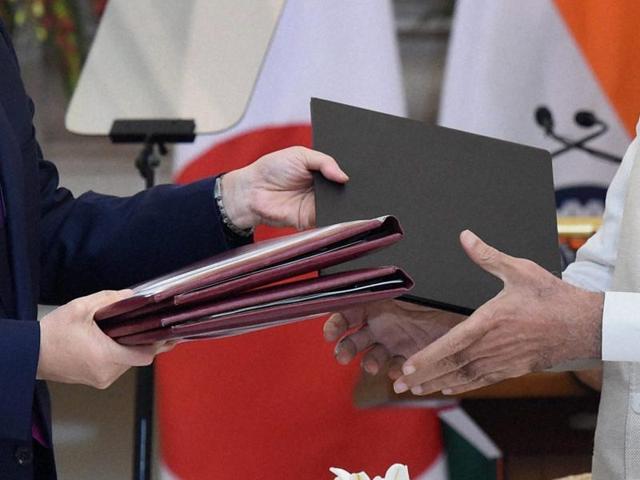
Beijing would have carefully scrutinised the section titled “Vision for Peace and Stability” in the long joint statement.
Beijing, mildly put, is sensitive to countries not in the region talking about the South China Sea and the ongoing disputes that it is locked into with countries like Vietnam, Malaysia and Philippines.
It has consistently warned that countries not directly involved should never comment or refer to the disputes.
China claims almost the entire maritime region and the shoals and reefs that dot the choppy waters of the South China Sea.
Beijing has repeatedly said that the region has historically under its rule and has been rapidly building artificial islands in the region.
Not the way countries like the US, Japan and India sees the issue.
“In view of critical importance of the sea lanes of communications in the South China Sea for regional energy security and trade and commerce which underpins continued peace and prosperity of the Indo-Pacific, the two Prime Ministers noting the developments in the South China Sea called upon all States to avoid unilateral actions that could lead to tensions in the region,” the India-Japan joint statement said on Saturday.
{{/usCountry}}“In view of critical importance of the sea lanes of communications in the South China Sea for regional energy security and trade and commerce which underpins continued peace and prosperity of the Indo-Pacific, the two Prime Ministers noting the developments in the South China Sea called upon all States to avoid unilateral actions that could lead to tensions in the region,” the India-Japan joint statement said on Saturday.
{{/usCountry}}It added that both countries hoped for “…peaceful resolution of disputes without use or threat of use of force”.
Exactly the words, China would want to hear to react angrily.
It had responded with a pointed statement to HT soon after the first Japan-India-US trilateral dialogue among the foreign ministers of the three countries in New York in September 2015. The statement after the meeting mentioned South China Sea and the freedom of maritime navigation.
“China enjoys indisputable sovereignty over the Nansha (Spratly) Islands and their adjacent waters as well as sovereign rights and jurisdiction over relevant seabed and subsoil,” the Chinese ministry of foreign affairs had told HT in a written statement.
The response mentioned the “Five Persistence” followed by China.
“…we have always adhered to the principle of “ Five Persistence”, which stands for persistence in maintaining the peace and stability of South China Sea; persistence in settling disputes with the party concerned according to the International laws via bilateral negotiation based on respect for historical facts; persistence in relying on rule-based system to control disputes; persistence in sustaining the freedom of flight and navigation in South China Sea; persistence in practising a win-win policy via cooperation”.
State media has already said that the reason behind Japan’s increasing closeness to India is to contain China. The mention of South China Sea in the joint statement is bound to increase China’s indignation.