
 E-Paper



Ministers fail to arrive at consensus on Paris climate deal
Ministers of 196 countries at the Paris climate talks on Wednesday failed to arrive at consensus on tricky aspects of a roadmap to rein in global warming, underscoring the huge differences between the developed and developing nations.


Ministers of 196 countries at the Paris climate talks on Wednesday failed to arrive at consensus on tricky aspects of a roadmap to rein in global warming, underscoring the huge differences between the developed and developing nations.

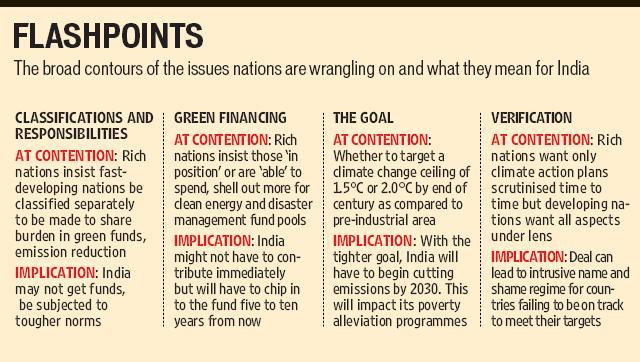
The issues that failed to get consensus were specifics of differentiation, climate finance, long-term temperature goal and review mechanism.
The first ministerial draft of the Paris agreement, however, hinted at progress over lesser contentious issues of adaptation, technology transfer and capacity building of the least developed nations.
The 29-page draft, down from 48-page text of negotiators last Saturday, indicated that a lot of political will and compromise will be required in the remaining two days, especially on maintaining the difference between rich and developing world, transparency and clear finance roadmap, to arrive at an agreement by Friday.
“The draft reflects the stand of all countries and the real fight will start now,” said Srinivas Krishnaswamy of Vashudha Foundation. Sanjay Vashisth of Climate Action Network South Asia added that the text fails to narrow down options on climate finance and differentiation.
Jennifer Morgan of World Resources Institute added that the text showed that the newly formed high ambition coalition of rich and most vulnerable nations was at play with draft providing clarity on adaptation and capacity building.
Environment minister Prakash Javadekar described the next 48 hours as “crucial” for an ambitious and equitable agreement in Paris before heading for a meeting of Like Minded Development Countries to strategise for the next two days.
Admitting of the tough hours ahead, conference president and French foreign minister Laurent Fabius asked ministers to work overnight and on Thursday with the spirit of “compromise”.
Indian negotiators expressed satisfaction saying all their issues including right to carbon space and differentiation in all elements of the agreement were “adequately” addressed in the highly bracketed text.
What could be disheartening for India is that the draft mentions 2021 as the year of review for climate action plans called INDCs, which India was seeking only in 2030. The review mechanism provides differentiation in review but with two two options --- one of developing world and other of the rich nations.
The issue of long term temperature goal of 2 degree Celsius or 1.5 degree raised by least developed countries and backed by developed world finds clear mention with several options. There appears to be no forward movement on compensation mechanism called Loss and Damage with United States rejecting the liability clause. Same is the state with transparency mechanism for mitigation to adaptation with countries not willing to budge from their stands.


