Tweaks in MGNREGA may help ease farm and labour crisis
The government should pay 25% of wages of MGNREGA workers employed in individual farms and the poor should get an option to choose between money or subsidised food
The government should pay 25% of wages of MGNREGA workers employed in individual farms and the poor should get an option to choose between money or subsidised food grains under the public distribution system (PDS).
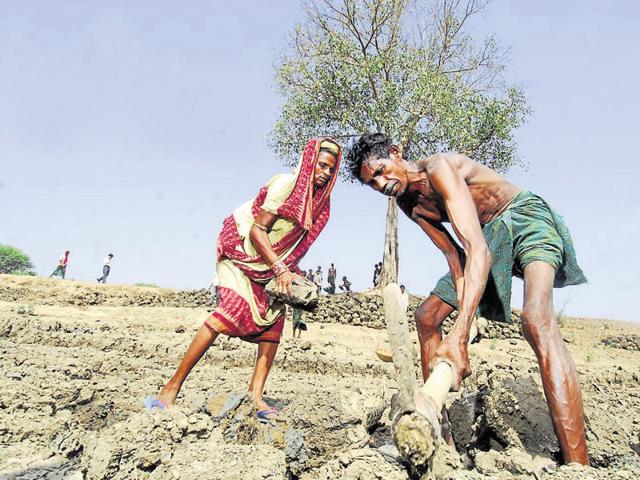
MGNREGA workers at an excavation site in a village in Kalahandi, Odisha. (Mint File Photo)
{{^htLoading}} {{/htLoading}}
These are a few suggestions to be made by the National Institution for Transforming India (NITI) Aayog in the occasional paper that will be discussed with the states for framing a national policy to eliminate poverty.
In the peak season, farmers may be permitted to hire workers under the Mahatma Gandhi National Rural Employment Guarantee Act (MGNREGA) by paying 75% of the wages, with the balance paid by the government. “This would lead to a more productive use of labour while spreading MGNREGA wages over more workdays,” the draft of the paper says.
A senior NITI Aayog functionary explained that it can also solve the problem of labour shortage and rising labour costs for farming. “The NREGA worker will be paid market wages, which would be much higher than the government rates,” he said.
{{^htLoading}} {{/htLoading}}
{{^usCountry}}
However, the NITI Aayog failed to provide an answer to how the proposal, if accepted, would be implemented. There are questions on how the government will monitor the work done and what wages will be given to the farmers.
{{/usCountry}}
{{#usCountry}}
However, the NITI Aayog failed to provide an answer to how the proposal, if accepted, would be implemented. There are questions on how the government will monitor the work done and what wages will be given to the farmers.
{{/usCountry}}
The same paper also revives the debate over if poor households should be given an option of getting money in place of subsidised food grains. The UPA government had also conducted some pilots on money transfer instead of food grains but gave up the idea after resistance from right to food activists.
“Keeping in view that poor households lag the most in consumption of protein-rich items such as milk and eggs, it makes sense to offer them option between cash and in-kind transfers under the PDS,” the paper says.
{{^htLoading}} {{/htLoading}}
But it fails to give a definite answer on the methodology to measuring poverty in the country.
Chetan Chauhan is the National Affairs Editor looking into all aspects of news and features from across India. A Chevening scholar with over three decades of experience in reporting and news management, Chetan has extensively covered all important aspects of the social sector, political economy, environment and climate change nationally and internationally. He did a journalism course at the Reuters Institute of Journalism in Oxford and Digital Media training at Nanyang Technological University in Singapore. He started as a reporter with The Statesman in 1996 and joined the Hindustan Times in 2000 in the metro bureau covering environment, crime and Delhi politics. He covered hot local news, from the Jessica Lal murder case to the rebellion of Delhi Congress MLAs against then Chief Minister Sheila Dikshit, to the replacement of toxic vehicle fuel with cleaner compressed natural gas (CNG) in the national capital. Some of his stories on air pollution became part of the Supreme Court’s landmark MC Mehta versus Government of India case in the National Capital Region (NCR), forcing the government to take corrective measures. As part of the national political bureau since 2004, he covered important central sectors such as environment, education, social justice, labour, rural development, water resources, renewable energy, agriculture, broadcasting and the Planning Commission for more than a decade producing several exclusive and investigative breaking stories. His specialisation is the environment, having covered at least a dozen United Nations global conferences on climate change, biodiversity and wildlife including climate summits in Paris, Copenhagen and Bali. He also covered India’s two five-year plans ---11th and 12th and reported on drafting and execution of right based laws such as Right to Education, Right to Information and rural job guarantee law, MG-NREGA, now being introduced in new format as VG-RAM-G Act. He has in-depth knowledge of social sector issues. He was one of the first to report on tigers vanishing from Sariska and Panna wildlife reserves in 2004 and 2008, respectively, leading to the setting up of the National Tiger Conservation Authority (NTCA) and the introduction of stringent penal provisions for poaching. He has written extensively on the rising human-animal conflict in India and the degradation of India’s biodiversity hotspots because of mining and other activities. Since 2004, Chetan has covered Parliament comprehensively and participated in training on the nuanced coverage of Parliament proceedings. He has travelled extensively across India to cover national and provincial elections since 1998, especially in the Hindi heartland states, considered India’s road to power. He writes a regular column for Hindustan Times, Ecostani, on important national politics, economy, Himalayan ecology and environmental issues. His other responsibilities include providing inputs for edits and edit page articles for the publication, apart from managing news flow from across India.
{{^usCountry}}{{/usCountry}}
Get the latest India News, breaking headlines and real-time updates from across the country. Stay informed about politics, government policies, crime, weather major national developments and Karnataka Bandh LIVE.
Get the latest India News, breaking headlines and real-time updates from across the country. Stay informed about politics, government policies, crime, weather major national developments and Karnataka Bandh LIVE.