
Sign in

Women, youth power push up turnout by 140 million over 2009

Propelled by the high octane poll campaign by leaders of all parties, women and youth have registered record turnouts in 438 Lok Sabha constituencies where polling was over by the seventh phase on Wednesday, Election Commission (EC) officials said.

Updated on: May 2, 2014, 12:45:12 IST
Hindustan Times | By , New Delhi
Share
Share via
  • facebook
  • twitter
  • linkedin
  • whatsapp
Copy link
  • copy link

Propelled by the high octane poll campaign by leaders of all parties, women and youth have registered record turnouts in 438 Lok Sabha constituencies where polling was over by the seventh phase on Wednesday, Election Commission (EC) officials said. But there is only one Congress-ruled state — Maharashtra — in the list of top 10 states recording higher voter turnouts.

Article image

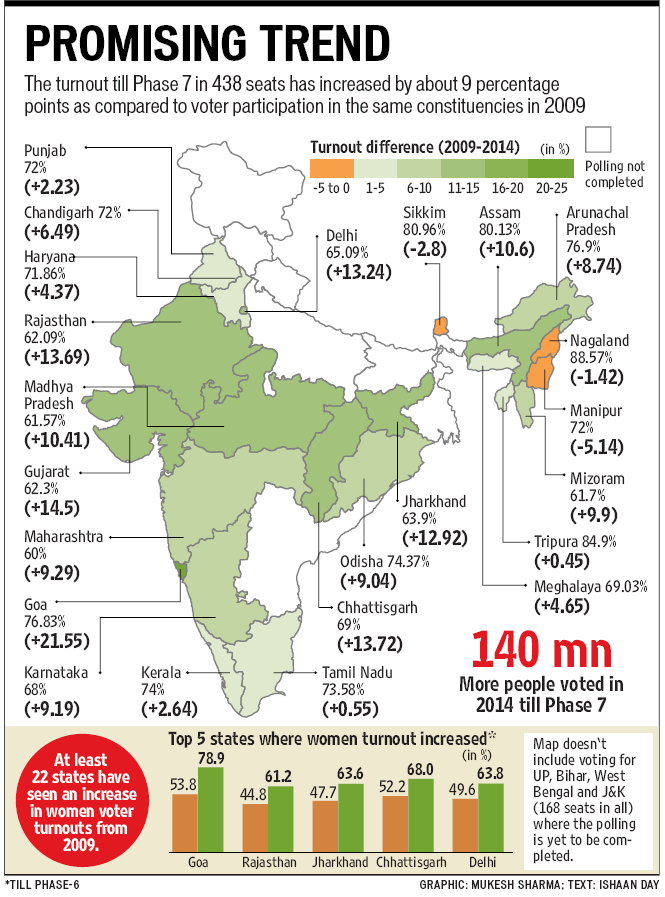
About 140 million more people turned up at polling stations in these constituencies compared to the turnout in these 438 constituencies in the general elections in 2009. This is about 40 million more than the total number of voters -- 100 million -- added to the electoral rolls in the past five years.

According to EC data, as many as 442 million people -- more than South America’s population -- of India’s 814 million voters have exercised their franchise so far. In 2009, the number of people who cast their votes was about 300 million in the same constituencies.


Read:
Article image


“It is an impressive and phenomenal voter participation never seen before,” said Akshaya Rout, director general in charge of the EC’s voter awareness programme. Rout said the EC’s efforts to simplify voter registration and cleaning of electoral rolls contributed in a big way to the higher turnout this time.

The figures translate into 66.20 % voting this time compared to 57.61% in 2009. The highest ever polling was registered in Punjab, Chandigarh, Goa and Tripura. And if the present trend continues, the 2014 polls will break the record of 64.01% polling in 1984-85 when the elections were held in an emotionally surcharged atmosphere following the assassination of the then PM, Indira Gandhi.

Read: Women must 'lean in’ to be taken seriously in the political sphere

This election has also shown that voting has become fashionable among many young voters, with many of them posting selfies with the ink marks on the social media. BJP prime ministerial candidate Narenda Modi galvanising the campaign and Priyanka Gandhi dominating the media space over the past fortnight may have contributed to the high turnout, analysts said. Arvind Kejriwal’s AAP has also caught the imagination of the youth in many constituencies.

This would not have been possible without women and youths, who constitute about two-thirds of the country’s population of 1.2 billion.

EC data shows that more women turned up at polling booths than men although the difference in voting numbers between the two genders was marginal. Ranjana Kumari, director of the Center for Social Research, said the data gives two clear indications. “First, they (women) are now more aware about their rights and want to exercise it and second, they are angry,” she said.

Another interesting trend is the higher voter participation in states with sizeable numbers of youth in the electoral rolls. About one-fifth of the total voters in India are in the age group of 18-25.

Read: Youth flaunt inked fingers on social networking sites

Read: Women vote to see drug-free Ludhiana

  • Chetan Chauhan
    ABOUT THE AUTHOR
    Chetan Chauhan

    Chetan Chauhan is the National Affairs Editor looking into all aspects of news and features from across India. A Chevening scholar with over three decades of experience in reporting and news management, Chetan has extensively covered all important aspects of the social sector, political economy, environment and climate change nationally and internationally. He did a journalism course at the Reuters Institute of Journalism in Oxford and Digital Media training at Nanyang Technological University in Singapore. He started as a reporter with The Statesman in 1996 and joined the Hindustan Times in 2000 in the metro bureau covering environment, crime and Delhi politics. He covered hot local news, from the Jessica Lal murder case to the rebellion of Delhi Congress MLAs against then Chief Minister Sheila Dikshit, to the replacement of toxic vehicle fuel with cleaner compressed natural gas (CNG) in the national capital. Some of his stories on air pollution became part of the Supreme Court’s landmark MC Mehta versus Government of India case in the National Capital Region (NCR), forcing the government to take corrective measures. As part of the national political bureau since 2004, he covered important central sectors such as environment, education, social justice, labour, rural development, water resources, renewable energy, agriculture, broadcasting and the Planning Commission for more than a decade producing several exclusive and investigative breaking stories. His specialisation is the environment, having covered at least a dozen United Nations global conferences on climate change, biodiversity and wildlife including climate summits in Paris, Copenhagen and Bali. He also covered India’s two five-year plans ---11th and 12th and reported on drafting and execution of right based laws such as Right to Education, Right to Information and rural job guarantee law, MG-NREGA, now being introduced in new format as VG-RAM-G Act. He has in-depth knowledge of social sector issues. He was one of the first to report on tigers vanishing from Sariska and Panna wildlife reserves in 2004 and 2008, respectively, leading to the setting up of the National Tiger Conservation Authority (NTCA) and the introduction of stringent penal provisions for poaching. He has written extensively on the rising human-animal conflict in India and the degradation of India’s biodiversity hotspots because of mining and other activities. Since 2004, Chetan has covered Parliament comprehensively and participated in training on the nuanced coverage of Parliament proceedings. He has travelled extensively across India to cover national and provincial elections since 1998, especially in the Hindi heartland states, considered India’s road to power. He writes a regular column for Hindustan Times, Ecostani, on important national politics, economy, Himalayan ecology and environmental issues. His other responsibilities include providing inputs for edits and edit page articles for the publication, apart from managing news flow from across India.Read More

Get the latest India News, breaking headlines and real-time updates from across the country. Stay informed about politics, government policies, crime, weather and major national developments.