
Sign in

‘Our universe in different kinds of light’: NASA shares mesmerising post

“This is incredible,” wrote an Instagram user under the post.

Updated on: Sep 7, 2020, 15:07:15 IST
Hindustan Times, New Delhi | By
Share
Share via
  • facebook
  • twitter
  • linkedin
  • whatsapp
Copy link
  • copy link

There is something astounding about the images which capture the world outside the Earth. They are often beyond belief and case in point is this post shared on NASA’s official Instagram account.
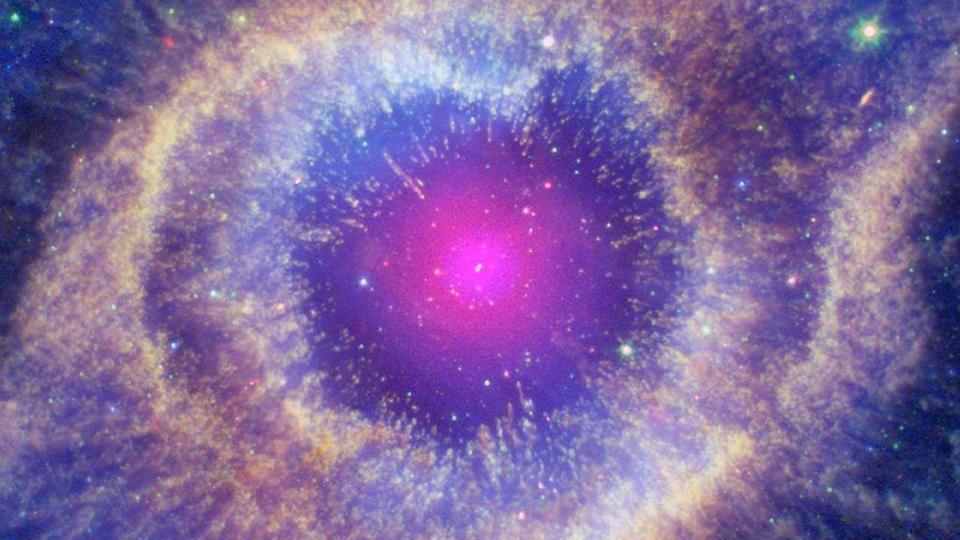
The image combines data from NASA Chandra X-ray Observatory with data from other missions. (Instagram/@nasa)

“Observing our universe in different kinds of light,” NASA wrote as the opening line of their post and shared some images. The rest of the post described that each of the images combine data from NASA Chandra X-ray Observatory with data from other missions.

“This “multiwavelength” approach to astronomy helps us get a more complete understanding of objects in space,” they wrote further. The post also explained from where the data is collected for each image. The post further detailed that the first image is that of “Helix Nebula” and the second one is “the Cartwheel Galaxy” that resembles a bull’s eye. As for the third and the fourth, they’re “Eta Carinae”, a volatile system containing two massive stars and “Supernova 1987A (SN 1987A)” in the Large Magellanic Cloud, respectively.

Take a look at the entire post here:

View this post on Instagram

Observing our universe in different kinds of light 🌌⁣ ⁣ Each of these images combines data from our @NASAChandraXray observatory with data from other missions. This "multiwavelength" approach to astronomy helps us get a more complete understanding of objects in space. ⁣ ⁣ 1. This Helix Nebula image contains infrared data from our Spitzer Space Telescope (green and red), optical light from our @NASAHubble Space Telescope (orange and blue), ultraviolet from ours Galaxy Evolution Explorer (cyan), and Chandra's X-rays (appearing as white) showing the white dwarf star that formed in the center of the nebula. The image is about four light years across.⁣ ⁣ Credit: X-ray: NASA/CXC; Ultraviolet: NASA/JPL-Caltech/SSC; Optical: NASA/STScI(M. Meixner)/ESA/NRAO(T.A. Rector); Infrared: NASA/JPL-Caltech/K. Su)⁣ ⁣ 2. The Cartwheel Galaxy resembles a bull's eye, which is appropriate because its appearance is partly due to a smaller galaxy that passed through the middle of this object. X-rays from Chandra (purple) show disturbed hot gas initially hosted by the Cartwheel galaxy being dragged over more than 150,000 light years by the collision. Optical data from Hubble (red, green, and blue) show where this collision may have triggered the star formation.⁣ ⁣ Credit: X-ray: NASA/CXC; Optical: NASA/STScI)⁣ ⁣ 3. Eta Carinae is a volatile system containing two massive stars that closely orbit each other. This image has three types of light: optical data from Hubble (appearing as white), ultraviolet (cyan) from Hubble, and X-rays from Chandra (appearing as purple emission).⁣ ⁣ Credit: NASA/CXC; Ultraviolet/Optical: NASA/STScI; Combined Image: NASA/ESA/N. Smith (University of Arizona), J. Morese (BoldlyGo Instituts) and A. Pagan)⁣ ⁣ 4. Supernova 1987A (SN 1987A) in the Large Magellanic Cloud was one of the brightest supernova explosions in centuries. The Chandra data (blue) show the location of the supernova's shock wave interacting with the surrounding material about four light years from the original explosion point. Optical data from Hubble (orange and red) also shows evidence for this interaction in the ring.⁣ ⁣ Credit: Radio: ALMA (ESO/NAOJ/NRAO), P. Cigan and R. Indebetouw; NRAO/

A post shared by NASA (@nasa) on

Since being shared on September 4, the post has gathered over 1.5 million views – and the numbers are only increasing. Additionally, it has also amassed over one million likes and close to 7,000 comments.

“This is incredible,” wrote an Instagram user. “Looks like a party in space,” joked another. “Love you so much NASA. Thank you for your work. This nebula is so fantastic,” praised another. “This is so beautiful,” said a fourth and many agreed.

What do you think of NASA’s post?

Also Read | NASA shares image of galaxy over 200 million light years away from Earth, calls it ‘eccentric and beautiful’

  • Trisha Sengupta
    ABOUT THE AUTHOR
    Trisha Sengupta

    Trisha Sengupta works as Chief Content Producer at Hindustan Times with over six years of experience in the digital newsroom. Known for her ability to decode the internet’s most talked-about moments, she specialises in high-engagement storytelling that bridges the gap between viral trends and traditional journalism. Throughout her tenure, Trisha has focused on the intersection of technology, finance, and human emotion. She frequently covers personal finance and real estate struggles in hubs like Gurgaon, Bengaluru, and Hyderabad, while also documenting the unique challenges of the NRI experience. Her work often highlights the movements and philosophies of global newsmakers and personalities like Elon Musk, Mukesh Ambani, Nikhil Kamath, Dubai crown prince, and MrBeast. From reporting on Amazon or Meta layoffs and startup culture to the emergence of AI-driven platforms like Grok and xAI, she provides a grounded and empathetic perspective on the stories shaping our world. When not decoding the internet, Trisha is likely offline: lost in a book, exploring a historical ruin, or navigating the world as a solo traveler. She balances her fast-paced career with family time and a healthy dose of curiosity, currently trading her "human" sources for silicon ones as she masters AI to future-proof her storytelling.Read More