
 E-Paper



After Bihar, it is now focus Bengal and Tamil Nadu for the BJP
Preparations are afoot in these states with home minister Amit Shah visiting West Bengal earlier this month and planning a trip to Tamil Nadu on Saturday (November 21) to take stock of the party’s preparedness.

 Prefer HTon Google


After winning a close electoral race in Bihar and improving its solo performance, the Bharatiya Janata Party (BJP) has set its focus on West Bengal and Tamil Nadu, the two big states that will go to polls in early 2021.
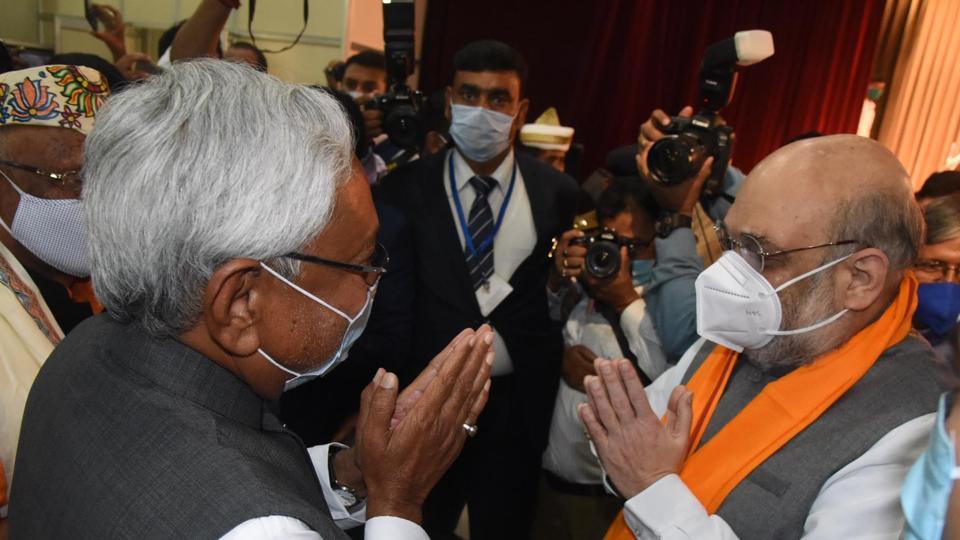
Preparations are afoot in these states with home minister Amit Shah visiting West Bengal earlier this month and planning a trip to Tamil Nadu on Saturday (November 21) to take stock of the party’s preparedness.
In the 2019 Lok Sabha elections, the BJP came up with a stellar show in Bengal, winning 18 of the state’s 42 constituencies in its best-ever performance in a fiercely fought contest that was marred by political killings and violence.
It, however, drew a blank in Tamil Nadu, where a Dravida Munnetra Kazhagam (DMK) alliance won 37 of the state’s 38 seats while one went to BJP ally All India Anna Dravida Munnetra Kazhagam (AIADMK). In 2014, the BJP won the Kanyakumari seat in Tamil Nadu.
In its attempt to reap political gains in the southern state, the BJP has been able to draw attention towards its Vetrivel Yatra (“victorious spear march”), which began on November 6.
Also Read: Nitish Kumar takes oath as Bihar chief minister for seventh time
Despite the AIADMK government’s denial to the march — citing the ongoing Covid-19 pandemic and law and order — BJP workers went ahead with the programme. And now, they are continuing with the month-long rally as planned, courting arrests briefly. Despite differences over the issue, leaders of both parties say that their ties are not strained.
According to analysts, the yatra has helped the BJP to become a talking point in the state and the month-long road show is an effort to consolidate the Hindu vote bank by invoking Lord Muruga, a popular deity amongst the Tamils who wields a spear. The BJP decided to hold the solidarity march after YouTube channel Karuppar Kootam in July ridiculed Kandha Sashti Kavasam, a devotional hymn dedicated to Lord Muruga.
“It seems like Lord Muruga is being hijacked by the Aryan discourse,” said Ramu Manivannan, head, politics and public administration department, University of Madras.
“The BJP is bringing in a Hindu narrative, which may create some dent, but insignificant. While the Ram mandir issue has appeal in the north, people in Tamil Nadu and Andhra Pradesh have been marching for Lord Muruga for a long time, so they don’t need BJP to campaign for them now,” he added.
Meanwhile, speculation was rife that M Karunanidhi’s elder son and ousted DMK leader, MK Alagiri, had been in talks with the BJP. But Alagiri dismissed it as a rumour. “I am not meeting anyone. I am not meeting Amit Shah,” he said. “I will be meeting my associates soon (in Madurai). Elections are anyway six months away. There is time.”
Alagiri is said to have strong base in the Madurai region and has been looking for political partner to defeat the DMK led by his brother, MK Stalin.
In the 2016 assembly elections, the BJP joined hands with some small parties and did not win a single seat in Tamil Nadu. It had a vote share of 2.8%, according to data from the election commission. The AIADMK, under the leadership of its charismatic leader J Jayalaithaa (who died in December 2016), won a consecutive second term with the party bagging 135 out 232 seats (vote share of 40.77%). The DMK won 88 out of the 180 seats it contested with a vote share of 31.6%.
Also Read: Why blaming Congress in Bihar is a red herring
“Ultimately, people would evaluate the BJP on its potential to become an alternative or a third party,” says Manivannan.
In the eastern state of Bengal, the BJP has made a series of organisational changes and the party’s top leaders are arriving there to chart an effective game plan.
The BJP’s IT cell chief, Amit Malviya, who has been recently appointed the co-incharge of West Bengal, came calling on Monday. BL Santosh, the BJP’s national general secretary (organisation), is set to arrive there on Tuesday.
“For the last two-three elections fought in Bengal, Malviya has managed the social media and IT strategies of the party. He is well aware of the issues in Bengal. Santosh is also arriving to hold some meetings,” said Dilip Ghosh, the president of the BJP’s state unit.
On Monday, the BJP upped its ante against the ruling Trinamool Congress. Ghosh, while speaking to the media, said that the BJP aims to transform Bengal into Gujarat.
“Chief minister Mamata Banerjee sometimes says that efforts are to transform Bengal into Gujarat. I would say this is 100% true. We would turn Bengal into Gujarat. Now people from Bengal need to migrate to Gujarat to get jobs. In the coming years, people will not have to go to Gujarat. They will get jobs in Bengal,” said Ghosh.
The Trinamool hit back. “The problem with Gujarat and Uttar Pradesh is police encounter....So we don’t want Bengal to be turned into Gujarat,” said Firhad Hakim, state minister and TMC leader.
During his visit to Bengal in the first week of November, Shah said that the BJP should win over 200 of the 294 seats in the upcoming assembly polls, stressing that the Trinamool government will be ousted.
In the 2011 assembly elections, the BJP failed to win a single seat and got a vote share of around 4%. In 2016, it did better, winning three seats and bagging a vote share of around 10%.
Buoyed by the Lok Sabha performance last year, the BJP is now focusing on the issues of corruption and nepotism, lack of employment, and law and order in the politically charged state.
“There is a popular resentment among some sections of people against the ruling party. The BJP has an even chance. The scenario will get clearer within the next two to three months as situations unfold. But it is a fact that the BJP, over the years, has become the principal opposition party and this time they are eyeing for the Bengal polls,” said Amal Mukherjee, a political commentator and a former principal of the Presidency College.


