Kolkata's drinking water may now contain a few hundred times more arsenic than just before the tremors of April 25 and Tuesday.Scientists and experts in Kolkata dealing with arsenic contamination in the city’s groundwater are now exploring this possibility after a Chinese study revealed how the arsenic level in the groundwater shot up hundreds of times after an earthquake in China, before it settled again over time.
The study, conducted by a team of five Beijing-based scientists after the 2008 Sichuan earthquake, pointed out that arsenic concentration increased a few hundred-fold just after the earthquake in such areas as Deyang and Guangyang. It, however, came down to the normal levels as time passed. The team stressed that more attention should be paid to the safety of water supply after earthquakes.
“This is very interesting. I don’t think such studies have been carried out your scientists. But what this paper suggests is highly possible. There could be a temporary rise in arsenic level. It’s opened up ua new avenue of thought and definitely calls for a research,” said KJ Nath, chairman, state arsenic task force. “Traces of arsenic have been brought down by such Himalayan rivers as the Ganges, Yamuna and Indus through the ages. These get deposited as sediments in the river bed. When the rivers change course, they leave behind the arsenic in the ground, which then seeps into the aquifers to contaminate groundwater,” Dipankar Chakraborty of the School of Environmental Studies (SOES) under Jadavpur University said.
{{/usCountry}}“This is very interesting. I don’t think such studies have been carried out your scientists. But what this paper suggests is highly possible. There could be a temporary rise in arsenic level. It’s opened up ua new avenue of thought and definitely calls for a research,” said KJ Nath, chairman, state arsenic task force. “Traces of arsenic have been brought down by such Himalayan rivers as the Ganges, Yamuna and Indus through the ages. These get deposited as sediments in the river bed. When the rivers change course, they leave behind the arsenic in the ground, which then seeps into the aquifers to contaminate groundwater,” Dipankar Chakraborty of the School of Environmental Studies (SOES) under Jadavpur University said.
{{/usCountry}}“You may think of it like this: Take a glass of water with soil sediment at the bottom. Shake it. The water becomes murky, with high doses of particles moving around. Now, allow it to settle for sometime. The water becomes clear again and the mud precipitates.”
The study has recently been published in the form of a book, titled One Century of the Discovery of Arsenicosis, in Latin America (1914-2014), along with a few other scientific papers on arsenic contamination. The Sichuan earthquake was of almost a similar magnitude as the one that hit Nepal on April 25. While the Nepal earthquake measured 7.9 on the Richter scale, the Sichuan earthquake measured 8. Both the areas, Deyang and Guangyang, from where the water samples were collected were located hundreds of kilometres from the epicentre.
Arsenic was first detected in Kolkata in 1993 by Chakraborty. At present, almost 80 wards out of the 144 wards in Kolkata are in the grip of arsenic. While the permissible limit suggested by WHO is just 10 micrograms per litre, water samples collected from some areas in South Kolkata, such as Jadavpur and Bikramgarh, contained much, much higher doses of arsenic. Some samples contained even 199 micrograms per litre.
“But now that Chinese scientists claim that even this level could shoot up by a few hundred times — at least temporarily — just after the tremors, it could trigger a hundred questions. But it’s possible,” Chakraborty said.
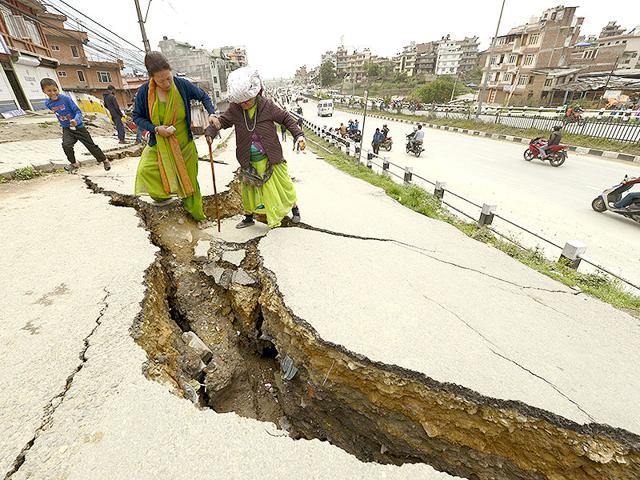
There could be numerous possibilities, such as cracks developing in the layers of soil after the quake and new water aquifers — natural underground water reservoirs —getting contaminated with loads of arsenic.
But then, the question is: how did the contamination level come down again? The Chinese team has suggested that the impact of earthquakes on groundwater is complex and there may be many factors influencing the arsenic level.