New Delhi: The capital's air quality remained in the ‘very poor’ category for a third straight day on Monday. The 24-hour average air quality index (AQI) stood at 316 (very poor) at 8 am, which was an improvement from Sunday when it was 366 (very poor) at 4 pm, when the Central Pollution Control Board (CPCB) releases its daily national bulletin. The AQI had touched a season peak of 388 at 10 am on Sunday, before the situation began to improve as wind speed picked up, touching around 10 km/hr during the day.
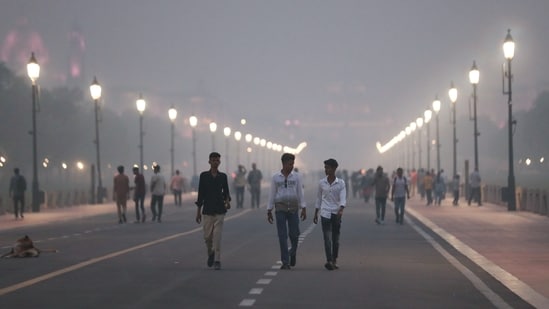
Forecasts show this improvement is expected to be shortlived, with Delhi likely to record its first 'severe' air day in the capital on Tuesday.
“Delhi’s air quality is very likely to be in the ‘very poor’ category from Sunday till Monday. The air quality is very likely to be in the ‘severe’ category on Tuesday, before once again returning to ‘very poor’ on Wednesday,” said the centre’s Air Quality Early Warning System (EWS) for Delhi in its daily bulletin issued on Sunday.
The CPCB classifies an AQI between 0-50 as “good”, between 51 and 100 as “satisfactory”, between 101 and 200 as “moderate”, between 201 and 300 as “poor”, between 301 and 400 as “very poor”, and over 400 as “severe”.
The capital is yet to record a ‘severe’ air day so far this year. The last came on December 23, 2024, when the AQI was 406 that day.
{{/usCountry}}The capital is yet to record a ‘severe’ air day so far this year. The last came on December 23, 2024, when the AQI was 406 that day.
{{/usCountry}}Long-term data shows the capital has now entered its most polluted time of the year. A Delhi Pollution Control Committee (DPCC) assessment of CPCB’s air quality index (AQI) for Delhi between 2018 and 2022 had shown the period November 1-15 has the highest AQI annually. This is followed by the period December 16-31, which has the second highest average over a 15-day period. This also coincides with a similar IIT Delhi study carried out in 2019, which revealed while the first peak in pollution usually comes between October 29-November 4, a second peak is then reported between December 30-January 5.
Mahesh Palawat, vice president at Skymet meteorology said atmospheric conditions were unfavourable for dispersion of pollutants – which was leading to gradual accumulation on Sunday. “Winds picked up – touching around 10 km/hr during the day on Sunday, which led to an improvement in the AQI. Otherwise, we were mostly seeing calm winds,” Palawat said, adding the wind direction was variable through the day, barring the afternoon period, when it switches to westerly and northwesterly – favourable for transport of stubble smoke to Delhi.
Palawat added while a western disturbance is expected to influence the region on November 4 and 5, no rain is likely. “It will impact the hills. Over Delhi, we will only see some cloudiness,” he added. Winds are also expected to become calm on Tuesday, he said.
Delhi’s AQI has been oscillating sharply in the past few days even as the BJP-led Delhi government has clarified AQI readings cannot be manipulated. The AQI was 373 on October 30, 218 on October 31, 303 on November 1 and 366 on November 2.
The remarks were made by Delhi chief minister Rekha Gupta at an event on October 31. “There is something seriously wrong with AAP’s thinking. If the AQI improves, they say the data is fudged. If it worsens, they question why it’s rising. It’s not our job to respond to their constant nuisance. We are working sincerely to tackle Delhi’s pollution problem. Anyone can check the AQI for any location in real time. The data cannot be tampered with or hidden,” Gupta had said.
Data from the Decision Support System (DSS) meanwhile showed the contribution of stubble burning was low, standing at 3.5% on Sunday. It was at a season-high contribution of 9% on Saturday. In previous years, peak contribution from stubble burning – typically in the first week of November, has touched up to 35%.
In comparison, the source with the biggest contribution to Delhi’s PM 2.5 was Delhi’s transport sector (18.13%), followed by 11.2% from Jhajjar and 4.5% from Delhi’s residential sector. DSS also said around 36.8% was coming from unaccounted sources from outside Delhi.
Delhi’s minimum temperature stood at 17.2°C on Monday, which was two degrees above normal. This is expected to touch and possibly dip below 15°C after November 7, forecasts show. Delhi’s maximum meanwhile stood at 30.7°C on Sunday, which was around normal. The maximum is likely to oscillate between 29-31°C on Monday.
Get Current Updates on India News, along with Latest News and Top Headlines from India and around the world
Get Current Updates on India News, along with Latest News and Top Headlines from India and around the world