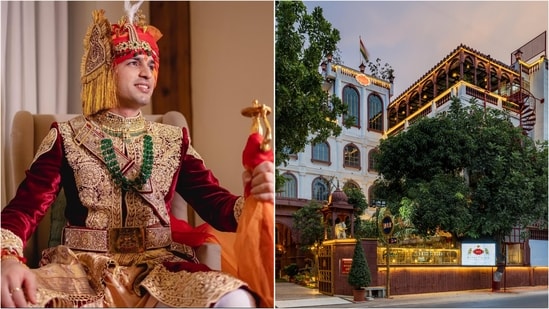
What does it feel like to grow up in a home that carries 13 generations of your family’s history? For Harsh Vardhan Singh Kurki, owner and current successor of WelcomHeritage Kurki Palace in Jaipur, it means growing up surrounded by stories, heirlooms and spaces that have been part of his family for generations. The family traces its direct ancestry as the 23rd lineage of Mira Bai and is descended from the Ranbanka Rathore family of Kurki Fort in Rajasthan’s Pali region.
In an exclusive conversation with HT Lifestyle, Harsh Vardhan Singh Kurki speaks about growing up with this legacy, preserving the character of the palace and what it means to share his family home with a new generation. (Also read: Inside Holkar’s 300-year legacy: Prince Richard and Yeshwant Rao Holkar III on Rani Ahilyabai, Maheshwar and heritage )
‘It is a privilege and a responsibility’
“Opening our generational family home to guests is both a privilege and a responsibility. For generations, this house has been a place where family, friends and travellers were welcomed with warmth and generosity. Today, we are extending that tradition to people from around the world,” he says.
For him, Kurki Palace is more than a heritage property. “For me, Kurki Palace is not simply a hotel; it is an opportunity to share a living piece of our family’s history, Rajasthan’s culture and our tradition of hospitality with a new generation,” Harsh Vardhan adds.
{{/usCountry}}For him, Kurki Palace is more than a heritage property. “For me, Kurki Palace is not simply a hotel; it is an opportunity to share a living piece of our family’s history, Rajasthan’s culture and our tradition of hospitality with a new generation,” Harsh Vardhan adds.
{{/usCountry}}Growing up with Mira Bai lineage
The family’s connection to Mira Bai is also deeply woven into its understanding of its own history. “Mira Bai has always been an important part of our family’s sense of identity and history. Beyond the lineage itself, what has stayed with us is the importance of simplicity, devotion, dignity and staying connected to one’s roots,” he says.
Much of that history, he recalls, was passed down through conversations within the family. “Family stories were traditionally passed down through conversations rather than books, and I grew up hearing about our ancestors, our relationship with Kurki and the people and traditions that shaped the family over generations. That oral tradition of remembering where we came from remains very important to me,” he says.
The family heirlooms that hold the most meaning
Inside Kurki Palace, several of those memories survive through objects that belonged to earlier generations. For Harsh Vardhan, the most meaningful artefacts are not necessarily the most ornate ones, but those that have a direct connection to his family.
“The most special artefacts to me are the pieces that have a direct connection with the family rather than simply being valuable or visually impressive. Among them, our family heirlooms and archival objects carry a particular significance because they have been witnesses to several generations of our story,” he says.
“Their value lies in the memories and continuity they represent. When you see something that was handled, used or preserved by your ancestors, history becomes much more tangible,” he adds.
Turning a family home into a heritage hotel
That philosophy also guided the transformation of the family residence into a heritage hotel. Rather than recreating an old-world aesthetic, the family wanted to retain what was already there.
“Our approach was to treat the property as an emblem of the family first and a hotel second. We wanted modern hospitality standards without losing the character that makes the palace distinctly ours,” Harsh Vardhan says.
The property retains its architectural language, family heirlooms and traditional details, while contemporary comforts have been integrated into the spaces. “Portraits of the previous 13 generations adorn the walls, alongside fresco-inspired artwork, stonework, marble and Rajasthani design elements, while we carefully integrated contemporary comforts and services,” he says.
“The objective was never to recreate an old palace artificially, but to allow its existing character to continue evolving while remaining recognisably rooted in its past,” Harsh Vardhan adds.
‘Heritage is not just about preserving buildings’
For him, however, the real purpose of sharing the family home with guests goes beyond its architecture and interiors.
“I hope guests leave with more than photographs and memories of a beautiful stay. I would like them to feel that they have experienced a small part of Rajasthan through a family’s eyes, its hospitality, stories, architecture, food and traditions,” he says.
He believes that is what preserving heritage ultimately comes down to. “Most importantly, I hope they understand that heritage is not just about preserving buildings or objects; it is about preserving the stories, values and sense of belonging attached to them. If a guest leaves feeling connected to that story, then we have achieved something meaningful,” he says.
What the Rathore legacy means today
And while the family carries a long royal lineage, Harsh Vardhan says the Rathore legacy today is less about status and more about responsibility.
“For us, the Rathore legacy is ultimately about responsibility rather than status. It represents the history of the family and the values that have been carried forward through generations — courage, dignity, hospitality, loyalty to one’s roots and a responsibility towards the people and place one comes from,” he says.
“We are conscious that we are custodians of a history that predates us, but we also believe that every generation has to interpret its heritage in its own way. For our generation, that means preserving the past while creating something relevant for the future,” Harsh Vardhan concludes.