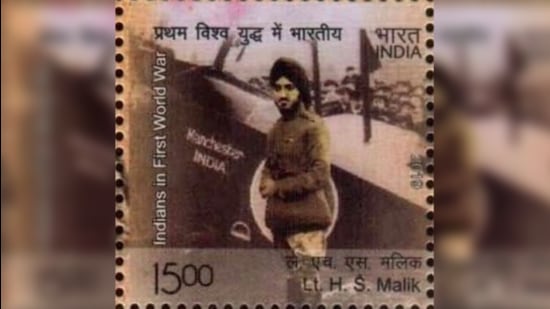
Think of it as a thank-you note that’s more than a century overdue. Last week, the British port city of Southampton announced that it will erect a statue to represent the overlooked (and often erased) contribution of ethnic minorities who fought for Britain in the First World War between 1914 and 1918. A 17-ft bronze sculpture, expected to be ready in 2023, will depict a man in the uniform of the Royal Flying Corps — Britain’s air force at the time. He’s looking out bravely into the distance, one hand on a giant airplane propeller. And he’s wearing a turban.
History buffs will recognise him immediately. Hardit Singh Malik, known affectionately as the Flying Sikh, was the first Indian fighter pilot. His aerial combat not only won battles for the British, it paved the way for the establishment of an Indian Air Force.
The memorial is a hard-won victory in more ways than one. To fight the war, Malik had to first battle prejudice in Britain.
He didn’t have to enlist. He came from wealth and privilege — the Maliks were a noble Sikh family from Rawalpindi in Punjab. And young Hardit, born in 1894, grew up in a grand home, with horses and carriages, servants and private tutors. He was sent to England to study at 14, becoming the first in his family to attend university when he pursued Modern History at Balliol College, Oxford, in the 1910s. He was good at sports too, winning at golf and playing for the Sussex Cricket Club.
When the Great War broke out in 1914, Malik dropped it all to step up, even though he’d be serving in an army that wasn’t his and, as it turned out, an army that didn’t want him.
{{/usCountry}}When the Great War broke out in 1914, Malik dropped it all to step up, even though he’d be serving in an army that wasn’t his and, as it turned out, an army that didn’t want him.
{{/usCountry}}Malik tried to join the Royal Flying Corps (RFC) in 1915, right after graduating. But the British viewed young Indians in Britain as potential revolutionaries — hot-blooded types conspiring to overthrow the Raj. They enlisted more than 1.3 million Indians to fight in the trenches, but they didn’t want Indians in the warplanes. “There were no vacancies for Indian students,” Malik recalled in an interview to The Times in 1982.
So he joined the French forces, serving in the Red Cross in 1916. Malik was on the verge of joining their Aéronautique Militaire when his former tutor from Oxford, aghast, wrote to the RFC commander asking him to take the young Sikh boy on. It worked. Malik was enlisted as second lieutenant with the RFC’s new Sopwith Camels — single-seat fighter biplanes, fast and manoeuvrable, but only in the hands of the most skilled aviators. The world’s first Indian fighter pilot would be fighting for Britain.
And he’d be doing it on his own terms. A devout Sikh, Malik refused to take off his turban. Instead he wore a custom-made helmet that fit over it, which earned him the Flying Sikh nickname.
The Sopwith Camels started off with combat missions across France and Italy. Then, late in 1917, came a historic mid-air dogfight with the Germans over Belgium. It unfolded almost movie-style. Four Camels, emerging from a cloud, found themselves surrounded by enemy planes and taking fire from the ground. Bullets flew back and forth. Malik was shot twice in the leg and crash-landed behind enemy lines, bleeding and unconscious. His plane had been hit by more than 400 bullets.
He somehow survived. “It was like a miracle,” he recalled in that Times interview. “My pursuers just did not have the bullet with my name on it.” By the time the war ended in 1918, four Indians had flown in the RFC. Only two survived — one of whom was the Flying Sikh.
Some recognition came right away. In 1918, when India was presented with a Sopwith Camel plane as appreciation for the colony’s contribution to the war, Malik was the one who flew it to the ceremony in Manchester.
India treated him well too. He married a lawyer, had three children and joined the Indian Civil Service, serving as a senior minister in Punjab in 1944. After Independence, Malik became India’s first high commissioner to Canada, helping secure full citizenship rights for Indians there. He retired in 1956 as India’s ambassador to France.
The Flying Sikh died in 1985, aged 90, those bullets still in his leg, his love of golf and cricket intact. The Southampton statue, then, is more than a thank-you note. “We feel honoured that he is being remembered by the new generations,” says Malik’s nephew, golfer Ashok Malik. He wishes that the idol, which is meant to represent all the ethnic minorities that fought in the First World War, bore more of a likeness to his uncle. “Nonetheless, it is a great feeling for us that the contribution of our elders is being recognised by the people for whom they fought.”
For the world, it will be a reminder of battles won, while the war against racism still rages.
(With input from Amanjeet Singh)
.
INDIA, PILOTS AND THE FIRST WORLD WAR
* The British hunger for manpower meant that more than 1.3 million Indians fought in the first world war. More than half — a total of 70,000 — died.
* Indian troops were in Belgium’s Ypres Salient within six weeks of the start of the war. At least two divisions remained in Europe till almost the end of the war, enduring grinding trench warfare for years.
* Four Indians — Lieutenants Malik, IL Roy and SC Welinkar and Second Lieutenant ESC Sen — served as pilots in the RFC during World War 1. Only two survived.
* Malik, one of those two, went on to join the Indian Civil Service. After Independence, he served as India’s first high commissioner to Canada, and retired as India’s ambassador to France. He died in 1985, aged 90.
(This story has been amended to reflect the correct number of Indians in the First World War as 1.3 million.)