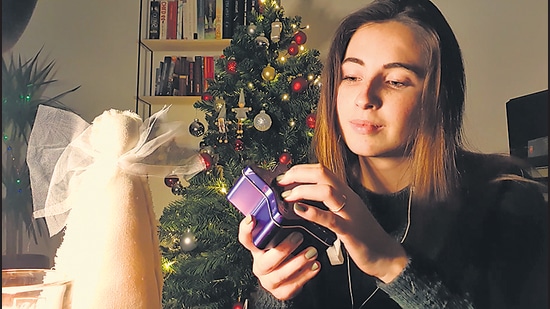
Vaiva Ignataviciute, 25, a web developer from Denmark, was in her teens when she discovered that she loved the sound of pages being turned. The mild swoosh gave her a tingling sensation, and if she turned enough pages, the sounds left her feeling calmer.
What Ignataviciute was experiencing is known as autonomous sensory meridian response or ASMR. For some people, it’s the sound of Velcro being detached, for others it’s the crunch of gravel underfoot. For a lot of people it’s the sound of someone else eating — slurping down noodles and chomping on tempura tend to be the most popular.
For years now, millions of ASMR videos have been generated every month, catering to those on the lookout for the resultant high. What Ignataviciute couldn’t have predicted when she first started turning the pages was that she’d be providing customised ASMR, for a fee, to connoisseurs.
She is among thousands of men and women performing niche ASMR on demand on platforms such as Fiverr and Cameo, YouTube, Instagram and OnlyFans. On her Fiverr account, @RainbowASMR, Ignataviciute charges a fee per viewing. Videos include her whispering sibilantly or running her fingernails down a plastic brush.
Rising anxiety and boredom levels in the pandemic have led to a boom in ASMR viewing. “We saw a 673% increase in searches for ASMR-related content on the platform between March 2020 and December 2020, over the previous year,” says Abby Forman, associate director of communications at Fiverr. “Anecdotally, we know that ASMR helps with anxiety and pain relief, helps people relax, and also helps with sleep, so it makes sense that during a global pandemic, the demand for these types of services increased.”
{{/usCountry}}Rising anxiety and boredom levels in the pandemic have led to a boom in ASMR viewing. “We saw a 673% increase in searches for ASMR-related content on the platform between March 2020 and December 2020, over the previous year,” says Abby Forman, associate director of communications at Fiverr. “Anecdotally, we know that ASMR helps with anxiety and pain relief, helps people relax, and also helps with sleep, so it makes sense that during a global pandemic, the demand for these types of services increased.”
{{/usCountry}}Ignataviciute discovered Fiverr — a platform that seeks to connect those who need a service with freelancers who provide it — while looking for a job. She began producing ASMR content in July, “to earn some side money” but is now thinking it could be her career.
The requests she gets on the platform are varied — from sounds of whispering to the brushing of teeth and soft reading. Her rates start at $5 for 5 minutes of only audio. With video, she charges a minimum of $30 per 10 minutes.
When she started, she says, she was doing two to three videos a month. By September, that number had jumped to 12. The types of requests also changed, allowing her to charge more. People started asking her to use their names in the videos, make positive affirmations about them or offer comforting thoughts on life and the future.
“ASMR is very personal and for each of us the sounds that trigger pleasure may be different. I think that’s why so many people ask for personalised videos,” she says. “Many of my customers write to me that they are very lonely. In my positive affirmation videos, I tell people that they are confident, they are good at what they do. Sometimes people just want me to repeat their names over and over.”
Ignataviciute gets her share of unwelcome requests. “There’s a very thin line between what we call ASMR and something inappropriate. I receive many such requests and finally made a policy that a customer has to tell me what they want before paying for it.”
Most of Ignataviciute’s customers tune in from the US, Russia and Norway, she says, and the large majority are male.
Her strangest request so far, that she’s complied with, has been from a man who wanted a video shot through a glass tray, of water dripping from her fingers onto the glass. It was a close-up of her still fingers, and there was virtually no sound involved.
“ASMR changed my life, reduced my anxiety and calmed me when I needed it. That’s why I put a lot of effort into making these videos,” Ignataviciute says. “Stress is a silent killer and I also believe that I’m helping a lot of people through these videos, to focus, lower their anxiety levels. It helps me to focus too.”
The demand for personalised ASMR is most likely growing because of the pandemic and the resultant social isolation and anxiety — whether related to the virus or working from home and the increased stress of daily living, says Dr Manoj Kumar Sharma, clinical psychologist with the National Institute of Mental Health and Neurosciences (NIMHANS), Bengaluru. “Based on the qualitative data available, it can be said the users find these experiences quite useful and want to listen or watch repeatedly,” he adds. It can be said to alleviate low-grade anxiety but “ASMR is still largely a novelty and some of its attraction is linked to that.”