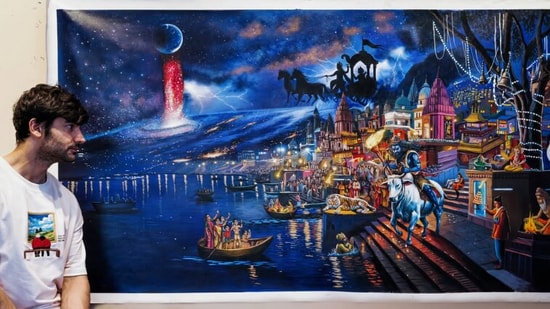
Celebrity artist Abhay Sehgal, whose bespoke artworks and private commissions have been created for personalities including Ranbir Kapoor, Dinesh Karthik, Kalyani Priyadarshan and Govind Dholakia, believes mythology should not be viewed as something confined to the past. However, his work has also been part of conversations around originality, including questions about similarities with other artists’ works, plagiarism and the role of AI in his creations.
In an exclusive interview with HT Lifestyle, Abhay addresses these allegations, reflects on experimentation, artistic influences, and explains how he approaches originality while continuing to reinterpret ancient stories for a contemporary audience. (Also read: Ranasaheb Digvijaysinh Kathiwada on carrying forward his family’s 600-year-old royal legacy and building Kathiwada 2034 )
Reimagining mythology through a modern lens
Abhay takes a surrealist approach to mythology, bringing together elements from ancient stories with imagery from the modern world. His works explore how age-old ideas of faith, conflict, love and human nature continue to resonate even as the world around us changes.
Speaking about his relationship with mythology and his artistic process, Sehgal said, “I have always found it strange that we talk about mythology as if it belongs to another time. For me, it doesn't feel that way.”
He recalled growing up surrounded by these stories through books, television, temples and conversations at home. “I grew up seeing these stories everywhere, in books, television, temples, conversations at home. Rama, Krishna, battles, gods, kings, stories of good and evil. But as I grew older, I started seeing these stories differently. Maybe because the world around me had changed. Or maybe because I had,” he said.
{{/usCountry}}He recalled growing up surrounded by these stories through books, television, temples and conversations at home. “I grew up seeing these stories everywhere, in books, television, temples, conversations at home. Rama, Krishna, battles, gods, kings, stories of good and evil. But as I grew older, I started seeing these stories differently. Maybe because the world around me had changed. Or maybe because I had,” he said.
{{/usCountry}}That shift in perspective has become an important part of Abhay’s work. “That is what I try to explore through my work. I don't want to paint mythology exactly as I remember it. I am more interested in what happens when these stories collide with the world we live in today. Surrealism gives me the freedom to do that,” he explained.
Abhay Sehgal on copying allegations
Abhay’s work has also come under scrutiny in conversations around originality, with artist Krishna Bala Shenoi among those raising concerns over alleged similarities between his illustrations and other artists’ works, prompting questions around copying, plagiarism and the possible use of AI in the creative process.
Addressing these remarks, Abhay says, “I believe every artist’s journey comes with moments of learning and reflection. The conversations around my work have given me an opportunity to look more closely at my creative process, learn from the experience and become better and more conscious in the way I create. My work has always involved experimentation across different mediums and techniques, but the ideas, intent and storytelling come from my own artistic journey.”
He adds that, in hindsight, these conversations have encouraged him to evolve as an artist, saying his focus now is “simply on moving forward, creating better work and letting that work speak for itself.”
Varanasi where the ancient meets the new
“In Varanasi, I wasn't trying to make another painting of the ghats. Varanasi is a city where the past and present seem to exist together anyway. So I brought that feeling into the painting,” he said.
The artwork brings together temples, aarti and oil lamps with distinctly contemporary details. “You see the temples, the aarti and the oil lamps. You also see children sitting on a boat, photographing the city on their phones. There are kings and queens at the ghats, Krishna guiding Arjuna, and somewhere in the distance, a meteor is heading towards Earth,” Sehgal said.
While these elements may appear contradictory at first, that contrast is central to his vision. “None of these things should exist together. But somehow, they do. That is how I often see it. There is something ancient sitting right next to something completely new. We carry our traditions while constantly changing the way we understand them,” he added.
Why mythology still resonates with younger generations
For Sehgal, this ability to reinterpret familiar stories may also explain why mythology continues to find an audience among younger generations. “I think that is why mythology still connects with younger generations. The stories may be thousands of years old, but the questions inside them haven't really changed. We are still trying to understand love, ambition, fear, faith, conflict and ourselves,” he said.
Ultimately, Sehgal believes mythology does not necessarily need to be reshaped to fit the modern world. Instead, it can evolve naturally through the way each generation sees it. “I don't think mythology needs to be modernised. I think we just need to look at it through our own eyes,” he said.