See what biologists are unearthing amid specimens in museums, and fossils on dusty shelves. See how the problem comes full circle, to your habitat and you.
Dead as a dodo, we say, because there is nothing that bird is more famous for than being extinct. Yet, its extinction wasn’t recorded until nearly 200 years after it occurred.
{{^htLoading}} {{/htLoading}}
A quick recap: The bird lived peacefully on the island of Mauritius. The Dutch arrived in the late 1500s. They hunted the bird for its meat (a single dodo could weigh 20 kg), raided its nests, altered its habitat, introduced invasive species such as rats, pigs and monkeys.
{{^usCountry}}{{/usCountry}}
As
(Photos courtesy: Newman-Martin et al, Alcheringa; Robert Lucking, Florida Museum of Natural History; HT Illustrations: Mohit Suneja; Imaging by Puneet Kumar)
In dry, desert regions of west and north Australia, a small ferocious marsupial called the mulgara builds burrows in which to live, and forages for insects in the ground. All of which helps with soil turnover.
{{^htLoading}} {{/htLoading}}
Last month, researchers at Curtin University described three new species of mulgara, all likely extinct as a result of the introduction of feral cats and foxes into Australia in the 19th century. “This suggests that the small carnivores have suffered a greater loss in diversity since European arrival than previously believed,” the study states.
Researchers are now studying the likely fallout of these missing species.
“Dark extinctions raise the question: Are we making the best decisions about how and where we protect species? ” says VV Belavadi, former professor of entomology at the University of Agricultural Sciences, Bengaluru. “Because the demise of one keystone species can set off a chain of distressing events.”
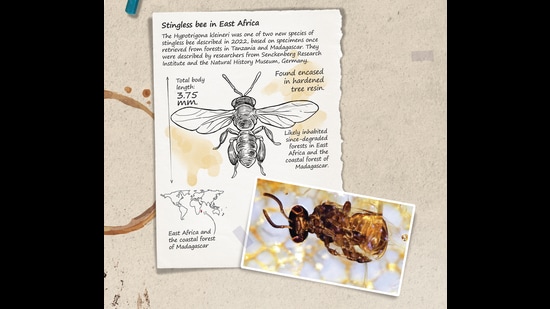
Keystone species — essentially the ones that maintain habitats — can include bees, bats, frogs, birds and marsupials. Many such species are being lost in wildfires, for instance, biologists warn. And there isn’t enough data on which they are, or were.
{{^htLoading}} {{/htLoading}}
In the absence of real data, researchers are drawing on mathematical models, but even here the lack of data is affecting the parameters. With about 86% of the species on Earth and 91% of those in the oceans still undescribed, we simply do not know enough.
In 2020, Chisholm publiushed a study in the journal Conservation Biology that looked at how we could account for undescribed species statistically when estimating extinction rates. He addressed the big hurdle too: the mathematical models don’t have enough to go on. “Part of the problem is a lack of reliable data for parameterising the statistical models,” he says. “We need to invest more in biodiversity discovery and in digitising existing information.”
Flow chart
(Photos courtesy: Smithsonian National Museum of American History, American Museum Novitates; Wilson Costa, ZooKeys; HT Illustrations: Mohit Suneja; Imaging by Puneet Kumar)
In Brazil’s moist tropical Atlantic Forest, a misidentified species of killifish that had vanished by the 1980s awaited discovery, on the shelves of the National Museum of Brazil and the Museum of Zoology of the University of Sao Paulo. It was described in 2019 by ichthyologist Wilson Costa of the Federal University of Rio de Janeiro.
{{^htLoading}} {{/htLoading}}
The shallow, acidic swamp channels in the forest, where the species was originally collected, no longer exist. “Probably as a result of the lowering of the water table caused by the diversion of waters from the streams to supply an ornamental fish farm in the vicinity of the forest,” states the study published in the journal ZooKeys.
A similar threat is playing out in India’s Western Ghats.
Tiny snails called Cremnoconchus that inhabit several waterfalls here face a new threat: tourism. “Each waterfall that houses Cremnoconchus is associated with a distinct species, such as Cremnoconchus agumbensis, which is found only in a single waterfall in Agumbe Ghat,” says Aravind Madhyastha, a senior fellow at the Ashoka Trust for Research in Ecology and Environment (Atree), and a member of IUCN’s Mollusc Specialist Group.
{{^htLoading}} {{/htLoading}}
The frequent littering and use of shampoos and soaps by tourists who frequent these waterfalls, as road connectivity improves, can affect the fragile conditions in which these molluscs live and eventually wipe out a species entirely. And we would likely never know.
Peer review
(Photo courtesy: James Liebherr, Zoosystematics and Evolution; HT Illustrations: Mohit Suneja; Imaging by Puneet Kumar)
Interestingly, human bias is a fairly big hurdle in the matter of tracing species and extinctions. “There is quite a comprehensive database of butterflies in India today, but these are charismatic species that are large and attractive. More mundane species such as leaf hoppers are often overlooked,” says Yeshwanth HM, who heads the collections facility at the National Centre for Biological Sciences (NCBS), Bengaluru.
{{^htLoading}} {{/htLoading}}
Leafhoppers, meanwhile, are crucial indicators of the overall health of an ecosystem. Their abundance or absence can signal environmental change such as rising temperatures.
Bias even affects the specialisations that biologists pick too. It would help to have more — a lot more — taxonomists, says Madhyastha of Atree, but sadly this is seen as an out-of-date specialisation, when it really isn’t. “Taxonomy is a fundamental part of conservation. It needs to be given the importance and funding it deserves.”
For the benefit of future generations, we need to build a strong foundation for comparative biology, says entomologist John Ascher, an assistant professor with the department of biological sciences at the National University of Singapore. This can be done by better supporting museums, encouraging more taxonomic experts and setting up bioinformatics portals for shared information. “Only with an improved taxonomic and biogeographic foundation in place can we hope to address serious conservation and policy issues such as food security, for instance,” Ascher says.
{{^htLoading}} {{/htLoading}}
Meanwhile, a good first step is the preservation of rich ecosystems. As Madhyastha puts it, that way we can discover new creatures in micro-hotspots, and learn more about them, our planet, and our impact on both, instead of discovering them on shelves and in jars, when they can no longer tell us much at all.
All Access. One Subscription.
Get 360° coverage—from daily headlines to 100 year archives.
Explore the latest Lifestyle News on health, fashion, travel, relationships, food and festivals. Find useful tips, expert advice, trends and inspiring stories for everyday living.
Explore the latest Lifestyle News on health, fashion, travel, relationships, food and festivals. Find useful tips, expert advice, trends and inspiring stories for everyday living.