We are today celebrating our third Republic Day and we should not forget the great sacrifices rendered by lakhs of our countrymen and women who have given their all, and many their lives, for securing political emancipation. We are proud today to call ourselves the citizens of this great Republic of India.
The Constitution of India has guaranteed fundamental rights to its citizens and enunciated certain directive principles of State policy and, in particular, emphasized the need for securing the
Talks helpful
The Conference appointed a seven-man committee to go into the various implications on the subject of industrial relations on the basis of discussions at the session. The committee met last month, representing the three central organizations of employers and four central organizations of labour for the purpose of evolving, if possible, an agreed scheme of industrial relations.
They held useful discussions on several important aspects of the problem. While no conclusions as such were reached, the meeting was helpful in resolving many differences and giving a lead to the Government as to the general form in which future legislation may be based.
With so much useful material on hand and so large a measure of hopeful progress towards all-round agreement, the Central Government feel that the time has come for the Labour Ministers of the Centre and the States to meet together and take counsel with a view to hammering out a scheme of industrial relations which, in their opinion, would have the largest measure of acceptance at the hands of the parties concerned. The Central Government would then make up their mind on this subject after having had the benefit of the opinions of State Governments. This conference is being convened in February at New Delhi.
During the Budget discussions last year, I gave an assurance to the employers and workers’ organizations and the public that in the matter of future legislation, whether it is in respect of industrial relations or otherwise, the Government will take full counsel of all concerned and without having complete discussions on all matters, no Bills will be introduced. The Government is trying to keep up its timetable with regard to this matter and hopes to introduce legislation at the fag-end of the Budget session unless any unavoidable circumstances intervene which may necessitate introduction in the autumn session.
Labour welfare
A field in which there are immense possibilities of sustained work is of labour welfare.
The Labour Ministry has in recent years devoted much attention to the subject and made considerable progress, but the field is so vast and leeway still so great that opportunities for work in the field of welfare are well-nigh limitless. Enactments such as the Factories Act, the Mines Act, the Plantations Act and the Minimum Wages Act of 1948 provide for various types of welfare measures.
Canteens, creches, first-aid and ambulance facilities, protected water supply, play-grounds, education, etc are the important items which employers are required to provide to varying extent. The law, however, has its limitations. It can lay down only certain minimum standards — standards which even minor units can afford to comply with.
The establishment of the Employees’ State Insurance Act had laid the foundations of social security in this country. It is true that the scope of the scheme is for the present somewhat restricted, extending as it does only to sickness, maternity and employment injury, and that even in this limited sphere we have had to go slow. But every great scheme starts in a humble way, and so long as the foundations have been laid properly, we can look forward to the future with hope and confidence. Let us trust that in the years to come this scheme will gradually extend its scope so as to include such vital social security measures as unemployment insurance and old age pensions
Provident Fund
Another important scheme that we have launched is the Employees’ Provident Fund Scheme in six important industries. This is in fact in extension of the experiment which we have been trying in the coalfields during the last two years under a separate legislative enactment. I know some of the employers were somewhat critical of the inclusion of dearness allowance in wages provident fund contributions. But I am confident when they reflect calmly, they will feel as happy as I do that they are contributing to the happiness of thousands of their employees who might have otherwise been exposed to misery and suffering towards the evening of their lives.
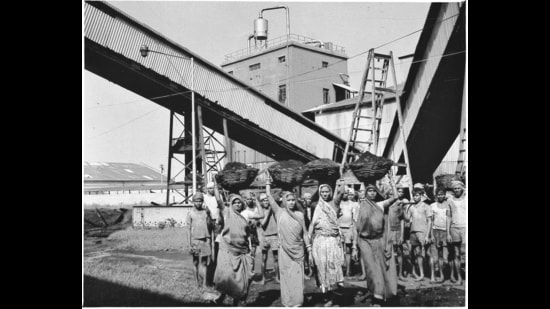
There are special enactments regulating the welfare in coalfields and mica mines which is financed through a cess on output. Funds to the order of nearly ₹1 crore are being realized and spent on various welfare measures including hospitals, dispensaries, schools, welfare centres, recreations, cinemas and housing.
The Directorate-General of Resettlement and Employment came into existence during World War II and continues its activities. Its functions may be broadly divided into two parts, namely, (i) registration and placement of employees through the agency of employment exchanges and (ii) imparting of vocational and technical training. Vocational and technical training centres and institutions run by the department have done much to supply skilled workers and to impart practical bias in the hitherto academical and theoretical training in several of the older technical institutions.
A committee has been set up under the chairmanship of Mr B Shiva Rao, MP, to go into all aspects of this institution and make a report on which the Government will give its future direction in the matter of making this institution permanent.
It must be distinctly understood that whether in the matter of industrial relations or in instituting welfare measures for the amelioration of labour, co-operation between workers and employers’ organizations and the Union and State Governments is most essential without which success is impossible. The employers and workers must realize the efficacy of good and cordial relations in the matter of running industries. While workers and employers can have sanctions behind them and possess disciplined organizations for protecting their respective interests, strikes and lock-outs should be considered as last resorts in their armoury and should be sparingly used when all other methods of settlement have completely failed.
Workers’ organizations, whatever their ideology may be, must come to the inevitable conclusion that they must run their trade unions on unquestionable democratic lines. The weapons such as sabotage and violence and go-slow methods should find no place. The employers, on the other hand, must come to the fullest determination that trade unions are a permanent feature in the industry and that all trade disputes and differences must be settled at the level of the industry itself without invoking a third party to compose them.
As good government is no substitute for self-government in politics, so in the industrial system, besides providing good amenities for all, the workers will also acquire the highest satisfaction by doing their work well and by their rendering service to the community not as slaves of the system but as free men. If these implications are understood by the partners in the industry, namely, the workers and employers, I am absolutely certain that the future of the industries in this country is bright and that industries, whether managed by State or private employers, will run on sound lines for the benefit of the country as a whole.
[VV Giri (1894-1980) served as President of India from 1969 to ’74. He had close ties to union movements in pre-Independence India, heading the railwaymen’s federation and the All India Trade Union Congress in the 1920s. This article was first published on January 26, 1953]
One Subscription.
Get 360° coverage—from daily headlines
to 100 year archives.
Archives
HT App & Website