E-Paper



It is alive! Could a reanimated spider change how we think about robotics?

 Prefer HTon Google


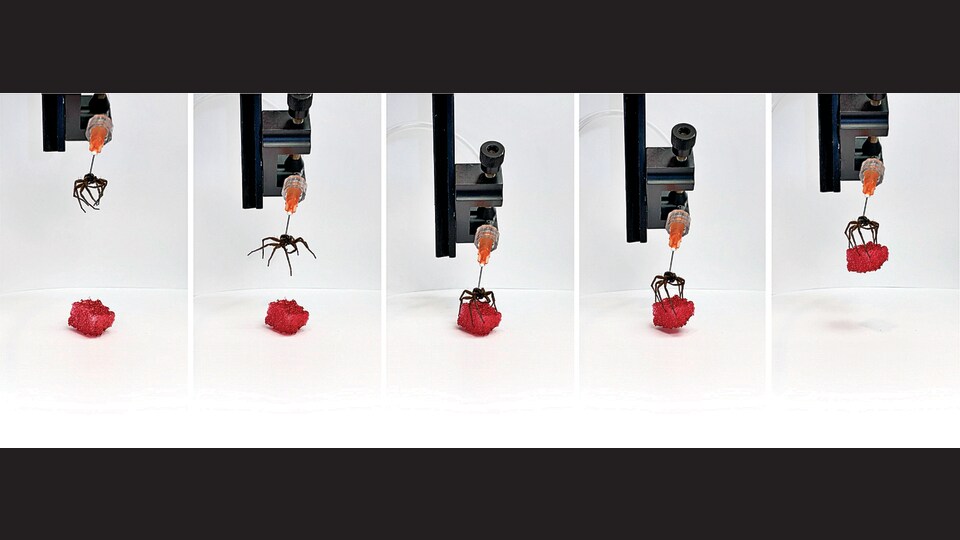
A dead insect repurposed as a gripper recently won an Ig Nobel. It’s not about what it can lift. It could help reframe the search for new materials in robotics.
The icky inspires Anoop Rajappan. Squishy dead spiders; leaves floating on a sticky marsh; the slimy insides of bhindi.
The natural design and chemistry observable in each of these hold clues that could help us create new generations of engineered devices, says the 30-year-old researcher, who has a Master’s degree and a PhD from the Massachusetts Institute of Technology (MIT) and is now a post-doctoral researcher with Rice University in Texas.
The water-repellent leaves of the lotus, for instance, led him to develop superhydrophobic coatings that could be applied to the hulls of ships or other seagoing vessels to make them more hydrodynamic and reduce fuel consumption.
And recently, the mechanical engineer was part of a five-member team that reanimated the curled-up legs of a dead spider to create a gripper that has now won an Ig Nobel Prize. The award, instituted by the satirical scientific magazine Annals of Improbable Research, honours innovations that “first make people laugh and then make them think”.
This idea of the gripper was born in 2019, when mechanical engineering professor Daniel Preston and a group of research students spotted a dead spider in the corner of a corridor. What caught their attention was the deceased arachnid’s curled-up legs.
Humans, and most animals, use muscles to move their legs, Rajappan points out. When an animal goes limp, the limbs relax. Spiders use the hydraulic pressure of their haemolymph (the blood-like fluid in invertebrates) to extend their legs. Which is why, when they die, their legs curl up.
Considering that the legs of the spider look exactly like mechanical grippers, the researchers wondered if they could be reanimated using hydraulic pressure. “By fixing a needle to a deceased spider, we supplied pressurised air to actuate its legs,” says Rajappan. The necrobotic gripper was born.
It has so far been used to remove a jumper wire affixed to an electronic breadboard, and pick up and move tiny blocks of foam. About two days after the death of a spider, dehydration turns its joints brittle and it can no longer be used. The team is now studying coating materials that might extend this period.
Waste not...
But the point of the necrobotic gripper isn’t really what it can grip or move.
The team’s research paper, Necrobotics: Biotic Materials as Ready-to-Use Actuators, published in the journal Advanced Science in 2022, lists how the gripper could begin to address a growing concern in the field of robotics: electronic waste.
Mechanical grippers have a lot of moving parts, each of which must be cast and manufactured, shipped, assembled and eventually disposed as waste. In contrast, the necrobotic gripper repurposes a cadaver using “only one simple assembly step, allowing us to circumvent the usual tedious and constraining fabrication steps required for fluidically driven actuators and grippers,” the research paper states.
The existing necrobotic gripper is already able to lift objects 1.3 times its own weight. It can reportedly withstand about 700 uses before the onset of degradation. It is biodegradable and can potentially be deployed “to grip small and delicate samples in an unobtrusive and ecofriendly manner,” the paper notes.
An evolved choice

“It’s a joy to work on a scientific question or idea that is both quirky and useful,” says Rajappan, who grew up in Kerala and graduated from the Indian Institute of Technology-Madras (IIT-M).
Growing up in Ernakulam, the child of engineers, he grew up fascinated by their sketches and calculations, and the idea that small, often invisible, changes could dramatically alter a much larger whole.
After his Master’s and his PhD, bio-inspired solutions became his mission, he says. What excites him most about the field of necrobotics is the ability to look at an ancient design with new eyes.
“Prior research has largely focused on bio-inspired or biomimetic systems, where researchers draw inspiration from natural designs and create engineered devices that mimic the form and function of living organisms. In this work, we go a step further,” he says. “As scientists, we often look to nature for inspiration on new ways to answer engineering and scientific questions. But complex natural designs, which have evolved through millions of years of evolution, can be difficult or impossible to replicate faithfully through artificial methods.”
In a world of giant leaps in technology, growing challenges (resource depletion, the climate emergency, demographic flux) and severe disparities in access, it’s time to rethink the formula of manufacturing everything from scratch, Rajappan adds, and instead simply look around and work with what is already available — and functioning perfectly — in one’s environment.
Technology then remains a driver. But Nature, just as it is, becomes the key resource for reinvention. It’s why the professor and his students were halted in their tracks by the dead spider in the first place.