The English-speaking world tends to be resistant to children’s literature from other languages. “Serious” literature — whether in French, Russian, Spanish or Sanskrit — finds its way across language barriers, helped along by awards and prizes, but this genre has it harder.
How many young Indian readers have heard of Tetsuko Kuroyanagi and her book, Totto-Chan: The Little Girl at the Window (1981)? It is the bestselling Japanese book of all time, and has been translated, among other languages, into
The English-speaking world tends to be resistant to children’s literature from other languages. “Serious” literature — whether in French, Russian, Spanish or Sanskrit — finds its way across language barriers, helped along by awards and prizes, but this genre has it harder.
How many young Indian readers have heard of Tetsuko Kuroyanagi and her book, Totto-Chan: The Little Girl at the Window (1981)? It is the bestselling Japanese book of all time, and has been translated, among other languages, into Hindi, Bengali, Assamese, Kannada, Tamil and Malayalam.
Nikolai Nosov’s 1980s stories about Dunno the Know-Nothing were very popular behind the Iron Curtain but are virtually unknown in the West, for both ideological and linguistic reasons.
The Brazilian José Mauro de Vasconcelos’s Meu Pé de Laranja Lima (My Sweet Orange Tree; 1968) is a children’s classic in the Portuguese-speaking world, but is far less-known in the English.
One children’s classic that has made it past the language barrier and into the popular cultural consciousness, albeit belatedly, is Tove Jansson’s Moomin series. Beloved in Scandinavia, particularly in the author’s native Finland, and immensely popular in Japan, the Moomins are now having their moment in the sun in the English-speaking world too.
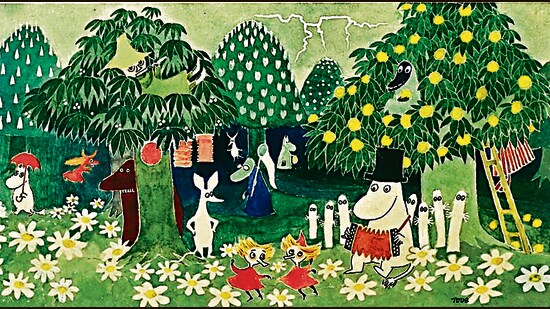
Moomins are a kind of troll. They look like bipedal hippopotami, and are small and soft. You can draw a moomin’s shape with a single stroke of the pencil.
Jansson (1914-2001) once said they were partly inspired by a story her uncle once told her, about strange little creatures who lived in his pantry and came out to rub their cold noses on food thieves.
In 1939, Jansson, who was already a published author, illustrator and cartoonist at 25, found herself facing up to the reality of World War 2. “One’s work stood still; it felt completely pointless to try to create pictures. Perhaps it was understandable that I suddenly felt an urge to write down something that was to begin with ‘Once upon a time’... What followed had to be a fairytale… but I… (avoided) princes, princesses and small children and chose instead my angry signature character… and called him the Moomintroll,” she wrote, in the introduction to the first in the series, The Moomins and the Great Flood (1945).
This was followed by Comet in Moominland, published in 1946, with the comet standing in for shadow of the atomic bomb. But it was with the third book, Finn Family Moomintroll (1948), that the series really took off.
.Over the next two decades, Jansson wrote six more novels featuring a recurring cast of characters: young Moomintroll; the affectionate and capable Moominmamma; the adventurous Moominpapa; cowardly little Sniff, Moomintroll’s companion; carefree Snufkin, a thinker and wanderer; and Hemulen, the family friend from a collection-obsessed species.
There were also picture books and a syndicated comic strip that, at one point, ran in 120 newspapers across 40 countries. In Finland, there are Moomin cafes. There’s a museum devoted to Jansson and her creations. Some Finnair planes have her characters painted on their sides. The Moomin World theme park is one of the country’s biggest tourist attractions.
There were animated TV shows, starting as far back as 1959, in Scandinavia, Germany, Poland, Japan and even the erstwhile Soviet Union. In 2019, the most recent such series, a Finnish-British collaboration with Taron Egerton as Moomintroll and Rosamund Pike as Moominmamma, was released.
There are videogames as well. The most recent, Snufkin: Melody of Moominvalley, was released by Hyper Games last year.
Last month, to mark 80 years since the first book, the first-ever Moomin exhibition in the US opened to visitors at the Brooklyn Public Library (it is on till September 30).
For its fans, Moominvalley is a safe, gentle space where Moominmamma is always at hand, in her red apron and handbag, ready with a kind word or a hot meal. Storms and comets may come and go but there is always room for kindness and gentle humour. And order is always restored.
It is this mood that permeates the memes by which many more now know the books.
The valley was intended as a happy place. But in another theme resonant today, Jansson’s creatures were also occasionally cast as migrants, searching for a new home, mourning lost loved ones.
The sense of loss would intensify, and a feeling of absence permeates the last Moomin novel, Moominvalley in November. Published in 1970, the year of Jansson’s mother’s death, the book aches with poignancy, making it more suitable for adults, despite working well as a children’s book.
“Snuffkin padded along calmly, the forest closed round him and it began to rain. The rain fell on his green hat and on his raincoat, which was also green, it pittered and pattered everywhere and the forest wrapped him in a gentle and exquisite loneliness...” she writes in chapter one. “There are those who stay at home and those who go away, and it has always been so. Everyone can choose for himself, but he must choose while there is still time and never change his mind.”
Jansson’s mother, Signe Hammarsten-Jansson, was an artist as well, and a big influence on her life. When she died, Tove couldn’t return to Moominvalley in quite the same way. There would be no more Moomin novels.
(K Narayanan writes on films, videogames, books and occasionally technology)
One Subscription.
Get 360° coverage—from daily headlines
to 100 year archives.
Archives
HT App & Website