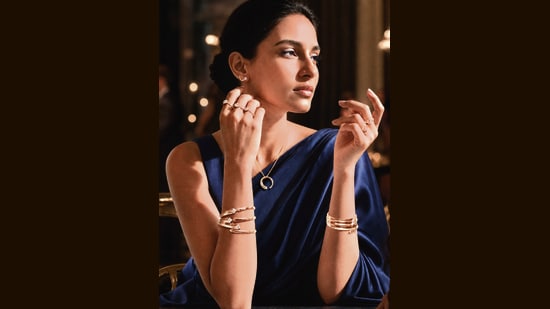
Natural diamonds and India share an unbreakable bond.
Lately, these gemstones have moved from special occasions to quiet luxury as well, via lightweight, versatile jewellery designed to be worn everyday: to work, to the pub or the park.
Diamonds are uniquely suited to such wear, because even the tiniest ones stand out in a way little else really can. Even the smallest of these gems, forged deep within the earth over millennia, is clearly priceless, timeless, and comes with a story.
These are some of the factors thought to be driving the growing adoption of diamonds as everyday wear in urban India. A study by the De Beers Group and Accenture Song offers a clearer picture.
In 2024, the leading motivations for buying natural-diamond jewellery were found to be: relationship milestones (12%), personal milestones (11%) and expressing love/commitment (10%). Completing or adding to an existing collection accounted for 9%, while 8% of the 9,000 women polled said they had wanted a specific piece for a while.
Overall, the Diamond Acquisition Study (DAS) found that about 29% of diamond jewellery acquisitions were wedding-related. As much as 52% of purchases were driven by feelings of indulgence and impulse, pointing to a growth of “because I want to” buys over traditional milestone-led ones. Overall, self-purchases accounted for about two-thirds of non-wedding acquisitions.
{{/usCountry}}Overall, the Diamond Acquisition Study (DAS) found that about 29% of diamond jewellery acquisitions were wedding-related. As much as 52% of purchases were driven by feelings of indulgence and impulse, pointing to a growth of “because I want to” buys over traditional milestone-led ones. Overall, self-purchases accounted for about two-thirds of non-wedding acquisitions.
{{/usCountry}}That last bit tells a story all its own. Young people, the study showed, want to buy this precious gem to mark their own moments of joy, pride and personal achievement. The desire to buy one’s own diamond jewellery was stronger, the study found, among members of Gen Z (those under the age of 30).
“This isn’t surprising; We’re talking about a generation that enjoys making a considered statement,” says stylist Pratyasha Sarkar. Diamonds, worn in different ways and gifted or bought for the self, become a fitting way to say: this is me; I am loved.
It serves, in a sense, as the ultimate everyday flex.
“From being a symbol of power, as seen in royalty, to a symbol of cool, as in the world of hip-hop, diamonds have constantly evolved with the culture,” Sarkar says. “What has endured is that they represent timelessness. This gives them an emotional significance. Whether it’s a personal or professional milestone, nothing says ‘this matters’ quite like a diamond, partly because of the sense of permanence they represent.”
They carry history within them, in other words, and yet are eternally cool.
NATURAL SELECTION
It helps that they have ancient ties to ideas of beauty, power and prestige in India.
Diamonds (natural, of course; there was no other kind) have been vital elements of king’s coronations and bridal trousseaus. Today, it is everyday Indians who wield them as elements of style and tokens of love.
They represent much that is distinctly Indian. Take the idea of value for money, reflected steadily in these gems. Natural diamonds are something beautiful that can be used everyday while their worth increases over time, and they can be liquidated at will. This makes them an ideal asset class for the discerning Indian.
Their worth and beauty together lend these gems a shelf life that outlasts trends. This gives them an enduring value within the Indian family. In a culture of jewellery made to be treasured and passed down from one generation to the next, a string of diamonds becomes the ultimate heirloom: a small object carrying the weight of a family’s story, and the heft of its wealth.
Put together, this makes for intentional value-led luxury. Which helps explain the changing math of what one buys to celebrate a first promotion, the birth of a child, an anniversary.
NEW ESSENTIALS
On the personal front, meanwhile, these are vital components of any modern jewellery collection.
“Jewellery, for millennials and Gen Z, is no longer mainly about what one wears to a wedding. It’s about the story you want to tell, the memories you want to hold on to, and the pieces that reflect and become part of your identity,” Sarkar says. “Diamonds fit this brief beautifully. They say a lot, but they can do it as subtly as you choose. As a stylist, I find this shift particularly interesting. These rare gems, glittering in the ear or around the finger or wrist, are in a sense the equivalent of a mic drop.”
A TOUCH OF LIGHT
And so it is that diamonds have come to be an ultimate Indian status symbol. The twinkle that says: Congratulations. Good luck. Well done. I love you. Or: Thank you for being there for me.
The gemstone that says: Will you, please, marry me?
The sense of rarity and luxury attached to each stone becomes part of the statement of abiding love that such a gift carries, whether it is given to the self or to someone else. That statement of love, pride or support then becomes a public declaration, each time the wearer tells the story of how they came to own the jewel. (And people are always going to ask, in a way we rarely ask about other jewellery.)
The diamond, after all, carries within it a vocabulary of grandeur: ideas of rarity and something precious. It is this that makes it the perfect addition, to an occasion when words don’t seem quite enough. This that makes it the perfect tiny milestone: I did it; I’m here; I made the dream come true.
The natural diamond, that is. Dreams that matter, and promises that count, cannot really be entrusted to anything less unique, less precious or less real.