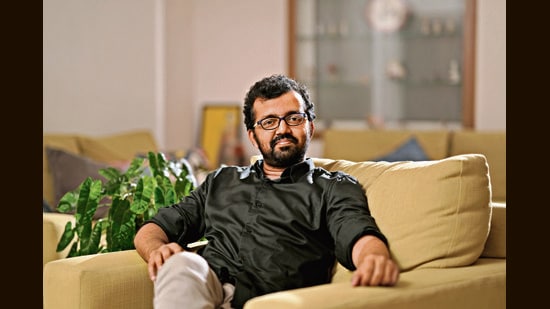
There’s a bit of a problem with how we study history, says Mahmood Kooria, and it’s limiting what we see.
We tend to study what happened on land. But most of the planet is water. And some of this water served as “highways of exchange”, where people met, interacted, traded, invented, sought new horizons and built their fortunes.
The story of a place and its people changes when one factors in the seas around them, Kooria says. This is particularly
There’s a bit of a problem with how we study history, says Mahmood Kooria, and it’s limiting what we see.
We tend to study what happened on land. But most of the planet is water. And some of this water served as “highways of exchange”, where people met, interacted, traded, invented, sought new horizons and built their fortunes.
The story of a place and its people changes when one factors in the seas around them, Kooria says. This is particularly true of India.
What we now know as the Indian Ocean has a recorded history that goes back more than 2,000 years; a lot further back than any other sea on the planet. In his new book, Indians in the Ocean, Kooria, 38, seeks to tell this story.
It is the tale of the world’s first global economy, one that thrived long before the colonial era. Communities from across half the world, from the Mediterranean in the west to South China Sea in the east, traded, travelled and migrated in and around this ocean.
The historical record offers a reminder of just how vast and varied this community was. Documents that survive are written in Hebrew, Arabic, Gujarati, Bengali, Kashmiri and numerous other languages.
“Even places such as Bihar and Madhya Pradesh, which are not close to the sea, are tied to it, because people from these regions ventured out for trade, travel and profit,” says Kooria, who teaches at University of Edinburgh’s School of History, Classics and Archaeology, and heads the Edinburgh Centre for Global History.
As for Indians not crossing the ocean because of ideas rooted in caste… well there’s a bit of truth and plenty of myth to that idea, he adds. Excerpts from an interview.
* Your book dispels a number of myths. Was that part of your mission in writing it?
Yes... One major thrust was to challenge the popular assumption that Indians did not travel abroad, especially across the sea, in the medieval period. I wanted to debunk that myth. On multiple fronts, including trade, politics and religion, Indians were always venturing out to sea.
That’s how the Chola dynasty conquered the Malaya region. How other minor kingdoms managed to conquer parts of Sri Lanka and the Maldives. The pull of the ocean, in terms of adventure, profits and royal orders, impelled people to become voyagers.
* Can you tell us a bit more about why history should be looked at from the oceans?
We are trained to focus on land-based history. We look at the history of regions as defined by their borders: country, state, empire. And then we study everything that happened within those borders. But history has been shaped by the seas and oceans: the Mediterranean, the Indian Ocean, the Atlantic.
Look at it this way and a different story emerges. Indian Ocean history becomes a story of multiple communities coming together.
Because the earth’s surface is more than 70% water, in ignoring the seas, we end up trying to think of the whole of world history from a one-third perspective, missing out on the two-thirds.
* For a long time, the Indian Ocean wasn’t even the Indian Ocean…
Precisely. It had multiple names. The name Indian Ocean coexisted with names such as the African Ocean, Abyssinian Ocean, Ethiopian Ocean, Persian Ocean and Arabian Ocean. Through the book, in fact, I try not to use the category “Indian Ocean” as far as possible, for this reason.
* History viewed from the oceans changes how we see things like culture and cuisine too, doesn’t it?
Many of the things that we think are our own are not our own. This is certainly true of cuisine. We may have contributed to it, but these things come from other places, and they go to other places. We are in this vast ocean where everything is in constant flux.
In Kerala and Tamil Nadu, we have the appam or puttu. In Indonesia, Singapore or Malaysia, you find the same kinds of things being cooked: rice steamed with coconut in the middle. How did the recipes travel? When? We don’t really know.
Culture, by definition, is not something that simply springs out of the earth. It is something that comes and goes; there is constant give-and-take. The Indian Ocean has been a highway for this kind of exchange.
This fluidity is a part of what we lose when we study histories by land. The boundary becomes the limit. Tussles break out. Things have to “belong” to that particular place, even though many of the things we associate with that place may have come from elsewhere.
* With the Indian Ocean, we lost a unique kind of history too, as you write.
It has the longest recorded history of any ocean. We have over 2,000 years of recorded history here, and many more millennia attested in archaeology. This is also one of the most populated regions in the world.
Local rulers and kingdoms were receptive to those who were coming and going. We see this in the Bay of Bengal and across the Arabian Sea too.
Take a place like Kochi. We have communities from almost every religious groups one can think of, living here, in the medieval period. They left behind written records in 10 to 15 languages.
I should also stress, though, that the history of our travels by sea is not a rosy one of people from different backgrounds coming together in a beautiful, peaceful way. It was also brutal, with slavery, piracy, capture, and maritime violence of all sorts woven in.
* There’s an interesting segment in your book about women aboard ships.
I have been teaching a course on women’s travel at sea, focused on the medieval period, and there are so many fascinating stories of women voyagers. There are accounts of women going in search of lost fathers; say a man who left on a trading voyage and didn’t return.
* Have you travelled widely across the Indian Ocean yourself?
I have been to islands in the Arabian Sea and Bay of Bengal, but most of these journeys were made by air. I have taken a few boats and ships, but nothing on a grand scale. I would love to do that. I would love to travel from Sofala in East Africa’s Mozambique to Guangzhou all the way in southern China, by sea, the way many in the medieval period did.
One Subscription.
Get 360° coverage—from daily headlines
to 100 year archives.
Archives
HT App & Website