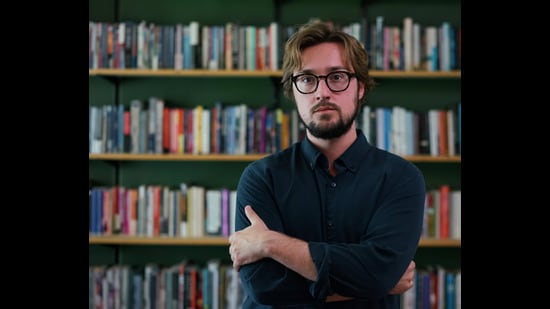
Kenan Orhan is a man divided between hope and dismay.
“There is a great disillusionment in me in the experience of being American today,” says the 32-year-old, who was born in Kansas, to an American father and a mother who left Istanbul as a young woman, amid an economic crisis and political unrest.
“My mother’s family really wanted to assimilate, and became very proud of being American. As children, we were very proud too. But the America of my parents’
Kenan Orhan is a man divided between hope and dismay.
“There is a great disillusionment in me in the experience of being American today,” says the 32-year-old, who was born in Kansas, to an American father and a mother who left Istanbul as a young woman, amid an economic crisis and political unrest.
“My mother’s family really wanted to assimilate, and became very proud of being American. As children, we were very proud too. But the America of my parents’ and grandparents’ generation doesn’t exist,” he says. “There is, for me, a great deal of disappointment. We were taught of America’s exceptionalism growing up, but beyond the wealth we’ve allowed to be robbed from the people, and the number of bombs we’ve dropped on other countries, I don’t think we’re particularly exceptional.”
Meanwhile, Orhan has been losing the ties that bound him to his mother’s homeland, Turkey.
“When my two brothers and I were young, we visited relatives there every year. Istanbul became this place of infinite summer, busy streets, crowded apartments. As we grew up, it became a place of nightclubs and fancy restaurants. It was quite the contrast to the landlocked city in Kansas we called home, where our teachers could never pronounce our names correctly, and the food we served our friends was always a little odd to them.”
The visits stopped amid waves of protests, crackdowns and violence, in 2013. Orhan was 19; he only recently returned for the first time since.
From this pain and confusion came his debut novel, The Renovation (2026), longlisted for the Booker Prize. In it, a Turkish woman who has fled to Italy sees her two worlds slam together, with surreal results.
Dilara is renovating a bathroom for her father, who has dementia, when she discovers that the contractors have botched the job, and somehow turned the space into a cell in an Istanbul prison (complete with a bed next to the toilet and sink).
Dilara can enter the prison through the cell, interact with inmates. Speak Turkish again, and feel the ache of familiarity as she does. But also feel the very real terror that she will not be able to leave.
As the pull of the cell intensifies, Dilara finds herself unable to tell real from unreal, freedom from captivity, home from exile.
***
The book isn’t just a remarkable conceit, it is also surprisingly humorous.
The deadpan treatment of the absurd begins at the start. When Dilara points out to the contractor that he has turned her bathroom into a functioning cell in a Turkish prison, he argues that she had looked at all the plans, and cannot be complaining now.
It’s “a rude exaggeration” to describe it as a jail cell, he adds; despite the fact that the bathroom now comes with its own guard.
The prison’s guards, meanwhile, adjust immediately to the idea of a cell that serves as a portal to Italy, taking the stand that if it exists, then clearly it is meant to. Their only response to the development is annoyance at her incessant questioning.
Her questions serve to tether the plot to reality, offering the reader a glimpse into what it can be like to live in a society that is slowly altering its nature: discourse to diatribe; logic to absurdity; freedom to authoritarianism.
***
Orhan was a substitute teacher with a side business in woodwork, when he began to write this debut novel, three years ago.
It had been a decade since his last visit to Turkey. Family was dwindling there, as elders died and youngsters left. He was starting to realise he may never truly return.
Then came the turmoil of 2023. His beloved grandmother developed dementia. A national election neared in his mother’s homeland. Hope rose and was crushed. President Recep Tayyip Erdogan won a third term (albeit with a far smaller margin than before).
The Atlantic reached out asking Orhan, who had by then won the O Henry award for a short story in 2019, if he would write a personal response to the poll results.
The Renovation grew from the short story published in The Atlantic. “I kept writing in Dilara’s voice,” he says. “It was her frustration and my frustration in one.”
***
The book could have been far grimmer; more unsettling. What made him decide to give humour such a big role?
“That was deliberate, because I think the natural reaction for many people in the face of overwhelming adversity is to laugh. And because I think doing otherwise is a kind of death,” Orhan says. “Humour might not keep morale high, but somehow it keeps you alive.”
It’s hard enough to hope, he adds. “I live in a place where… the loudest people are the most cruel.”
Amid corruption, authoritarianism and hyper-nationalism, the climate crisis, mass surveillance, and the wholesale pillaging of the working class by billionaires, Orhan says he fears the erosion of empathy, “the most important human impulse”. “It takes a lot to cripple that instinct, but it is happening around the world,” he adds.
There are those who think we can save ourselves by clinging to old beliefs; but many of these held little truth, even in the better times, he argues.
“Deeply detrimental to the well-being (of any nation) is the cult-like belief that one’s country is incapable of doing wrong,” Orhan says. “America has a long history of transgressions we need to face, and until we can do so, we cannot move forward.”
There is no one truth to any country, he adds. “No one version of the past that we can cling to and put back on like a warm blanket.”
(This story has been updated to reflect that the author has returned to Turkey since he finished writing The Renovation.)
One Subscription.
Get 360° coverage—from daily headlines
to 100 year archives.
Archives
HT App & Website