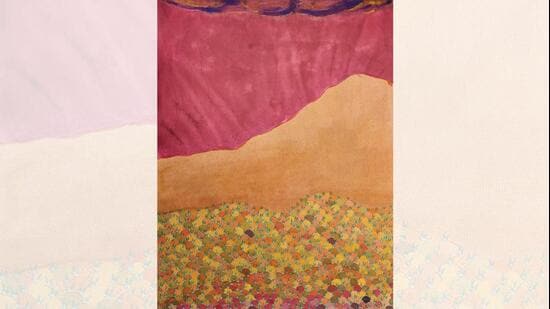
To understand Feroza Hakeem’s paintings, it’s essential to know her story. She was born into the marginalised Hazara community in Quetta, a semi-arid region in Balochistan in Pakistan, where her grandfather had migrated decades ago to escape the violent persecution of their Shia community by the Sunni rulers of their native Afghanistan. But even with the change in location, the marginalisation and hatred against Shias continued. Hakeem’s brother was murdered in a targeted killing in 2018.
As an artist, Hakeem turns this fraught personal and communal history into bright and beautiful naturescapes created in the Persian miniature style. There are no straightforward scenes of violence or suffering. Instead, the grief, tension and centuries of subjugation are sensitively layered within vibrant mountains, flowers, trees and streams. Nature becomes the receptacle to store memories and heal from long-held scars.The landscapes are beautiful, but not innocent. They draw from the struggle and resilience of the Hazara community spread across southern Afghanistan and western Pakistan. They’re laden with loss, and a strange sense of hope. I am drawn to this tension; to the possibility that something beautiful can hold something painful without the need to illustrate the pain in an obvious manner.
Born in 1995, Hakeem graduated from the National College of Arts in Lahore in 2019, having spent a semester at the Siena Art Institute, Italy. Her Persian miniature style looks traditional and meticulous, but they’re definitely of the present. In some works, the decorative borders of Mughal miniatures are replaced by newspaper cuttings and photographs recording the violence against her community members. In others, she repeats motifs to create layers without filling up every inch of space with a natural element.
{{/usCountry}}Born in 1995, Hakeem graduated from the National College of Arts in Lahore in 2019, having spent a semester at the Siena Art Institute, Italy. Her Persian miniature style looks traditional and meticulous, but they’re definitely of the present. In some works, the decorative borders of Mughal miniatures are replaced by newspaper cuttings and photographs recording the violence against her community members. In others, she repeats motifs to create layers without filling up every inch of space with a natural element.
{{/usCountry}}Some motifs recur across her paintings. Spot the apple blossom tree, a familiar landscape, vibrant-hued skies and more at her first solo show in India, at Delhi’s Gallery Pristine Contemporary. A massive unframed canvas, Women, Life, Freedom (2026), hangs from the wall like a tapestry. The trailing braids are made from Hakeem’s own hair, shorn in the depressive aftermath of losing her brother. There’s a bright red sky, a yellow landscape and cheery bunches of multi-coloured trees. And yet, it echoes how one feels after suffering a devastating loss.
Take a look also at Between Two Places (2026). It’s divided into two halves with the repeated motif of a dense copse of trees: One is bright and boldly coloured, while the other is black-and-white. They form a stark mirror image, with the mountainous landscape of her homeland placed in a small square between them. It’s perhaps a comment on how she feels pulled in different directions physically and mentally.
In My Loved Ones (2026), a woman dressed in a headscarf sits amid bountiful trees, with a river running below. The trees form a rectangular margin, replacing the traditional decorative border of miniature paintings. She seems almost a part of the flowers and leaves. She looks upwards, displaying a sense of hope as the foliage offers the love and protection one might expect from loved ones. It, like so many of her works, is a statement on choosing positivity even in the most dire of circumstances.
Salony Garg is a Hyderabad-based artist and co-director of the Samsara Academy of Art. Her paintings explore identity, belonging and human connection.
From HT Brunch, October 3, 2026
Follow us on www.instagram.com/htbrunch