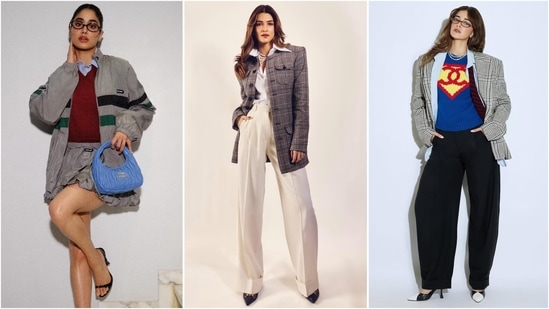
The traditional idea of workplace power dressing has long been associated with structured blazers, sharp tailoring, heels and formal silhouettes. But as workplace culture evolves, so does the way women dress for professional spaces. Hybrid work, changing schedules and more fluid work environments have made comfort and personal expression increasingly important parts of the modern work wardrobe.
In an interview with HT Lifestyle, Arushi Roopchandani, designer and founder of Atleisure, shares her perspective on how workplace dressing is evolving. (Also read: Festive beauty trends 2026: Expert reveals what’s in, what’s out and how to make your makeup last for hours )
Evolving workplace fashion
“Traditional work culture has shifted massively post-Covid 19 pandemic, where we no longer work in a 9-to-5 setup necessarily. Along with that, the number of startups in India has also risen, where women are dominating in multiple fields, and hence our days no longer look linear,” Arushi says.
“We are constantly going from one place to the other, be it a shoot to a meeting to a quick coffee catch-up with friends or sometimes even travelling across cities just to take that one meeting and be back. The variety of roles we as women have to take in a day can no longer be satisfied by one category, i.e. ‘corporate’ dressing, hence, we are seeing a shift towards comfort-led style,” she adds.
{{/usCountry}}“We are constantly going from one place to the other, be it a shoot to a meeting to a quick coffee catch-up with friends or sometimes even travelling across cities just to take that one meeting and be back. The variety of roles we as women have to take in a day can no longer be satisfied by one category, i.e. ‘corporate’ dressing, hence, we are seeing a shift towards comfort-led style,” she adds.
{{/usCountry}}“So while power dressing might still be relevant for the days that require you to just bring confidence to the table, for most days we need both comfort and style.”
How women are redefining what it means to look powerful
According to Arushi, the idea of looking powerful is increasingly being replaced by the more personal idea of feeling powerful. “I would say feeling powerful would always come prior to looking powerful for women, and hence confidence automatically takes centre stage today,” she says.
“Confidence comes from accepting oneself the way they are and being able to express themselves the way they are. Hence, abiding by any sort of ‘dress codes’ is only limiting our expression,” she explains.
“And if we fail to express ourselves, we will feel like we’re residing in a foreign body, which would directly affect our confidence.”
The rise of relaxed tailoring and elevated casuals
From oversized shirts and sneakers to relaxed tailoring and unconventional pairings, contemporary workwear is increasingly finding a middle ground between polished and comfortable dressing.
“I think it’s a balance of two elements, i.e. ‘messy’ + ‘clean’, that’s redefining the modern work wardrobe,” Arushi says. “For example, women wearing oversized shirts either finish the look with a clean, sleek bun, classic jewellery like a wristwatch, dainty gold earrings, or when choosing something more structured like a waistcoat, women pair it with a slip skirt, headbands, strappy sandals, etc.”
“The trick is to be right in the middle, neither too intimidating nor too careless,” she adds.
Should professional dressing still come with expectations?
While comfort-led dressing has become more accepted, women can still face expectations around looking polished and put together at work. Arushi believes professional capability should not be linked to how formally someone dresses.
“In the past and sometimes even now, women have felt the pressure to look put together at all times, whether at a place of work or a casual setting, because of the constant judgements associated with their look,” she says.
“But given how times are progressing, we shouldn’t be associating a woman’s professional capabilities with how formally or casually she chooses to dress. If a man can show up to work in a casual pair of trousers and T-shirt and still be taken seriously, then so should a woman.”
“The expectation shouldn’t have to be attached to her clothing, it must be attached to her work. Her clothing must do just one thing — make her feel at ease.”
What does the future of power dressing look like?
For Arushi, the future of power dressing may not mean abandoning formal fashion altogether but redefining what qualifies as powerful workwear.
“The definition of power dressing has always been limited to a ‘blazer and heels’ uniform, and I think what’s actually going to change is the freedom to not accept that definition anymore,” she says.
“Every woman now has a very distinctive idea of what power means to them. For some, it might be a pair of boots with a T-shirt dress; for others, it might simply be a floral dress with a blazer.”
“So in my opinion, formal dressing might actually come back more as a trend incorporated in elevated casuals, rather than making a full-blown comeback as ‘formal wear’ for workplaces.”
Catch your daily dose of Fashion, Taylor Swift, Health, Festivals, Travel, Relationship, Recipe and all the other Latest Lifestyle News on Hindustan Times Website and APPs.
Catch your daily dose of Fashion, Taylor Swift, Health, Festivals, Travel, Relationship, Recipe and all the other Latest Lifestyle News on Hindustan Times Website and APPs.