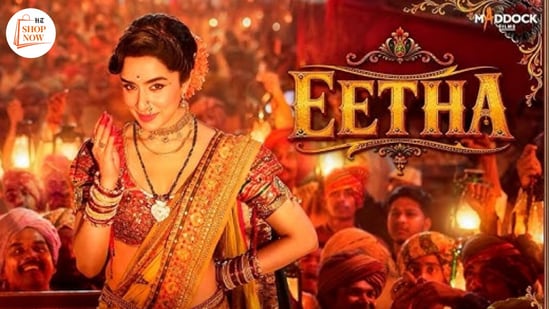
A saree is often associated with pleats gathered at the waist, a pallu draped over the shoulder and a silhouette that follows the body's natural lines. But Maharashtra's Nauvari saree is constructed differently. Its nine-yard length is draped between the legs and tucked at the back, creating a distinctive dhoti-like silhouette that allows greater freedom of movement.
The traditional garment has found renewed attention through Shraddha Kapoor's upcoming film Eetha, in which she portrays celebrated Lavani and Tamasha performer Vithabai Bhau Mang Narayangaonkar. With the film scheduled to release on December 4, the Nauvari is more than a costume choice. It is an important part of the cultural world the film seeks to recreate.
Here's what makes this traditional drape different, and why its construction matters.
What exactly is a Nauvari saree?
The word Nauvari comes from the Marathi words 'nau', meaning nine, and 'vari', meaning yards. As its name suggests, the saree traditionally measures nine yards, approximately 8.2 metres.
It is also known as a Lugade or Kashta saree. Unlike the conventional saree, which is generally worn with pleats tucked at the waist and a pallu over the shoulder, the Nauvari is draped in a dhoti-like style. A section of the fabric passes between the legs and is tucked at the back, creating a divided lower silhouette.
This construction is one of its defining features. Rather than having a long, uninterrupted length of fabric around the ankles, the drape allows the wearer to move more freely. It is particularly suited to activities involving walking, bending and dancing.
How is the Nauvari different from a regular saree?
While both garments use a single length of fabric, their draping techniques create noticeably different silhouettes.
1. The length of the fabric
A conventional saree is commonly around five-and-a-half to six metres long, although lengths vary by weave and style. A Nauvari traditionally uses nine yards of fabric, giving the wearer additional material to create its distinctive drape.
2. The dhoti-style pleating
This is the most recognisable difference. In a conventional saree, the pleats are tucked around the waist, with the remaining fabric falling as a pallu. In the Nauvari, the fabric is passed between the legs and secured at the back, creating a trouser-like appearance.
3. Freedom of movement
{{/usCountry}}3. Freedom of movement
{{/usCountry}}The drape allows the wearer to walk and move without the same restrictions associated with a conventional saree's longer lower hem. This is one reason the style is associated with working women, traditional everyday dressing and folk performers.
4. The overall silhouette
A regular saree creates a continuous skirt-like silhouette, while the Nauvari has a more structured, divided appearance. The way the fabric falls around the legs is what gives it its distinctive character.
It is worth remembering that the Nauvari is not one single, uniform drape. Regional and community-specific variations exist, with differences in how the pleats, pallu and fabric are arranged.
Why is the Nauvari important to Shraddha Kapoor's Eetha?
In Eetha, Shraddha plays Vithabai Bhau Mang Narayangaonkar, a celebrated performer associated with Maharashtra's Lavani and Tamasha traditions. The film's costume design therefore needed to reflect more than the visual glamour of a stage performance.
Costume designer Sheetal Sharma has spoken about the research that went into recreating this world, including archival references, traditional Tamasha performers and regional textiles. The team studied the way Lavani artistes wore their Nauvaris, along with the jewellery and other details that completed their stage appearance.
One particularly interesting decision was to avoid pre-stitched Nauvari sarees. Sharma explained that the team wanted the actor to wear traditionally draped sarees, including during rehearsals, because pre-stitched versions can fall differently around the hips and sides.
The costume team also worked with different Indian textiles, including Paithani, Ilkal, Banarasi brocade, Jamdani, Kanchipuram, Dharmavaram and Chanderi. Blouse construction was another important element, with variations in necklines, sleeves and back details helping create individuality across the character's wardrobe.
The accessories were equally considered. Traditional Maharashtrian jewellery, including the Kolhapuri saaj, thushi, tode and nath, helped establish the character's cultural identity.
What can we learn from the Nauvari's styling?
The Nauvari's appeal lies in the relationship between its construction, textile and accessories. The nine-yard drape creates the silhouette, while the blouse, jewellery and fabric bring individual character to the ensemble.
For someone interested in traditional Maharashtrian dressing, a few elements stand out:
- The blouse matters: Traditional silhouettes can be paired with different blouse constructions, from fitted short sleeves to puffed sleeves and varied necklines.
- Jewellery adds regional character: A nath, thushi, Kolhapuri saaj or traditional bangles can help complete the look.
- Textiles change the mood: Paithani silk, brocade and other regional weaves bring different textures, colours and levels of formality to the drape.
- The drape should remain authentic: The way the fabric is arranged is central to the Nauvari's identity, rather than simply using a nine-yard saree as a conventional drape.
Shraddha Kapoor's Eetha offers a timely reminder that traditional Indian clothing is not defined only by its appearance. The way a garment is constructed, worn and adapted to a particular cultural setting is just as important. And the Nauvari, with its distinctive nine-yard drape, is a particularly striking example.
Similar stories for you:
I recently attended a winter wedding and these 6 outfits went into my cart
Airbnb recreates K3G's Raichand House; 5 Poo-inspired looks to shop
Kate Middleton just made emerald necklaces irresistible again; 6 styles to shop
Shraddha Kapoor's Eetha puts the Nauvari saree in focus : FAQs
What is a Nauvari saree?
Which jewellery is traditionally worn with a Nauvari saree?
Why is Shraddha Kapoor wearing a Nauvari saree in Eetha?
How is a Nauvari saree different from a regular saree?
Disclaimer: At Hindustan Times, we help you stay up-to-date with the latest trends and products. Hindustan Times has an affiliate partnership, so we may get a part of the revenue when you make a purchase. We shall not be liable for any claim under applicable laws, including but not limited to the Consumer Protection Act, 2019, with respect to the products. The products listed in this article are in no particular order of priority.
Catch your daily dose of Fashion, Taylor Swift, Health, Festivals, Travel, Relationship, Recipe and all the other Latest Lifestyle News on Hindustan Times Website and APPs.
Catch your daily dose of Fashion, Taylor Swift, Health, Festivals, Travel, Relationship, Recipe and all the other Latest Lifestyle News on Hindustan Times Website and APPs.