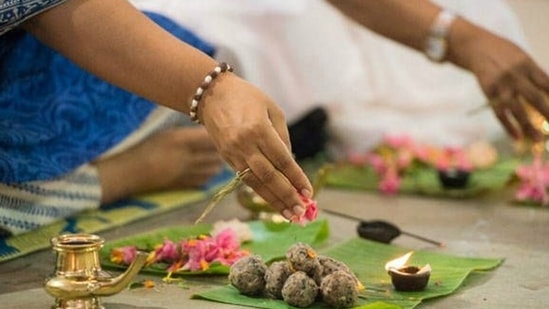
Pitru Paksha or Shraadh is the 15-day period preceding Navratri when Hindus offer prayers or tarpan to their ancestors through food offerings. Shraadhs are observed from the autumnal full moon to the following Amavasya for 15 days. On this day, til, rice among other food items are offered to ancestors during sunrise, followed by puja, havan and daan. During this time, no festivities are allowed and no new things are bought. The period is also called Pitri Paksha/Pitr-Paksha, Pitri Pokkho, Sorah Shraddha, Jitiya, Kanagat, Mahalaya, Apara Paksha and akhadpak, Pitru Pandharavda or pitru paksh.
DATE
Pitru Paksha falls in the 2nd paksha (fortnight) Hindu lunar month of Bhadrapada (September) and is observed the fortnight immediately after Ganesh Utsav. This year Pitru Paksha is starting from September 10 and will go on till September 25 post which the nine-day festival of Navratri will begin.
The end of Pitru Paksha and the beginning of Matri Paksha is named as Mahalaya.
SIGNIFICANCE
There is a reason why three generations of one's ancestors are worshipped during Pitru Paksha. According to ancient texts, the souls of three preceding generations reside in Pitriloka, a realm between heaven and earth and which is governed by Yama, the god of death. The generations before these three generations reside in heaven and are thus not offered tarpan.
HISTORY
According to a legend when Karna died in Mahabharata and his soul reached heaven, he was astonished to find that every food item he touched turned into gold, leaving him extremely hungry. When Karna and Surya asked Indra about the reason, he told them that while Karna had donated gold, he never offered food to his ancestors during Pitru Paksha due to which they cursed him. While Karna said he was not aware of who his ancestors were, he was eager to make amends and offered to return to earth for a period of 15 days to perform shraadh rituals and donate food and water in their memory. From that time onwards, the 15-day period came to be known as Pitru Paksha.
RITUALS
{{/usCountry}}According to a legend when Karna died in Mahabharata and his soul reached heaven, he was astonished to find that every food item he touched turned into gold, leaving him extremely hungry. When Karna and Surya asked Indra about the reason, he told them that while Karna had donated gold, he never offered food to his ancestors during Pitru Paksha due to which they cursed him. While Karna said he was not aware of who his ancestors were, he was eager to make amends and offered to return to earth for a period of 15 days to perform shraadh rituals and donate food and water in their memory. From that time onwards, the 15-day period came to be known as Pitru Paksha.
RITUALS
{{/usCountry}}- The rituals of Pitru Paksha are ideally performed by the eldest son of the family.
- The person performing the rituals should take a bath in the morning, should be bare chested and wear a dhoti. A ring made of darbha grass is then worn by the person.
- Ancestors are invoked to reside in the ring and the puja starts. Pind daan of cooked rice, barley flour balls mixed with ghee and black sesame seeds is done, accompanying the release of water from the hand.
- Lord Vishnu and Yama is worshipped.
- In the end, the food cooked especially for the Shraadh is then offered to a crow (considered as Yama), cow and a dog. After the crow has eaten the food, it is believed that Yama or the spirits of ancestors have accepted the offering. After this, the Brahmin who performs the puja is offered food.
- After this, other family members are served the food.
Follow more stories on Facebook & Twitter
Catch your daily dose of Fashion, Taylor Swift, Health, Festivals, Travel, Relationship, Recipe and all the other Latest Lifestyle News, Merry Christmas 2025 on Hindustan Times Website and APPs.
Catch your daily dose of Fashion, Taylor Swift, Health, Festivals, Travel, Relationship, Recipe and all the other Latest Lifestyle News, Merry Christmas 2025 on Hindustan Times Website and APPs.