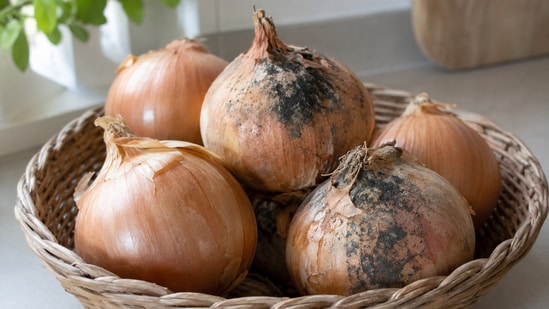
You may notice black spots on onions and wonder whether they are dirt or mould. Sometimes, even after you try to scrub them clean, the spots remain. So, what exactly are they? Are the onions safe to clean and use, or could they be dangerous to consume? In today's edition of Everyday Explained, we explore what causes these black spots and whether these onions should be eaten or discarded.ALSO READ: Everyday explained: Why are burgers almost always served with fries?
What are moulds?
The US Department of Agriculture's Food Safety and Inspection Service (USDA) discussed mould on food.
Firstly, let us check what mould is. As per the USDA, moulds are microscopic fungi that live on plant or animal matter. So, the ones that you see on onions, the spots that stay despite trying to scrub them clean, are moulds.
They are made up of thread-like structures and produce spores that can travel through air, water, or insects. These spores also give mould its visible colour, which may appear as the black coating you notice on an onion.
What appears on the surface may only be one part of the growth. Sometimes, the mould sprouts thin, root-like threads that can go deep into the food and sometimes may be hard to detect with the naked eye. So, your hack of chopping the part away won't work.
Is mould on food dangerous?
The USDA cautioned that if mould growth is extensive and widespread, it is best to discard the onion instead of trying to scrub it clean and consume it.
{{/usCountry}}The USDA cautioned that if mould growth is extensive and widespread, it is best to discard the onion instead of trying to scrub it clean and consume it.
{{/usCountry}}Most importantly, do not sniff an onion covered in mould, as inhaling the spores may cause respiratory problems. You should also clean the storage area where the onion was kept and check any products placed nearby.
These black spots should not be ignored as ordinary dirt, as they are fungal growth and may cause allergic reactions or respiratory problems.
As mentioned earlier, mould may penetrate the food even when it is only visible on the surface to you. Mould grows in warm and humid conditions, so it is best to avoid storing onions in such environments.
Note to readers: This article is for informational purposes only and not a substitute for professional medical advice. Always seek the advice of your doctor with any questions about a medical condition.