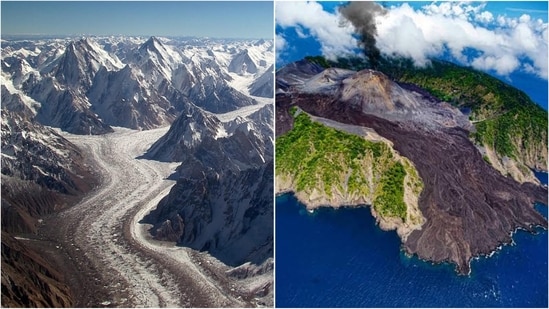
Think you’ve seen all of India? Think again. From an active volcano and a protected tribal reserve to high-security nuclear research facilities, the country has several places that tourists cannot simply visit like regular destinations. Access to these locations is restricted for reasons ranging from national security to protection of indigenous communities. Here are seven places in India where entry is heavily controlled or prohibited. (Also read: Travel vlogger takes ‘world’s most expensive first-class flight’ from Dubai to London: ‘It’s literally an apartment’ )
1. Barren Island, Andaman and Nicobar Islands
Home to India’s only active volcano, Barren Island is one of the country's most unusual destinations. While tourists can view the volcano from boats, landing on the island is not permitted. The Andaman and Nicobar Tourism Department says visitors may travel to the island by vessel for viewing, but no direct landing is allowed. The Ministry of Home Affairs also lists Barren Island as a restricted destination where visits are limited to vessels with no landing ashore.
2. Bhabha Atomic Research Centre (BARC), Mumbai
The Bhabha Atomic Research Centre in Trombay is a major nuclear research facility under the Department of Atomic Energy. It is not a conventional tourist attraction and access to its premises is tightly controlled.
{{/usCountry}}The Bhabha Atomic Research Centre in Trombay is a major nuclear research facility under the Department of Atomic Energy. It is not a conventional tourist attraction and access to its premises is tightly controlled.
{{/usCountry}}Official BARC documents refer to security procedures governing entry, including permissions and entry passes for authorised personnel and workers. Its security staff is also responsible for regulating the entry and exit of authorised people, vehicles and materials. For ordinary tourists, this means you cannot simply walk into the facility for a visit.
3. North Sentinel Island, Andaman and Nicobar Islands
North Sentinel Island is home to the Sentinelese, an Indigenous community that has remained largely isolated from the outside world. The island and surrounding waters up to 5 km from the high-water mark have been declared a Tribal Reserve.
The Ministry of Home Affairs states that entry into the Sentinelese Tribal Reserve by non-tribals and others is strictly prohibited. The restrictions are intended to protect the community from outside interference, including the risk of introducing diseases to which the Sentinelese may have little or no immunity. The Andaman and Nicobar Administration also prohibits photography of Indigenous tribal people in Tribal Reserves.
4. Siachen Glacier, Ladakh
Siachen is known as one of the world's highest battlefields and has major military significance. However, the claim that the entire Siachen Glacier is completely off-limits to civilians is no longer accurate. The Ladakh administration opened the Siachen Base Camp to domestic tourists in 2021, and the administration continues to list the opening of the base camp as a tourism initiative.
However, access does not mean tourists can freely enter the operational military zone or travel wherever they want on the glacier. Movement in sensitive border areas remains regulated, with authorities coordinating access and establishing mechanisms for tourist safety and movement.
5. Nicobar Tribal Reserves
Large parts of the Nicobar Islands are subject to special restrictions designed to protect Indigenous communities and sensitive areas. Unlike a regular holiday destination, travellers visiting the Nicobar Group require a Tribal Pass issued by the Andaman and Nicobar Administration.
The Directorate of Shipping Services states that general passengers travelling to the Nicobar Group must possess a Tribal Pass or relevant government authorisation. Foreign nationals are not permitted to travel to the Nicobar Group under the stated passenger rules. These restrictions are particularly important in areas associated with vulnerable Indigenous communities, including the Shompen.
6. Indira Gandhi Centre for Atomic Research (IGCAR), Kalpakkam
Located in Kalpakkam, Tamil Nadu, the Indira Gandhi Centre for Atomic Research is another important nuclear research facility under the Department of Atomic Energy.
IGCAR's official documents refer to the DAE Complex, Kalpakkam and specific security and entry procedures governing access to the premises. Entry is therefore controlled rather than open to tourists like a conventional public attraction.
7. Nanda Devi Inner Sanctuary, Uttarakhand
The Nanda Devi region is a UNESCO World Heritage landscape known for its exceptional Himalayan environment. While parts of the broader Nanda Devi National Park can be accessed through regulated routes, the inner sanctuary is not a place tourists can freely explore.
Government documents list the Nanda Devi Sanctuary among areas requiring a Protected Area Permit (PAP) for eligible visitors, while Uttarakhand's tourism planning documents describe the park as having limited visitor access and emphasise strict environmental management.
The restrictions help protect the area's fragile Himalayan ecosystem and regulate human activity in one of India's most environmentally sensitive mountain regions.
Catch your daily dose of Fashion, Taylor Swift, Health, Festivals, Travel, Relationship, Recipe and all the other Latest Lifestyle News on Hindustan Times Website and APPs.
Catch your daily dose of Fashion, Taylor Swift, Health, Festivals, Travel, Relationship, Recipe and all the other Latest Lifestyle News on Hindustan Times Website and APPs.