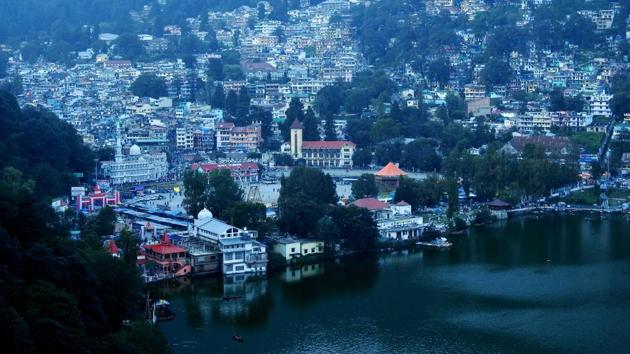
Educated youngsters at Bhimtal town in Uttarakhand’s Nainital district don’t have much to look forward to in their scenic tourist resort -- not much land for farming and not many local employment avenues, other than small jobs in hotel or transport industry.
Even when it comes to tourism-related jobs, these are either running small shops, acting as guides or ferrying boats. As a last resort, they move to Haldwani, Rudrapur or outside the Himalayan state for finding employment.
“With much hardship, we educate our children. But when they pass out, they get frustrated after finding no jobs here. Either they have to do petty jobs like us or move out in search of better jobs. This is our biggest tragedy especially when meagre farming on small hilly tracts hardly ensures profitable income,” said Sanjay Giri, a 43-year-old tour operator in Bhimtal.
People in most areas, especially villages, have similar tales across the Nainital-Udham Singh Nagar Lok Sabha constituency that stretches across 14 assembly segments, from hilly Bhimtal to Rudrapur in plains near the UP border.
Interactions with people across the constituency brought to fore its key problems -- unemployment, poor healthcare, lack of profitable farming practices, delay in infrastructural projects, especially the ones that could boost local tourism, and issues related to mobile and internet connectivity, civic amenities and sanitation.
{{/usCountry}}Interactions with people across the constituency brought to fore its key problems -- unemployment, poor healthcare, lack of profitable farming practices, delay in infrastructural projects, especially the ones that could boost local tourism, and issues related to mobile and internet connectivity, civic amenities and sanitation.
{{/usCountry}}The constituency came into existence in 1957 and until 2009 comprised Nainital, Kashipur, Haldwani, Khatima and Baheri. After delimitation of Lok Sabha constituencies following the creation of Uttarakhand in 2000, it was expanded to include 14 assembly segments. The constituency has traditionally remained a Congress bastion, barring a few times when the BJP won (1991-96, 1998-2002 and 2014).
Former Uttarakhand chief minister, BJP’s Bhagat Singh Koshiyari won the seat in 2014, defeating KC Singh Baba of Congress.
With a diverse demographic composition that includes people having migrated from hill districts and UP, it has emerged as one of the most-sought-after constituencies for political stalwarts. According to the 2011 census, out of 24 lakh plus population in this constituency, 63.1% people live in rural areas and 36.8 % in urban places.
Farmers in most areas said that in the absence of big land holdings, they focus on growing fruits and vegetables. “But monkeys and wild boars often destroy our crops, leading to heavy losses. This is the main problem most small farmers face in Kumaon, but nothing is being done to check this,” said Ramesh Chander Suyal, 66, a farmer from Bhaker village.
US Nagar district, with a major chunk of its population comprising Bengalis, Sikhs, Muslims and migrants, is battling problems related to overcrowding. “People from outside come here for jobs. With limited jobs here, it has led to a surge in unemployment levels. Educated youngsters are even accepting petty jobs with meagre salaries to make ends meet,” said Mohammad Saif, 24, a private employee in Rudrapur.
Sarup Pal, a Bengali who lives in Adarsh Indira Bengali Colony along with many others of his community, said overcrowding in Rudrapur had created civic and traffic-related problems. “You can see traffic chaos here. It is not surprising that there are many road accidents here,” he said.
Some said increase in crime was something they were worried about. “Rudrapur and Haldwani are emerging as the crime capitals of Kumaon. There are shootings, extortions, robberies, sexual assaults and rape of minors. Leaders representing this area should pay their attention towards this aspect,” said Santokh Singh, a Sikh living on the outskirts of Rudrapur.
People in Haldwani complained of delays in many development projects and initiatives, such as establishing ISBT bus stand, shifting of garbage dumping site and setting up a modern slaughterhouse. People in Nainital are battling issues that include conservation of Nainital Lake, encroachments in narrow hills lanes, traffic management, parking, irregular water supply and landslide-prone mountainsides.
CS Rawat, 26, a local trader in Malital, said this year landslides at Baliyanala and cave-in of Mall Road had made them worried about the possibility of a major catastrophe. “These issues should have been attended to a long ago. But authorities keep delaying to find solutions. For ultimate survival of people in Nainital, we have to ensure that mountainsides are made landslide safe and over-dependence on Nainital lake is lessened by ensuring regular water supply from Kosi river at the earliest,” he said.
During the peak tourist season, authorities are forced to stop vehicles temporarily on the outskirts of Nainital. “This coupled with lack of proper parking has affected tourist influx to Nainital, due to which we are suffering economically,” said Neeraj Joshi, president of the local Taxi Travel Association.