If the 2019 Lok Sabha election has touched a new low for its plummeting political discourse, it will also be remembered for the poetic twist that the leaders are giving to their speeches to convey their message effectively.
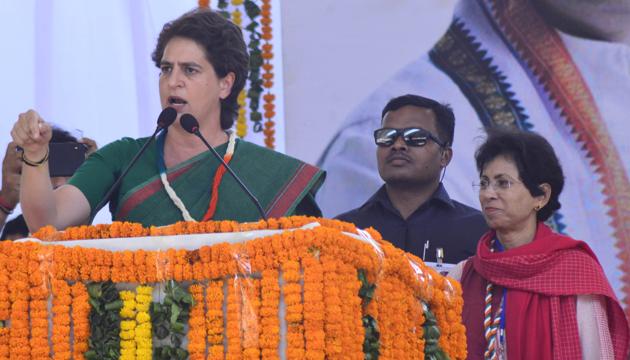
Congress general secretary for east UP Priyanka Gandhi Vadra on Tuesday targeted Prime Minister Narendra Modi for his arrogance.
To make her point, Priyanka referred to the Mahabharat and said the PM’s arrogance was like that of Duryodhan, the eldest of the Kauravas, who had threatened to hold even Lord Krishna captive.
Priyanka read out a poem by national poet Ramdhari Singh ‘Dinkar’ and said: “Jab naash manuj par chhata hai, pahle vivek mar jaata hai. Hari ne bhishan hunkar kiya, apna swaroop vistaar kiya, dagmag, dagmag diggaj dole, bhagwan kupit hokar bole- zanjeer badhakar saadh mujhe, haan, haan, duryodhan bandh mujhe.” (When a person’s end is inevitable, he loses his discretion. Lord Krishna dared Duryodhan expanding himself. The giants began shivering as the angry lord asked Duryodhan to take the chain and tie Him up.)
Also Read | ‘Duryodhan vs Krishna...’: When politicians leaned on epics to hurt rivals
{{/usCountry}}Also Read | ‘Duryodhan vs Krishna...’: When politicians leaned on epics to hurt rivals
{{/usCountry}}Priyanka’s poetic attack on Modi came a week after the PM himself read out an Urdu couplet to make his point that neither he nor his hopes were shattered by the opposition’s attacks.
“Instead, those who have tried to target me have been shattered,” said Modi.
“Na main gira na meri ummeedon ke meenar gire, par kuchh log mujhe giraane mein kayi baar gire.” (Neither I nor the towers of my hopes have fallen. But those who tried to bring me down fell a number of times.),” he said.
The PM had also invoked renowned poet Maithli Sharan Gupt while addressing a public rally in Hoshangabad, Madhya Pradesh, on May 1.
“Nar ho na niraash karo man ko, kuchh kaam karo kuchh kaam karo (Don’t be disheartened man, work, work and work),” Modi said, adding that India honoured those who wanted to move ahead on the basis of their work.
As the PM, in his Hoshangabad address, said that Maithli Sharan Gupt was “born on this land”, Madhya Pradesh chief minister Kamal Nath was quick to react.
The MP chief minister’s office tweeted, “Today in Itarsi of Haushangabad (MP), you referred to national poet Maithli Sharan Gupt and said he was from Haushangabad. Maithli Sharan Gupt was born in Chirgaon (UP) on August 3, 1886 while Haushangabad was the birthplace of Pt. Makhan Lal Chaturvedi. Thought to correct your information.”
Even as the leaders are quoting poets, there are poets who are contesting the elections too.
A noted Urdu poet and Congress candidate from Moradabad Imran Pratapgarhi had used Urdu couplets in his election campaign in Moradabad.
Before filing his nomination papers, Pratapgarhi launched his campaign with an Urdu couplet – “Buzurgon ke virasat par abhi tak raaj karta hoon, zamin ka saath dene ke liye parvaz karta hoon. Siyasat jung hai is daur main jamhooriyat walon. Moradabad se is jung ka elaan karta hoon (I rule the heritage of my ancestors. I take this flight to protect my ground. If politics is a war in this era of democracy, I launch this fight from Moradabad.) “
A seer and Congress’s candidate from Lucknow Acharya Pramod Krishnam is also known for his poetic skills of reciting ‘marsias’ (elegiac poetry). Krishnam attended a number of gatherings of the minority community and used his poetic skills to connect with Muslims.