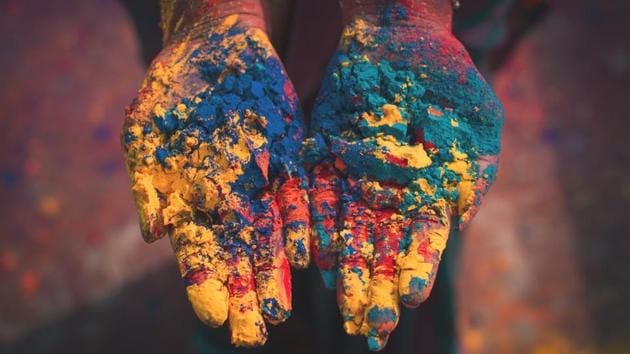
Legend has it that as a youngster, the dusky-hued Krishna was extremely jealous of his companion Radha’s fair complexion. One day he complained to his mother Yashoda, who told him to go colour Radha’s face in whichever hues he wanted. Krishna gleefully took the advice and coloured Radha’s face so that they both appeared the same, giving birth to a celebration for ages.
In Braj, where Krishna grew up, Holi is still celebrated as Rang Panchami, a commemoration of the divine love of Radha for Krishna. A second legend is connected to Prahlad and Lord Vishnu’s fourth avatar Lord Narasimha.
Prahlad was a pious devotee of Lord Vishnu, something that was not acceptable by his father, the demon-king Hiranyakashipu. To teach his son a lesson, he asked Holika, his sister, who had the boon of never being harmed by fire, to take the young Prahlad on her lap and enter a burning pyre.
While the king had hoped that his sister would survive, Prahlad’s devotion saved him, while Holika perished in the flames. Ever since the eve of Holi sees people light bonfires marking the incident and celebrating the triumph of good over evil. A festival of love and colours, Holi signifies the arrival of spring and is spread over two days, including Holika Dahan or Chhoti Holi and Rangwali Holi or Phagwah.
There is a third legend associated with the festival whose roots are embedded in the Shaivism school of thought.
{{/usCountry}}There is a third legend associated with the festival whose roots are embedded in the Shaivism school of thought.
{{/usCountry}}Perturbed by the Yogi Shiva’s eternal meditation, goddess Parvati sought help from the Hindu god of love Kamadeva. The love god shot an arrow at Shiva, but instead of waking him, the arrow only managed to open the god’s third eye, which burnt Kama to ashes.
Rati, upset by her husband’s demise, performed meditation for 40 days, which pacifies Shiva and brings back the god of love. This return of the divinity associated with love is celebrated on the 40th day after Vasant Panchami as Holi.
Holi is one of the oldest Hindu festivals that finds mention in the Puranas as well as the Dasakumara Charita. The festival has been immortalised by the poet Kalidasa in Kumarasambhava and Malvikagnimitram.
The festival of colours is also mentioned in the 7th-century Sanskrit drama Ratnavali.
Religious texts like the Vishnu Purana and Mimamsa Sutra too make mention of the festival and its association with Krishna.
The festival showcasing Lord Krishna finds innumerable references in Indian art. From mid-17th century Bikaner miniatures showing the colourful celebrations, to Mughal paintings, etched during the reign of Jahangir, Holi has been captured time and again on canvases, highlighting the significant position the festival has in Indian history.
Follow more stories on Facebook and Twitter