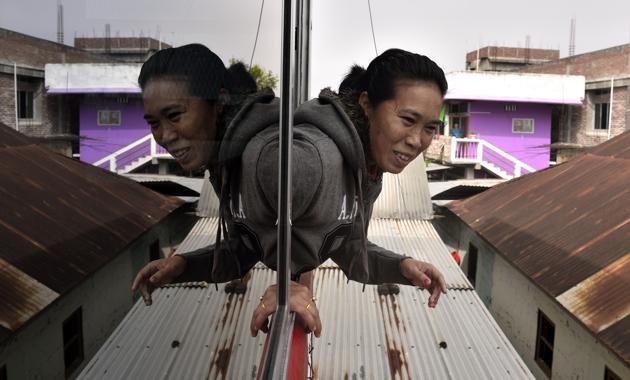
In September, Oinam Bembem Devi became only the second woman footballer to receive an Arjuna award (the first was Shanti Mullick in 1983).
Known as the ‘Durga of Indian football’, Devi started playing at the age of eight, with boys from her neighbourhood in Imphal.
“I can say with confidence that living in a society in which girls and boys are not seen as very different helps a lot,” says Devi, 37. “Playing every day, against boys, in those early years helped me build speed, power and confidence.”
Her first break came when she was selected for the Manipur U13 girls’ team in 1991. By ’96, she was playing for India in the Asian Games.
As captain, she led the women’s team to gold twice in the South Asian games, in 2010 and 2016.
“Manipuri girls have great stamina,” she says, grinning. “In an endurance test where you can pass with 20 points and the average for a national player is 25, I have often seen Manipuri girls score 40 and above. If someone scores a 50, my first guess would be she is from Manipur.”
It helps that the list of challenges a sportswoman faces is shorter in Manipur.
{{/usCountry}}It helps that the list of challenges a sportswoman faces is shorter in Manipur.
{{/usCountry}}“I remember a promising player from Tamil Nadu quitting the national team because her family felt it was time she got married,” Devi says. “In Manipur, the discussions are very different. A woman playing at the national level is a matter of pride for the family and the entire neighbourhood. When a fellow Manipuri footballer married, she came to an agreement with her husband’s family that she would continue training and playing. In fact, their main request had nothing to do with her career — they wanted her to wear the traditional phanek and enaphi [a fitting blouse and a wraparound skirt] when attending cultural and family events.”