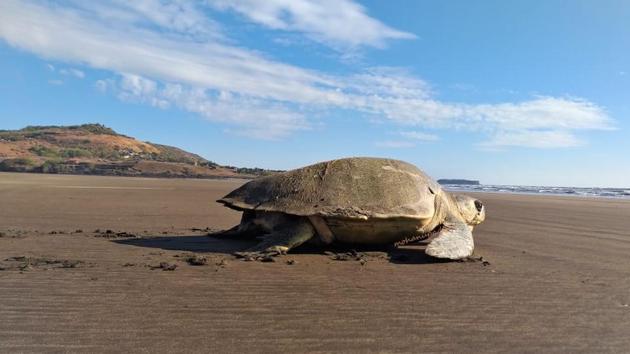
In a first for Maharashtra and the west coast, three Olive Ridley turtles along south Konkan will be satellite-tagged to understand their migratory pattern and nesting.
The project at a cost of ₹9.87 lakh will be undertaken by the Wildlife Institute of India (WII), Dehradun and was sanctioned during the third governing body meeting of the Mangrove and Marine Biodiversity Conservation Foundation on Tuesday chaired by forest minister Sanjay Rathod.
“The satellite telemetry study will commence soon since the final nod has been received. Presently, we have no information about how turtles migrate along the west coast of India whether they move towards the Middle East, Pakistan or towards Sri Lanka,” said Virendra Tiwari, additional principal chief conservator of forest (mangrove cell) adding, “This study will help us get access to authentic scientific information on their movement, which would be followed up with more conservation-based studies.”
Olive Ridleys are endangered sea turtles found in warm tropical parts of the Indian and Pacific oceans. They travel thousands of kilometres into the ocean and only the females return to the original breeding sites within a minimum of two years. According to the mangrove cell, approximately 600 Olive Ridley turtles find their way to nesting sites across prominent beaches in Ratnagiri, Sindhudurg and Raigad districts of Maharashtra.
“We are yet to finalise which district the study will be undertaken. We will be selecting three turtles from maximum turtle movement observed,” said Manas Manjrekar, deputy director, Mangrove Foundation adding, “Platform transmitter terminal (PTTs) will be used, which will be fitted with epoxy resin and fixed on the carapace (hard shell) of the turtle. The project duration is 12-14 months, and once the turtle is tagged, the study will depend on the life of the satellite tag and how long we will receive the data.”
{{/usCountry}}“We are yet to finalise which district the study will be undertaken. We will be selecting three turtles from maximum turtle movement observed,” said Manas Manjrekar, deputy director, Mangrove Foundation adding, “Platform transmitter terminal (PTTs) will be used, which will be fitted with epoxy resin and fixed on the carapace (hard shell) of the turtle. The project duration is 12-14 months, and once the turtle is tagged, the study will depend on the life of the satellite tag and how long we will receive the data.”
{{/usCountry}}Manjrekar added that there have been similar studies from the east coast. “This is the first time it is happening on the west coast and will give us an insight into where they migrate and information on the west coast population of Olive Ridley turtles. We hope to get valuable data over the next two years,” he said.
Meanwhile, a string of other decisions were taken on Tuesday by the Mangrove and Marine Biodiversity Conservation Foundation constituted by the state in 2015. It is an autonomous body that assists the mangrove cell in coastal marine conservation through research projects. Over five years, the foundation has undertaken numerous research projects to improve the livelihood of coastal communities as well as increase awareness and capacity building through marine biodiversity research along the Konkan coast.
The governing body approved the deployment of 183 guards of Maharashtra State Security Corporation (MSSC) for the protection of mangrove areas in Mumbai suburban and Thane districts. Both districts had 117 guards so far since 2017.
On Tuesday, the foundation’s governing body approved a ₹21 crore budget for the financial year 2020-21 for various activities including mangrove protection and conservation, sustainable livelihood projects, research activities, capacity building, awareness programs, coastal and marine biodiversity conservation measures, management of marine animal strandings etc. The meeting approved expenditure of ₹17.27 crore for the previous financial year.
“The protection and conservation of mangroves is our focus and all efforts for this coming financial year are focused towards this especially considering the impacts of climate change and sea level rise,” said forest minister Sanjay Rathod adding, “I have instructed the foundation to prepare a detailed plan for maximum coastal mangrove plantation, and the project shall be jointly implemented by the fisheries and forest departments.”
The governing body also approved the country’s first solar powered marine mammal museum - Giants of the Sea – at the Coastal and Marine Biodiversity Centre at Airoli, Navi Mumbai at a cost of ₹10 crore. The museum will house skeletal remains of endangered marine species. “The body approved the appointment of a project management consultant on Tuesday,” said Tiwari.
Other approved projects by the governing body on Tuesday
Other approved projects include:
· A study of dolphin population and monitoring along the Sindhudurg district.
· A fresh exercise to assess the exact boundary of the Malvan Marine Sanctuary protected area at a cost of ₹40.05 lakh by WII
· Overall approval to establish a multi-species hatchery at Vengurla, Sindhudurg for ₹21.14 crore with a ₹12 crore grant by the foundation and remaining cost by the fisheries department and various national level funding agencies.
(Source: State Mangrove Cell)
Stay updated with all the Breaking News and Latest News from Mumbai. Click here for comprehensive coverage of top Cities including Bengaluru, Delhi, Hyderabad, and more across India along with Stay informed on the latest happenings in World News.
Stay updated with all the Breaking News and Latest News from Mumbai. Click here for comprehensive coverage of top Cities including Bengaluru, Delhi, Hyderabad, and more across India along with Stay informed on the latest happenings in World News.