Much has been written about the state of Mumbai’s suburban railways, following the September 29 stampede on a foot over bridge (FOB) at the Elphinstone Road station, in which 23 commuters were killed. The incident led to widespread criticism. Now, thanks to a knee-jerk reaction by the Railways, our suburban stations look slightly neater as hawkers have vanished and security personnel have been posted at busy FOBs to prevent another stampede. Will this last? Experience says otherwise.
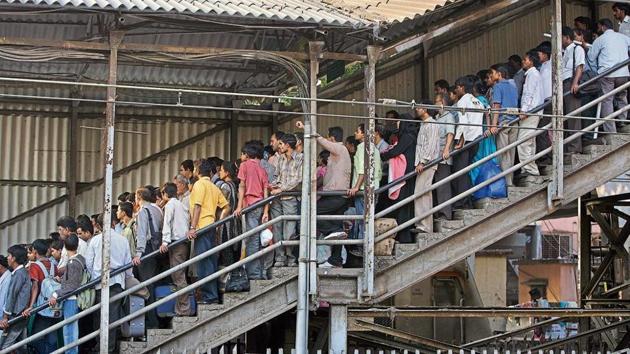
It’s probably just a matter of weeks before hawkers return to stations, autorickshaws and cabbies jam the entry and exit points and commuters are left to their fate. It will take more than gimmicks to solve the problems of the suburban railway network.
As many as 3,033 train services of the suburban railway network, which comprises Western, Central, Harbour and Trans-harbour (Thane-Vashi) lines, ferries more than 7.5 million commuters daily. To be fair to the Railways, the way it runs suburban trains has improved substantially in past decade.
It is commendable that hundreds of services run during the peak hours with precision. However, problems arise when it comes to upgrading the system, keeping in mind changes in the city. Either the basic infrastructure is ignored or it is rebuilt at a snail’s pace.
The Elphinstone Road-Parel stations are a classic example of this. The two are linked by the same FOB on which the stampede took pace. Once, these stations were mostly deserted, but in past 10 to 15 years, they have seen a gradual increase in the number of commuters as the erstwhile mill land transformed into commercial complexes.
{{/usCountry}}The Elphinstone Road-Parel stations are a classic example of this. The two are linked by the same FOB on which the stampede took pace. Once, these stations were mostly deserted, but in past 10 to 15 years, they have seen a gradual increase in the number of commuters as the erstwhile mill land transformed into commercial complexes.
{{/usCountry}}Still, neither the Railway administration nor the state thought it necessary to rebuild the infrastructure faster to accommodate the increasing number of commuters. Though a plan was in place, it was implemented too slowly. Unfortunately, 23 innocent lives needed to be lost for the state and Centre to swing into action.
The Mumbai Urban Transport Project (MUTP) was devised to upgrade and expand the suburban rail network. The most visible outcome of the MUTP was the additional lines that were laid on the central and western sections, as well as the new trains that replaced the old, bulky ones. However, some elements of the plan were either ignored or kept aside. Improving stations to disperse crowds better was one such element. It included building new FOBs, making entry and exit points more accessible and facilitating better last-mile connectivity by providing bus stops and auto stands in an organised way.
More than a decade ago, the Station Area Traffic Improvement Scheme (SATIS) was planned for seven major railway stations — to be undertaken jointly by the Railways and the local civic body. Later, the target was reduced to four stations. At the end, it was implemented only at Thane station which now sees a much better dispersal of crowd during peak hours.
While authorities kept chasing fancy dreams such as air-conditioned trains, less attractive elements such as SATIS were ticked off the agenda. Following, the tragedy, railway minister Piyush Goyal directed the Railways to identify overcrowded stations and build FOBs there.
We don’t know whether this will happen soon or if it will take years. Significantly, the stampede also reminds us of something that has been debated on several occasions: Mumbai’s over dependency on suburban trains owing to the lack of an alternative mass transport system.
CM Devendra Fadnavis has initiated the construction of three Metro lines, while five more are planned. We don’t know when these lines will be ready and can ease the pressure off the suburban railways.
Till then, let’s hope the basic infrastructure of our suburban train system is improved and no more lives are lost.
Stay updated with all the Breaking News and Latest News from Mumbai. Click here for comprehensive coverage of top Cities including Bengaluru, Delhi, Hyderabad, and more across India along with Stay informed on the latest happenings in World News.
Stay updated with all the Breaking News and Latest News from Mumbai. Click here for comprehensive coverage of top Cities including Bengaluru, Delhi, Hyderabad, and more across India along with Stay informed on the latest happenings in World News.