From the thumping, blaring music at pubs to vehicles honking endlessly in still traffic and firecrackers bursting in neighbourhoods for every victory and celebration, Mumbaiites live with a constant barrage of noise that is leading to hearing loss, cardiac problems and psychological issues.
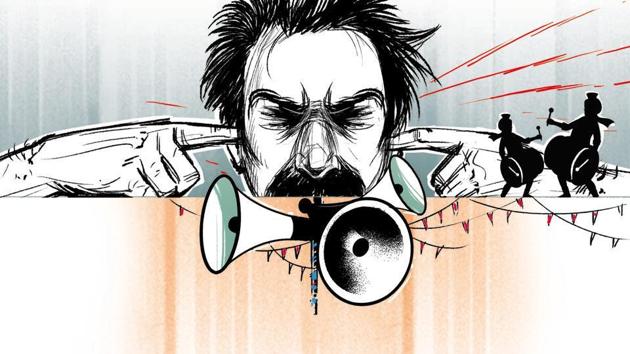
Noise, once just a source of annoyance, has become a full-fledged health hazard for people in this city, say doctors.
Dr Samir Bhargava, an ear-nose-throat (ENT) specialist attached to the civic body’s Cooper hospital in Juhu, said that in the last decade, he has seen a steady rise in patients suffering from hearing loss at a younger age than before. “If patients were coming to me at the age of 60 with complaints of hearing loss, now they are coming to me at the age of 45,” he said.
Though multiple factors are responsible for early hearing loss, scientific studies suggest that noise is a significant contributor, said Dr Bhargava. “Chronic exposure to noise above 85 decibels (db), such as the sound of aircraft taking off, or drilling machine, leads to progressive hearing loss.”
“Typically, patients with Noise-Induced Hearing Loss (NIHL) have problems with high frequency sounds,” said Bhargava.
{{/usCountry}}“Typically, patients with Noise-Induced Hearing Loss (NIHL) have problems with high frequency sounds,” said Bhargava.
{{/usCountry}}Some of the most obvious signs of hearing loss, doctors said, are patients asking people to repeat what they said, hearing incorrectly, speaking loudly to hear their own voice and listening to the television at a loud volume.
Dr Milind Navalakhe, associate professor, department of ENT, Nair Hospital, said that in his 25 years of practice, he has seen a twelvefold rise in the number of patients coming with sensorineural hearing loss (SNHL), a type of deafness that results from damage to the inner ear. “While one may not be able to attribute the hearing loss to rising noise pollution, there is a need for more studies to be done on this issue,” he said.
Constant and excessive noise does not affect just your hearing; in the long run, it increases your risk of developing high blood pressure, which can lead to serious heart problems.
Various studies have shown that people living in noisy localities, such as near airports or industrial areas, suffer more from high blood pressure then those who are not exposed to high decibel levels. A 2008 study, called HYENA (Hypertension and Exposure to Noise near Airports), in Europe found that long-term noise exposure, primarily to night-time aircraft noise and daily average road traffic noise, raises the risk of hypertension.
Dr Rahul Modi, an ENT consultant at Hiranandani hospital, Powai, said that constant exposure to noise - say for around eight hours a day, for weeks to months - increases the secretion of hormones called catecholamines, which enhance stress levels. “Adrenaline is a catecolamine that when released directs blood to the heart. This leads to the heart pumping blood at a higher pressure,” said Dr Modi.
For people who are already struggling with anxiety disorders, noise levels above 85db can be a great source of distress. Dr Milan Balakrishnan, a psychiatrist at Juno clinic, Khar, said: “Even if we just drive through a noisy place, we find ourselves more agitated or upset. Depending on personality, some people can’t let go of that agitation and relax afterwards. Noise exacerbates problems for people with insomnia and anxiety problems,” he said.
Dr Modi recommends that people take simple measures such as using ear plugs or cotton balls to reduce exposure to loud noise.
Compared to adults, children are at a higher risk of suffering ear damage, warn paediatric ENT specialists, which in turn can affect their cognitive functions and development. “In children, hair cells of the inner ear, which convert the sound into electrical signals, are more sensitive as compared to adults’. Exposure to chronic noise can damage the inner hair cells,” explained Dr Shruti Bansal, consultant paediatric ENT specialist, Narayana Health SRCC Hospital, near Haji Ali.
Every year, during festivals and celebrations such as Ganesh utsav, Diwali and weddings, many parents bring their children with complaints of anxiety, irritability, incessant crying, often a result of constant loud noise. “In the later years, it could affect their cognitive functions and result in problems such as inability to concentrate and increased restlessness,” Dr Bansal said. “In some cases, a child can even develop personality issues.”
Like children, the elderly too have sensitive hair cells in the ear. “With age, these cells become more sensitive, and makes them prone to hearing loss,” Dr Navalakhe said.
Firecrackers can lead to sudden hearing loss: Doctors
Every year, during the Diwali week, Lokmaniya Tilak Sion hospital sees at least two patients a day with damaged inner ears, say doctors attached the hospital’s ENT department.
Dr Renuka Bradoo, a professor with the hospital’s ENT department, recalls a case from last year where a seven-year-old boy ruptured his ear drum after he set off a firecracker. “He was standing too close to the cracker. He came in complaining of a ringing sound in his ear and not being able to hear properly,” the doctor said. The child was put on neuroprotective medicines, and it took nearly three months for his ear drum to heal. “The tissue heals on its own, but sometimes the damage can be irreversible,” she said.
The loud noise emitted by firecrackers can result in temporary hearing loss, called temporary threshold shift. “Prolonged exposure to high noise levels can lead to reduced hearing for a couple of minutes, or even hours,” said Dr Divya Prabhat, an ENT surgeon at Bhatia hospital, Grant Road.
Loud noise can also result in a continuous ringing or buzzing sound in the ear, which is called tinnitus. “Eight to 10 per cent of tinnitus cases are because of noise pollution,” said Dr Rahul Modi, an ENT specialist at Hiranandani hospital, Powai.
Dr Hetal Marfatia, head of ENT department at KEM hospital, Parel, said that often, patients don’t realise that they suffer from hearing loss. “The loss of hearing is often for higher frequency sounds, such as a blast or a helicopter taking off, which one does not get exposed to on a daily basis, so it’s difficult to figure out,” she said.
Your best bet is to avoid firecrackers, whether it’s bursting them or standing close to where they are burst. “We usually ask people to avoid fireworks, but if they want to light them, I suggest that they choose fireworks that emit light over the ones that make noise,” Dr Bradoo said.
Stay updated with all the Breaking News and Latest News from Mumbai. Click here for comprehensive coverage of top Cities including Bengaluru, Delhi, Hyderabad, and more across India along with Stay informed on the latest happenings in World News.
Stay updated with all the Breaking News and Latest News from Mumbai. Click here for comprehensive coverage of top Cities including Bengaluru, Delhi, Hyderabad, and more across India along with Stay informed on the latest happenings in World News.