Seventy years (1948) after scientists in Mumbai sent a cluster of rubber weather balloons carrying instruments to study cosmic rays 30km into the earth’s atmosphere, the country’s scientific ballooning facility completed its 500th launch this month.
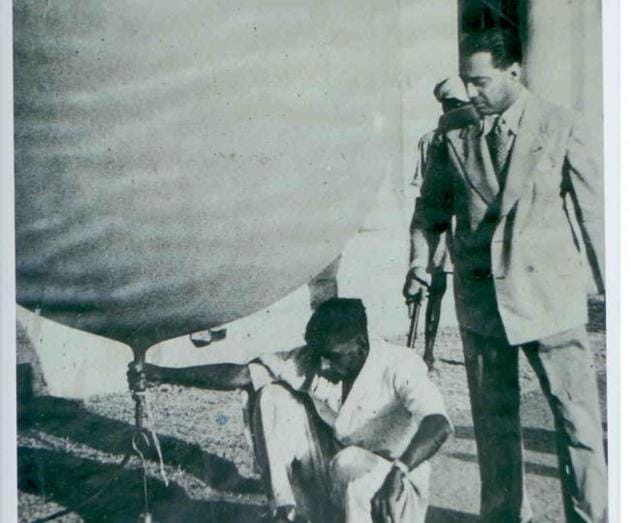
On April 13, Tata Institute of Fundamental Research Balloon Facility (TIFR-BF), Hyderabad, sent an indigenously designed and fabricated 3,026 cubic metre plastic balloon equipped with control instrumentation packages and developmental instruments weighing 57.5kg up to an altitude of about 25km above mean sea level (MSL). The balloon-borne experiment, called T500, was successful, and the payload was recovered 102km south-west of TIFR-BF.
“Balloons, sometimes fondly called a “poor man’s satellite” with its promising high vertical resolution due to slow ascent rates, provide useful sub-orbital platform for measurement of various important scientific parameters that may not always be achievable from aircraft or satellite platforms,” said professor Devendra K Ojha, chairperson, TIFR-BF committee.
It was in 1948 that nuclear physicist Homi Jehangir Bhabha, who founded TIFR at Mumbai, initiated balloon flights for cosmic ray research. Over the next decade, about 60 balloons were launched from Mumbai, Chennai, Bengaluru, Delhi and Srinagar. With limitations in using rubber balloons, a project to produce a plastic balloon was started at TIFR in 1956.
{{/usCountry}}It was in 1948 that nuclear physicist Homi Jehangir Bhabha, who founded TIFR at Mumbai, initiated balloon flights for cosmic ray research. Over the next decade, about 60 balloons were launched from Mumbai, Chennai, Bengaluru, Delhi and Srinagar. With limitations in using rubber balloons, a project to produce a plastic balloon was started at TIFR in 1956.
{{/usCountry}}“Rubber balloons had limitations — load carrying capability, reaching higher and predetermined altitudes, and maintaining long float durations. All these aspects were becoming increasingly important for the success of primary cosmic ray experiments,” said Ojha. “So it was decided to develop a new technique of flying large zero pressure plastic balloons, capable of carrying heavier payloads to higher altitudes.”
The first plastic balloon took off from the Old Tata Oil Mills, Sewri, in April 1957. Since then, plastic balloons carrying payloads anywhere between 10kg and 1,200kg have been sent up to an altitude of 51.8km for research in astronomy, astrobiology, atmospheric sciences and high energy physics. For the past 10 years, TIFR-BF has been conducting 10 flights annually.
The types of plastic used to make the balloons, however, changed over the years to withstand temperatures in the coldest region of the earth’s atmosphere. From using commercially available polyethylene (black plastic film) in 1956 for initial trial balloons for cosmic ray experiments, the TIFR balloon group went on to indigenously make balloons out of black tinted polyethylene film, which were called ‘black balloons’. These are zero-pressure balloons that are partially filled at time of launch and expands to its full volume, thus allowing for differences in pressure in the upper atmosphere. All these balloon flights could only be carried out during the day.
Unlike the black balloons, the black plastic film balloons could not survive as they passed through tropopause region (boundary layer between the troposphere and stratosphere) with temperatures between minus 78 degrees Celsius and minus 90 degrees Celsius.
“On the other hand, the black balloon film absorbed solar radiation, and the consequent heating would keep its temperature well above the cold brittle point of the balloon film,” said Suneel B Kumar, scientist in-charge, TIFR-BF adding that after 23 trial flights in December 1958, the first successful black balloon flight took off from the Old Tata Oil Mills, Sewri.
With astronomy being an integral part of experiments and one that needs the dark sky, TIFR-BF facility developed a ‘white balloon’ or ‘transparent balloon’ technique.
“The government banned black film because of the carbon content. We only use transparent film that we developed, which is much superior to the black film,” said Kumar. “There are no scientific balloon flights during the day anymore. Most flights for astronomy to study the stars and atmospheric sciences to collect samples of water vapour and aerosols are conducted during the night.”
Stay updated with all the Breaking News and Latest News from Mumbai. Click here for comprehensive coverage of top Cities including Bengaluru, Delhi, Hyderabad, and more across India along with Stay informed on the latest happenings in World News.
Stay updated with all the Breaking News and Latest News from Mumbai. Click here for comprehensive coverage of top Cities including Bengaluru, Delhi, Hyderabad, and more across India along with Stay informed on the latest happenings in World News.