The Juhu campus of Shreemati Nathibai Damodar Thackersey (SNDT) Women’s University on Wednesday inaugurated a 500 kilowatt-power (kWp) solar project. Considered one of the largest rooftop renewable energy projects in the city, the solar setup, which was installed in October 2018, has already reduced the Juhu campus’ electricity bill from ₹10 lakh a month to ₹4 lakh in December.
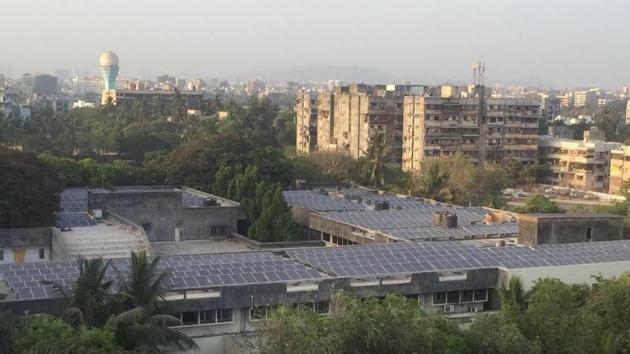
The power bill is expected to further dip to ₹2 lakh in summer months, which will amount to an overall reduction of 80% in electricity expenses. The university expects to save ₹50 lakh every year in power bills, said Dhaval Gori from Aditya Green Energy, the project proponent.
The university installed the solar setup under the Centre’s Solar Energy Corporation of India (SECI), New Delhi, which has allocated 3 megawatt (MW) rooftop solar amenities for every state in 2017. It has identified state-run educational institutes or government offices that can adopt solar power. SNDT was the first university in Maharashtra to be selected under the scheme, while Aditya Green Energy Private Ltd. Mumbai was chosen as the project proponent.
Based on a study by the Indian Institute of Science, Bengaluru, this project is estimated to mitigate 15,375 tonnes of carbon dioxide emissions during its lifetime, which is equivalent to planting 24,600 teak trees. Solar energy is a free source of renewable energy which does not cause pollution and reduces carbon emissions from burning coal, gas and oil for electricity generation.
{{/usCountry}}Based on a study by the Indian Institute of Science, Bengaluru, this project is estimated to mitigate 15,375 tonnes of carbon dioxide emissions during its lifetime, which is equivalent to planting 24,600 teak trees. Solar energy is a free source of renewable energy which does not cause pollution and reduces carbon emissions from burning coal, gas and oil for electricity generation.
{{/usCountry}}Solar energy will now cater to lights and fans across the entire 200-acre campus, which has around 4,000 students. “The idea was to focus on energy conservation for an environment-friendly future and a pollution-free campus,” said Dr. Shashikala Wanjari, vice chancellor of the university. “We installed the project under the central scheme where we did not have to pay any money for installation.”
With 1,540 panels, the setup will generate an average of 1,917 kilowatt-hour (kWh) units per day and 7,00,000 kilowatt-hour (kWh) units in a year. A two-bedroom-kitchen apartment in Mumbai consumes 10-15 kWh units every day. “The university expects to save ₹1,226.40 lakh over 25 years. We invested ₹2.5 crore in the project, which is likely to be recovered within seven years,” said Dhaval Gori, a representative of Aditya Green Energy, which is responsible for maintaining the project for 25 years.
The educational institution, with a strength of 40,000 students, is the first women’s university in India as well as in South-East Asia, and was founded in 1916. The university headquarters is located in Churchgate while it has another campus in Karve Road, Pune.
Stay updated with all the Breaking News and Latest News from Mumbai. Click here for comprehensive coverage of top Cities including Bengaluru, Delhi, Hyderabad, and more across India along with Stay informed on the latest happenings in World News.
Stay updated with all the Breaking News and Latest News from Mumbai. Click here for comprehensive coverage of top Cities including Bengaluru, Delhi, Hyderabad, and more across India along with Stay informed on the latest happenings in World News.