
 E-Paper



Collaborate to build up climate resilience
Like other parts of the Global South, our region has also been left to its own devices in the face of climate calamities. This is evident in the uneasy global silence around climate finance

 Prefer HTon Google


The floods in Pakistan have displaced 33 million people — almost the population of Canada — and assets worth millions have been lost. These angry waters are a result of wrong land use, aggravated by the climate crisis. For South Asia, this disaster and the climate crisis hold up a mirror to many realities. These show that there is an urgent need for regional collaboration, rethinking of development models, mainstreaming neglected local knowledge and spotlighting climate finance at the forthcoming United Nations Climate Change Conference (COP27) in Egypt.
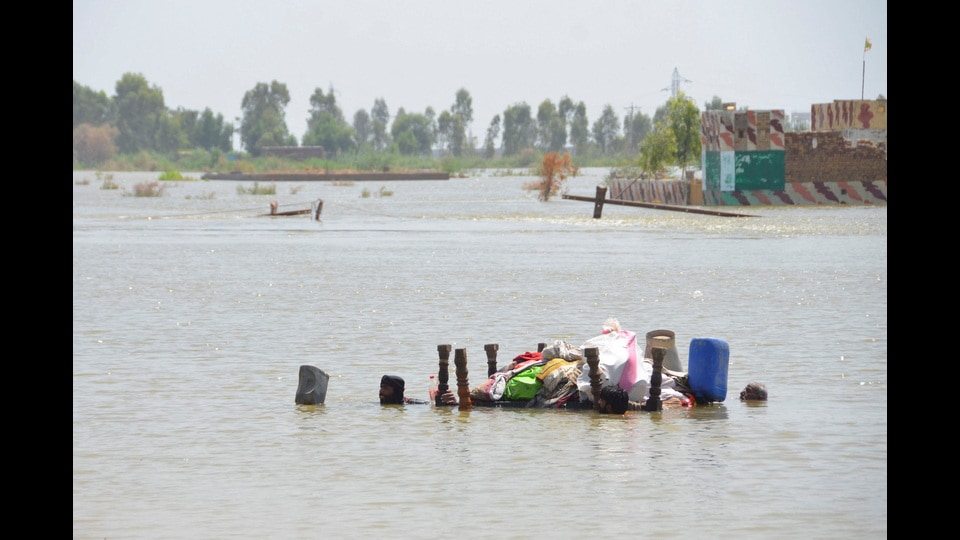
In the last two years, South Asia has been mauled by cyclones, heatwaves and floods. The intense, year-round air pollution is also influenced by the climate crisis. Regional collaboration can transform our preparedness in two ways.
First, when tragedies occur, the first responders must be from the region; this is quicker, more appropriate and a collective means to keep our region safer. To do this well, we must set up emergency plans and protocols.
Second, South Asia can build shared resilience to soften the blow. Whether these take the form of sharing innovation or building scientific capacity and joint research, we don’t know till we do a deep dive. Inter-governmental institutions such as the International Centre for Integrated Mountain Development (ICIMOD) in Nepal, where all South Asian nations participate, can serve as initial platforms while broader ideas are incubated. Political challenges will remain in this high-strung region, and so will intense climate upheaval. How the two intersect can save lives and dollars.
Millions of South Asians living along rivers, deltas, forests and coasts are repositories of ecological knowledge. Why not deploy them to boost regional resilience? Prime Minister Narendra Modi has advocated Lifestyle for Environment (LIFE) as a key part of climate solutions. However, to mainstream this, we must reconsider our development pathway. Building large infrastructure along rivers and oceans, over grasslands and wetlands, and in mountains isn’t economically viable anymore.
Like other parts of the Global South, our region has been left to its own devices in the face of climate calamities. This is evident in the uneasy global silence around climate finance. The forthcoming COP27 is an opportunity to highlight the forgotten promise by wealthy countries of $100 billion annually in climate finance.
South Asian negotiators must insist on new and additional payments, not re-labelling existing development aid, even if it fights this climate crisis. Funds must be paid by milestones, transparently. Payments for loss and damage are additional and non-negotiable. The developed world, home to 12% of the world’s population, has contributed to well over 50% of the historic greenhouse gases.
Funds alone are not the entire negotiation. The Asia Society Policy Institute recently released a report — Bringing India to Net Zero. It suggested India advance peak emissions and hit targets earlier, attracting greater investment. By making Indian emissions an issue, the report tosses aside the sacred premise of climate negotiations: Common but differentiated responsibilities. The think-tank, Council on Energy, Environment and Water, shows that China, the European Union and the United States will save 28.5% of the global carbon budget to stay below 1.5 °C, just by advancing their net-zero year by a decade. This effort will help the world’s poor to survive. So why should the Global South, fighting poverty, take on the rightful responsibility of the wealthy?
South Asia, home to 25% of the world’s population, is also a climate-vulnerable region. Let’s not shy away from holding developed countries accountable for the crisis they have burdened us with. Investing in South Asia offers everyone a better chance to live better in this age of uncertainty.
Bharati Chaturvedi is an environmentalist and writer. She is the founder and director of Chintan Environmental Research and Action GroupThe views expressed are personal


