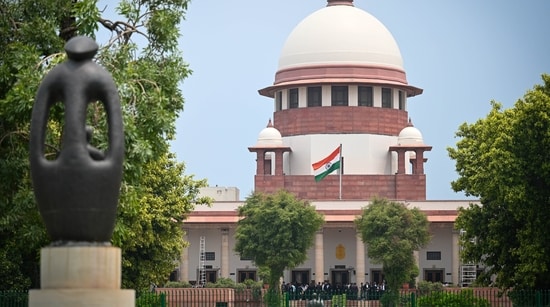
On August 18, the Supreme Court (SC) reaffirmed an archaic status quo. By dismissing a petition to replace hanging with more advanced methods — such as lethal injection, shooting, or electrocution — the Court underscored a startling paradox in modern jurisprudence. It allowed the Union government room to examine whether scientific advances offer a more dignified method of execution; yet for now, it anchored Indian law to the 19th-century ritual of the hemp rope under Section 393(5) of the Bharatiya Nagarik Suraksha Sanhita (BNSS).
There is a biting irony here. We are a nuclear-capable, spacefaring, 1.4 billion strong nation that can land rovers on the lunar south pole, yet we require a high-level committee to determine if breaking a human being’s neck with a rope is “painful”. By focussing on the mechanics of the kill, the SC avoids the more urgent constitutional mandate that any procedure depriving life must be fair, just, and reasonable.
The enactment of the BNSS in 2023 was marketed as a grand decolonisation of laws in India. Yet, Section 393(5) preserved the 1860 colonial method of execution in entirety. This sits in direct friction with the inseparable trio of Fundamental Rights — Article 14 (Equality), Article 19 (Freedom), and Article 21 (Life and Personal Liberty) — which collectively protect individuals from arbitrary State action.
The key constitutional tension is between State authority under the Bharatiya Nyaya Sanhita (BNS), which retains the power to execute, Fundamental Rights, and the 2015 Law Commission mandate, which explicitly recommended the abolition of the death penalty for all crimes except terror cases.
Going by Cesare Beccaria’s argument that laws must not augment the cruelty of formal execution, the petitioners’ request for lethal injection or electrocution is seen resting on the mirage of the State being able to kill “humanely”. This search for a sanitised execution is a distraction, be it with the noose or syringe. The gallows also never claim victims equally. It is fair to say that the noose has a distinct preference for those at the margins of society who cannot afford premium legal assistance.
Since Jagmohan Singh v. State of U.P. (1973) and Bachan Singh v. State of Punjab (1980), the judiciary has attempted to restrict the death penalty to the “rarest of rare” cases. However, this has made sentencing heavily dependent on judicial discretion rather than a consistent legal standard. In Laxman Naik v. State of Orissa, the rape and murder of a child resulted in a confirmed death sentence. However, in Kumudi Lai v. State of U.P., the court declined to affirm the death penalty for the rape and murder of a 14-year-old girl.
Switching to a medicalised method of killing is not a benefit to the condemned; it is for the State to soothe its own conscience. It attempts to mask the violence of an eye-for-an-eye under the guise of clinical efficiency. When the judiciary invokes collective conscience to justify the noose, it risks transforming justice into populism. Whether the heart is stopped by a drop or a drug, the act remains a rejection of reformative justice in favour of a State-sanctioned spectacle.
Years in solitary confinement and an uncertain mercy process may themselves violate the fundamental right to life long before execution. But what happens when the noose’s finality falls on a system prone to wrongful conviction and delay like ours? This is one of the most harrowing aspects of the 2026 decision.
India’s continued reliance on hanging is a step backward because it is the ultimate decolonisation paradox: We have replaced the names of our laws but kept the scaffold of our colonisers. While the world moves toward abolition, our framework remains tethered to 1860. The SC will do well to stop debating the method of the kill and start questioning the validity of the death penalty itself.
The apex court noted that death by hanging serves no restorative purpose. The reluctance to acknowledge that a painless death is an essential component of the Right to Life creates a vacuum where the State’s power to punish overrides the individual’s right to dignity. In a modern, democratic India, shouldn’t justice be measured by our capacity for reform, not by the efficiency of our gallows?
Ashish Bharadwaj is pro vice-chancellor of the upcoming WPU Goa Campus. Insiyah Vahanvaty is a socio-political commentator and author of ‘The Fearless Judge’. The views expressed are personal