Notwithstanding the recent exchanges between the Indian and Chinese foreign ministers and military commanders at the border, India-China relations remain at a critical stage. Negotiations on Depsang Plains, Demchok, Gogra and Hot Springs are anticipated to be difficult and will reveal whether China is serious about reducing tensions and restoring tranquillity at the border.
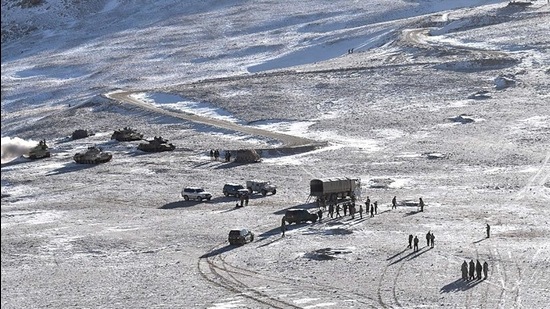
The disengagement, which began on February 10 at the Pangong Tso’s northern and southern banks in Ladakh, is just the first tentative step in a process envisaging Chinese forces pulling back from areas where they are present to their April 2020 positions. Adding to the complexity is the absence of trust and blanket of suspicion that cloud the talks.
The arc of military pressure created by China since early May 2020, initially in Ladakh and subsequently along the entire 4,057-kilometres of the Line of Actual Control (LAC), has enduring strategic implications. It blends military, civil and diplomatic instruments. Importantly, it has starkly contrasted the assiduously built myth of so-called historical and traditionally close ties between the two countries and peoples, and the reality that Beijing has not been sensitive to either India’s interests or need for good relations. India needs to now factor this across the entire gamut of the relationship.
The nine-month-long stand-off in the high-altitude Ladakh region still continues with both countries mobilised along the entire LAC. A report indicated that since May, China’s People’s Liberation Army (PLA) started constructing a military base on the Tibet-Bhutan border opposite Drowa village in the Tibet Autonomous Region (TAR). An airport has been built at Yadong opposite Nathu La in Sikkim. These have the potential to add to tension on the Tibet-Bhutan border. Equally significant are the activities of TAR’s propaganda and public security teams, which visited Pangong, Shihquanhe, Demchok to explain the alignment of China’s “borders” to villagers and plans for developing “Pangong Lake as an international lake”.
{{/usCountry}}The nine-month-long stand-off in the high-altitude Ladakh region still continues with both countries mobilised along the entire LAC. A report indicated that since May, China’s People’s Liberation Army (PLA) started constructing a military base on the Tibet-Bhutan border opposite Drowa village in the Tibet Autonomous Region (TAR). An airport has been built at Yadong opposite Nathu La in Sikkim. These have the potential to add to tension on the Tibet-Bhutan border. Equally significant are the activities of TAR’s propaganda and public security teams, which visited Pangong, Shihquanhe, Demchok to explain the alignment of China’s “borders” to villagers and plans for developing “Pangong Lake as an international lake”.
{{/usCountry}}During this period, China also hosted a video conference where Nepal’s leadership pointedly reiterated Kathmandu’s commitment to the “one China policy”. Nepal’s Prime Minister KP Oli also chose this sensitive time to raise contentious issues with India. Chinese foreign minister Wang Yi, quite unusually, visited Tibet in August. He met TAR leaders in Lhasa and travelled to border areas across Pangong Tso and Chushul.
China also sent mixed signals. There was a suspected cyberattack on India’s electricity grid. Coinciding with Wang Yi’s meeting with India’s external affairs minister S Jaishankar in September, the editor-in-chief of the Chinese Communist Party (CCP)-owned Global Times, Hu Xijin, wrote an editorial asking China to prepare for war.
Beijing’s punitive military action against India was not unexpected. Indicators include the establishment in 2016 of the PLA’s Western Theatre Command — the largest of China’s newly-created five military theatre commands — intended to ensure the projection of Chinese power into this region and protect the China-Pakistan Economic Corridor (CPEC). Soon after the announcement of CPEC in 2015, Chinese leaders began telling Indian visitors, including at the highest level, to “resume talks with Pakistan, ease tensions, resolve the Kashmir issue and then look to improving ties with China”.
After the disengagement at Doklam in 2017, training by the PLA’s ground and air forces in the high-altitude Tibetan Plateau visibly increased. Reports of these exercises in the Chinese military media included references implying they were part of preparations against India.
The period ahead will be one of uncertainty and unease. Relevant for India are the assertions by Hu Shisheng, director of South Asia Affairs Department in the Chinese Institutes of Contemporary International Relations (CICIR). A think-tank of China’s ministry of state security (MoSS) — the external intelligence arm — CICIR periodically briefs China’s Politburo. Hu Shisheng asserted that India and China “were doomed to have a serious collision of interests or even military conflict from the very beginning of their independence and since establishing frontier and regional order”. Equally candidly, he observed that more complicated than border issues are the contention for influence and dominance and “order in the region involving relations among China, India and their neighbours”.
Hu Shisheng’s subsequent article in Global Times (December 17) was more blunt. It accused India of adopting a negative and obstructionist approach towards China. He said, “India tends to disrupt China’s agenda in multilateral mechanisms” to prevent China’s rise and accused India of trying to dismantle the Brazil, Russia, India, China, and South Africa (BRICS) and Shanghai Cooperation Organization (SCO) from within. He anticipated that as the gap between India and China widens, differences on regional and global issues would grow and “the favourable atmosphere for China-India cooperation” will fade. Both articles would have required prior high-level approval before publication.
While there may be a temporary easing of military tension, there has been criticism in China of the disengagement. China could well attempt another military adventure in its bid to humiliate this government and frustrate India’s rise.
India, involving a lieutenant-general and diplomat for the first time in the negotiations, should ensure its territorial and sovereign interests are not compromised. India-China relations will no longer be the same and India will have to exclude China from vital sectors of its economy and development.
Jayadeva Ranade is a former additional secretary, Cabinet secretariat, Government of India, and is presently president, Centre for China Analysis and Strategy
The views expressed are personal