Maharaj, a Hindi film being streamed on Netflix, fictionalises a Gujarati docu-novel by Saurabh Shah that carries the same name. Both “semi-fictions” are constructed from existing documentary accounts and evidence of the now-famous Maharaj Libel Case of 1862 and the real-life story of the social reformer Karsandas (also spelt Karsondas) Mulji (Mulji is his father’s name and not surname). An otherwise superficial audio-visual spectacle, read between the frames, provides us with some crucial insights into the pantheon of porn and politics in religion, besides the play of sectarian conflicts on the mosaic chess board of Hindu rituals, prevailing then as also now. The film also depicts the deception of regulation camouflaged as reform, which keeps the status quo (patriarchy) intact. Entrenched within are the dogmatic domains of social-religious traditions we celebrate as parampara. In its niches, Maharaj is a contemporary film. At the time of its release, enough babas (call them mahants or maharajs) were behind bars for their illicit and immoral acts in their ashrams. Around the same time, 121 poor women and children died in a senseless manner at a satsang (spiritual preaching) in Uttar Pradesh’s Hathras. Maharaj is an ongoing phenomenon, as sadhu and shaitan have been a staple for Indian popular cinema.
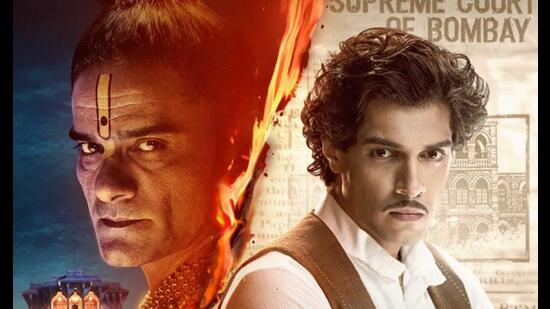
In the Karsondas Mulji centenary volume, Karsondas Mulji: A Biographical Study, editor-author BN Motiwala writes about the Vaishnava-Shaiva sectarian strife over some ritual, prologuing the Maharaj Libel Case in Bombay (now Mumbai, of course). To my mind, this resonates with what eminent historian Romila Thapar has been arguing about intra-religious conflicts happening across history, often violent and destructive. Even after Karsandas’s legal victory, Pushti Margi Vaishnava havelis kept operating as harems, as the minutes of the general meeting of the Kachhi Bhatias at New Halai Mahajan Wadi (Kalbadevi) very candidly reveal. (Bhatia Mahajan Sabha no Heval, published by Mulji Vidyaman Thackersey, Union Press, Mumbai, 1866, in Gujarati). In the meeting held on July 24, 1866, a member openly talks about maharajs indulging in sambhog (copulation) with women devotees, married and unmarried, in havelis. The film avoids such historical references. Though it generalises, what we see is the community of Halai Bhatias, hailing from around the region of Jamnagar.
Nevertheless, it nudges us to look retrospectively into the social-religious reformist oeuvre of Indian cinema, which, in fact, is substantial. Leading film production companies such as Prabhat Film Company (PFC) and New Theatres (NT) released bilingual (Marathi-Hindi, Bengali-Hindi) films that were re-comprehending the reformist Bhakti Movement. For instance, NT’s Bengali-language Chandidas (1932) was about the legendary 15th-century Bengali Vaishnavite poet. Puran Bhagat (in Hindi, 1933) was about the mythical Punjabi prince-saint. In PFC’s Marathi/Hindi Dharmatma (1935), Bal Gandharva essayed the life of Sant Eknath, who became an outcast thanks to the evil machinations of a mahant (this was the only male role Gandharva played in his entire career). Sant Tukaram (Marathi, in 1936) was about the 17th-century saint-poet who led a major emancipatory movement against Brahmanical caste domination. These were all pathbreaking B&W sound films. The 1952 Tamil language film Parasakthi is still cited as an example of cinematic representation of priestly sexual rampage and superstition. The film still resolutely provides us with the broad context in which socio-religious reformation films were made. Several such films can be found in Malayalam and Kannada, too.
{{/usCountry}}Nevertheless, it nudges us to look retrospectively into the social-religious reformist oeuvre of Indian cinema, which, in fact, is substantial. Leading film production companies such as Prabhat Film Company (PFC) and New Theatres (NT) released bilingual (Marathi-Hindi, Bengali-Hindi) films that were re-comprehending the reformist Bhakti Movement. For instance, NT’s Bengali-language Chandidas (1932) was about the legendary 15th-century Bengali Vaishnavite poet. Puran Bhagat (in Hindi, 1933) was about the mythical Punjabi prince-saint. In PFC’s Marathi/Hindi Dharmatma (1935), Bal Gandharva essayed the life of Sant Eknath, who became an outcast thanks to the evil machinations of a mahant (this was the only male role Gandharva played in his entire career). Sant Tukaram (Marathi, in 1936) was about the 17th-century saint-poet who led a major emancipatory movement against Brahmanical caste domination. These were all pathbreaking B&W sound films. The 1952 Tamil language film Parasakthi is still cited as an example of cinematic representation of priestly sexual rampage and superstition. The film still resolutely provides us with the broad context in which socio-religious reformation films were made. Several such films can be found in Malayalam and Kannada, too.
{{/usCountry}}The island city of the 1860s remains unexplored in Maharaj, which could have evoked it as the container of the historic event. Most of its architectural heritage still exists in the Kalbadevi-Bhuleshwar neighbourhood, dotted with many Hindu temples that retain their gorgeous architectural elan. I call this unique district of Bombay, a Hindu Vatican. The exact whereabouts of one of Karsandas’s key witnesses is given by Vahuji (the wife of the maharaj in Maharaj) when Karsandas meets her in her haveli. The address, written in Gujarati, on a slip of paper she gives to Karsandas is “Prakash Chamariya, near Bandu Kathiara’s shop, second house from right, Kumbharwada.” The still-existing Kumbharwada was then a sprawling potters’ colony. Dharavi came up later in 1884.
There are two differing opinions about Karsandas’s place of birth. In his memoir (1934), author Mahipatram Rupram Nilkanth mentions Vadal, near Mahua in Gujarat, but he is unsure about it. On the other hand, Motiwala categorically tells us it is Bombay where Karsandas was born. Maharaj begins with Vadal and not Bombay. The location, in the film, shifts to Bombay in 1842 when Karsandas was ten years old. This movement of history is drowned in the ubiquitous drone. According to Motiwala, between 1838 and 1843, Karsandas studied in the Primary Vernacular School. At the end of the film, as if they were an epilogue, documentary images of the real Karsandas Mulji, Dadabhai Naoroji, Bhau Daji Lad and others, as well the newspapers Rast Goftar (Truth Seeker), Satya Prakash (Light of Truth) and the buildings of the Supreme Court of Bombay, come to us as only a limping patchwork, failing to save the film’s necessary historicity. However, what is remarkable is Bhabhu, the widow, who makes the winning entry into the courtroom, as a witness in favour of Karsandas. In some sense, she is like Lagaan’s Kachra, who scores a hattrick in the game of cricket. In the sense of social ostracisation, both are untouchable in the caste-ridden, hierarchical society, but you can’t ignore them. They can change the balance.
Amrit Gangar is a Mumbai-based author, curator and historian.The views expressed are personal