The festive season has thrown a lid on the boiling cauldron that is Indian politics right now. Opposition to protests in the Capital during the Dussehra-Diwali period from trader associations mean that the protagonists of the ongoing story in the country’s politics — the Cockroach Janata Party (CJP), the Modi government, the Election Commission and the Congress — have some time to pause, regroup, and recalibrate.
But is there a storm coming after this lull? Or have things actually quietened down?
The challenges before the key players are varied, but clear.
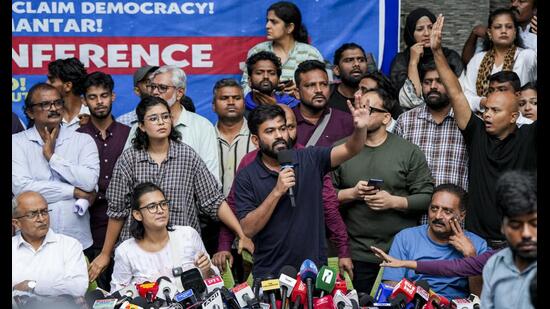
Let’s start with the CJP. Whether you like them, hate them, or are still to make up your mind about them, there can be no doubt that they have heralded the Age of Protest. Before the meme-turned-movement-turned-group gave a call for the street agitation against NEET question-paper leaks and Dharmendra Pradhan, who had to resign as education minister, Jantar Mantar was a barely-noticed, barely reported space. The CJP also forced other Opposition parties out of occasional conference-style tea parties onto the streets. While its ability to mobilise numbers without traditional party cadres is questionable, the sentiment rallying around it online remains palpable and strong. But how will it channel this and in what form? The CJP faces the dilemma and confusion of every amorphous protest movement in recent history. Does it become a formal electoral party? Does it embrace a stated, defined ideology? And if not, does it focus on a narrower set of issues — education and jobs — or does it become an all-issues pressure group. If it chooses the latter path, will it still have the same traction? Abhijeet Dipke and his supporters have stressed that their campaign is not for “regime change” — after remarks by prominent supporters of the outfit that endorsed regime change through the electoral process as a long-term outcome of the movement — but because Dipke was at the same press conference where these remarks were made, the dissociation became complicated. Yes, the remarks — on which the Congress has since doubled down — referenced a change via the ballot and not a violent overthrow of any government. But the BJP found much-needed ammunition in those remarks. It’s similar to how Arvind Kejriwal faced challenges in the India Against Corruption agitation when the Left and the Right came together in a confusing, often contradictory mish-mash. Dipke and his comrades began as a non-partisan, non-electoral entity. If they are now in the Opposition club — though the CJP and the Congress have not yet marched together — is it only a matter of time before they become a party?
For the Congress, some of the questions are similar to those the CJP faces. While Rahul Gandhi was among the earliest to protest against the Election Commission (EC) and the Special Intensive Revision (SIR) exercise, it was not until the CJP made the idiom of agitation popular that his comments started getting a different kind of attention. Gandhi has very consciously kept the Congress protests distinct from those of the CJP. He has deftly brought some protesters from the CJP agitation to his own press briefings without actually endorsing the CJP. While he has said there are no parallel protests, the distinction — and the distance — is unmissable. Will Gandhi and Dipke march together in the way that the former did with AISA leader Neha Bora? Gandhi’s decision to push the young Left leader to the front of the line alongside sister Priyanka caused some heartburn within the Congress and debate outside it. Some supporters wanted to know why Sachin Pilot or Deepender Hooda, who mobilised numbers for the INDIA bloc marches, were not given the same prominence. Others debated whether Bora was the right pivot for the party given her ideological leanings, despite her evident charisma and massive online popularity. Finally, if chief election commissioner Gyanesh Kumar does not resign — which increasingly seems the case — given that elections in Punjab, Uttar Pradesh, and Uttarakhand are now just a few months away, how will the Congress navigate this conundrum?
{{/usCountry}}For the Congress, some of the questions are similar to those the CJP faces. While Rahul Gandhi was among the earliest to protest against the Election Commission (EC) and the Special Intensive Revision (SIR) exercise, it was not until the CJP made the idiom of agitation popular that his comments started getting a different kind of attention. Gandhi has very consciously kept the Congress protests distinct from those of the CJP. He has deftly brought some protesters from the CJP agitation to his own press briefings without actually endorsing the CJP. While he has said there are no parallel protests, the distinction — and the distance — is unmissable. Will Gandhi and Dipke march together in the way that the former did with AISA leader Neha Bora? Gandhi’s decision to push the young Left leader to the front of the line alongside sister Priyanka caused some heartburn within the Congress and debate outside it. Some supporters wanted to know why Sachin Pilot or Deepender Hooda, who mobilised numbers for the INDIA bloc marches, were not given the same prominence. Others debated whether Bora was the right pivot for the party given her ideological leanings, despite her evident charisma and massive online popularity. Finally, if chief election commissioner Gyanesh Kumar does not resign — which increasingly seems the case — given that elections in Punjab, Uttar Pradesh, and Uttarakhand are now just a few months away, how will the Congress navigate this conundrum?
{{/usCountry}}Now, to the Modi government. The BJP seems to have recovered some of its aggression over the last week or so, pouncing on the talk of regime change and Bora’s congratulatory video for the Bangladesh Socialist Student Front. Bora issued a detailed clarification that the Left student body she was congratulating across the border has taken a strident position against religious fundamentalism and jihadists. She argued that a truncated video has been circulated to distort her message. But the BJP and its supporters have used her remarks and those referencing regime change to try and build an impression among fence-sitters and floating voters that the protesters want anarchy and de-stabilisation. More time is needed to judge whether this approach is working. The same holds for the government’s heavy-handed approach against the CJP. While holding Saurav Das and Ashutosh Ranka of the CJP in judicial custody for seven days may have tied them and the CJP in some legal knots and forced the commitment from the two that there will be no more calls for protest at Jantar Mantar, it remains to be seen if this reinforces a David vs Goliath narrative? Has it provided more attention to the CJP’s young leaders, as former Tamil Nadu state BJP chief Annamalai has alleged? The BJP faces the problem of being the establishment for an entire generation of youngsters anxious about jobs and the economy. They need fresh faces, younger faces in their arsenal and some creative communication. But, with key Assembly elections just months away, the party is likely to make the electoral race the focus and will be banking on winning in Uttar Pradesh to set the narrative once again on its own terms. It will also be interesting to see if the party actually makes another attempt at delimitation and women’s reservation in a special session of Parliament, returning the news cycle to the floor of Parliament instead of the street.
That leaves the EC. The EC is stepping back from some of its most contentious decisions. The new declaration for Form 6 for new voters has been scrapped for non-SIR states. “Logical discrepancies” that led to deletions from the voter list in Bengal led to issue of notices in Delhi, but 79% of 3.3 million notices sent to Delhi’s voters have been “resolved”, according to the commission. The EC also instructed booth level officers (BLOs) to do door-to-door visits instead of asking flagged voters to appear for physical hearings. The pressure from the street has had a corrective impact. The EC leadership’s future now rests with the Supreme Court, which has issued notices to the poll panel in response to a clutch of petitions, including one by Rahul Gandhi and INDIA bloc leaders.
In short, Happy Diwali and await the next phase of political fireworks in November.
Barkha Dutt is an award-winning journalist and author. The views expressed are personal