“The land north of the ocean and south of the snowy mountains is called Bhārata, where the descendants of Bhārata dwell.”
— Vishnu Purana
In February 2016, Prime Minister (PM) Narendra Modi bent down and touched the feet of a woman more than a hundred years old. Kunwar Bai Yadav of Kotabharri village, in Chhattisgarh’s Dhamtari district, owned about two dozen goats, the savings of a long life. She sold seven of them to build a toilet at home. Her example helped her village end open defecation, and a woman past 100 years of age became one of the many faces of the Swachh Bharat Mission.
Walk into any household in India, and four things decide whether life is secure: the kitchen, the toilet, the doctor’s bill, and the means to earn. For generations, each was a source of either drudgery or dread: smoke in the kitchen, a long wait for nightfall, a debt that could swallow a lifetime’s savings, and a moneylender’s ledger because no bank would lend against so little.
Far out in the Andamans, A Venkatalakshmi used to cook on a wood-fired chulha. In the monsoon, there was often no dry firewood, and the smoke made her children ill. One day, she heard about Ujjwala from her neighbours, applied for and got a gas connection.
In the hills of Meghalaya, at Umsning near Shillong, Pooja Thapa needed surgery for kidney stones. She paid nothing for it. In May 2020, she became the 10-millionth patient treated under Ayushman Bharat.
And in Manali, a woman who sold vegetables took a Mudra loan of ₹2.5 lakh in 2015-16, with no collateral to offer. She repaid it, and lenders then trusted her with ₹5 lakh, ₹10 lakh and ₹15 lakh. Today, she runs a ration-shop of her own. In April 2025, she shared with the PM her story of how Mudra has become a silent revolution.
{{/usCountry}}And in Manali, a woman who sold vegetables took a Mudra loan of ₹2.5 lakh in 2015-16, with no collateral to offer. She repaid it, and lenders then trusted her with ₹5 lakh, ₹10 lakh and ₹15 lakh. Today, she runs a ration-shop of her own. In April 2025, she shared with the PM her story of how Mudra has become a silent revolution.
{{/usCountry}}Four women, from the Andamans to the hills of Meghalaya, from a village in Chhattisgarh to a market in Manali, none lacking in aspiration — what they lacked was access, to clean fuel, to sanitation, to a hospital bed, and to credit. For decades, the poor were treated as recipients of doles, handed relief without choice or voice. Development was measured by the growth rate, and only rarely by the life of a single home.
Our nation-builders never accepted that measure. Mahatma Gandhi wanted an India “in which the poorest shall feel that it is their country in whose making they have an effective voice.” Babasaheb Ambedkar measured a community’s progress by the progress of its women. Pandit Deendayal Upadhyaya called the idea antyodaya, the rise of the last person. A nation is judged not by those at the top of the ladder but by those on its lowest rung.
PM Modi has turned this philosophy into a method of government. Its focus is the poor, women, the young and farmers. Its standard is saturation — not merely a showcase village or a sample district but every eligible household. Its instrument is direct delivery, so that what the State sends is what the citizen receives. In 1985, PM Rajiv Gandhi admitted that only about 15 paise of every rupee meant for the poor reached them. Today, through Jan Dhan, Aadhaar and the mobile phone, nearly ₹50 lakh crore has gone straight into beneficiaries’ accounts. The scale has no parallel in any democracy. NITI Aayog estimates that nearly 250 million Indians left multidimensional poverty in the decade to 2022-23. The governance objective in India no longer means only sustenance for the poor. It aims to set them on their feet.
This is shift from welfare to empowerment. Each scheme removes one barrier. Together, they form a ladder: from security to capability, from capability to opportunity, from opportunity to self-reliance, and, finally, to participation. Four programmes show that climb most clearly.
Ujjwala began in the kitchen and ended up changing the household. Launched from Balia in May 2016, it gave deposit-free LPG connections in the names of women from poor families and has now reached more than 105 million homes. LPG connections across India have grown from about 145 million in 2014 to over 330 million, and a NITI Aayog evaluation this year found that nearly 87% of Ujjwala households now cook mainly on gas. Suksho, who got her connection in 2019, used the hours once spent gathering fuel to grow vegetables with other women, “earning not just income, but respect”. A gas stove gave a woman back her time, and she turned that time into enterprise.
Swachh Bharat restored something no budget line can measure: dignity. When the PM picked up a broom on Gandhi Jayanti in 2014, fewer than four in ten rural homes had a toilet. By Gandhi’s 150th birth anniversary in 2019, rural India was declared open-defecation free, and nearly 120 million household-toilets have now been built. The Centre asked states to call them izzat ghar (homes of dignity): A daughter need no longer wait for nightfall. The World Health Organization estimated that the mission averted more than 300,000 deaths between 2014 and 2019. Sanitation stopped being a government target and became a matter of family honour. Since then, the mission has moved on from building toilets to keeping villages clean overall. Today, over 569,000 villages are Open Defecation Free Plus and 4,692 cities are open-defecation free.
Ayushman Bharat took away the fear that one illness could undo a lifetime’s savings. Since 2018, it has given eligible families cashless hospital cover of up to ₹5 lakh a year, and since 2024, it has covered every Indian aged 70 years or more, whatever their income. More than 450 million Ayushman cards have been issued and more than 120 million hospital admissions covered. The share of health spending that families pay from their own pockets has fallen from 64% in 2013-14 to about 43% in 2022-23. For a poor family, an operation like Pooja Thapa’s once meant selling land or borrowing at a ruinous interest rate. Health security is the floor on which every other kind of security stands.
Mudra did for ambition what Jan Dhan did for savings: It opened the doors of the bank. Launched in 2015 to fund the unfunded, it lends without collateral to the tailor, the vegetable seller and the small workshop that banks once ignored. Even its loan names tell the story of a business growing up: Shishu, the infant, up to ₹50,000; Kishore, the adolescent, up to ₹5 lakh; Tarun, the young adult, up to ₹10 lakh; and now Tarun Plus, up to ₹20 lakh. The Manali vegetable seller’s journey is that ladder climbed in real life. More than 590 million loans, worth ₹41.71 lakh crore, have been sanctioned, about two-thirds of them to women. Each loan is a vote of confidence in the ordinary Indian’s ability to build something of her own, and to employ others. And this credit comes through India’s own Mudra Card, a RuPay card, which ensures that the data of all transactions remains within India. Built by the National Payments Corporation of India (NPCI), more than 410 million Jan Dhan account holders carry this indigenous RuPay card, which carries free accident insurance of up to ₹2 lakh. With no merchant fee on RuPay payment cards, even the smallest shop can accept digital payments. A network built to empower the last mile is now accepted globally, from Singapore to the UAE and over 180 other countries worldwide. RuPay Card is locally built but globally compatible.
Beneath all this lies economic transformation of a scale India had never seen. In rupee terms, the economy has more than tripled since 2013-14, to ₹331 lakh crore, and the IMF still counts India as the fastest-growing major economy. It took nearly seven decades to build 74 airports; the years since 2014 have added 91 more. Mobile phone exports, a mere ₹1,500 crore in 2014-15, crossed ₹2.59 lakh crore in 2025-26.
What makes this growth different is who carries it. Roads take a farmer’s produce to distant markets, and data that costs 97% less than it once did lets a weaver sell to a buyer she will never meet. What the mobile phone brings — less travel, less waiting, and less cost — the PM calls “the greatest citizen dividend that technology can deliver.” More than 223,000 recognised startups have created over 2.3 million jobs, and women’s participation in the workforce has nearly doubled in six years. Growth was once something that happened elsewhere; now, ordinary Indians make it happen. The citizen has become an enabler of Viksit Bharat, not a spectator of it. “The bedrock of a Viksit Bharat,” the PM says, “is also a self-reliant Bharat.” Nowhere is the climb clearer than among women. More than 30 million rural women have become Lakhpati Didis through self-help groups, with incomes of at least ₹1 lakh a year; the target is to expand this pool to 60 million. More than half of all Jan Dhan accounts belong to women. A woman who owns a house, holds an account, and runs a business speaks differently in the gram sabha, and under the Nari Shakti Vandan Adhiniyam, a third of the seats in the Lok Sabha and state assemblies will be hers.
This is why the change runs deeper than any single scheme. Daron Acemoglu and James Robinson, who won the 2024 Nobel prize in economics, showed that nations prosper when their institutions are inclusive. A bank account in every home, money that moves without a middleman, and a ration card that works for a migrant worker in any state are inclusive institutions, built at a scale no country has attempted before.
When citizens see that the nation works for them, their sense of belonging deepens, and that belonging becomes the foundation for the next round of reform.
Empowerment is still not the summit. Sherry Arnstein’s ladder of citizen participation rises from tokenism, where citizens are merely informed, to partnership, where they share power. For many decades, Indian welfare stood on the lower rungs. Swachh Bharat helped begin the climb, as a people’s movement carried by village councils, schoolchildren and women like Kunwar Bai. The PM calls this sabka prayas, the effort of all, and jan bhagidari, the people’s share in governance. In such a nation, citizens are no longer passive consumers but the active producers of the economic and political capital.
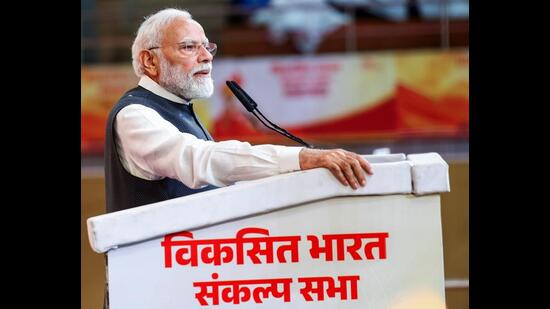
This is the heart of the PM’s vision of Viksit Bharat: inclusive by design and collective by necessity. The resolve for a Viksit Bharat will be fulfilled only when development reaches the last person. For the PM, the four biggest “castes” are the poor, the young, women and farmers. He added sabka prayas to sabka saath, sabka vikas, sabka vishwas, because “Viksit Bharat has to be built only through sabka prayas.” He has called the years to 2047 “Kartavya Kaal”, an age of duty. He has time and again emphasised that Viksit Bharat will be made with the contribution, efforts and participation of the 1.4 billion people of our nation. It will be built by the farmer who tries a new seed, the teacher in a remote school, the young founder in a small town, the woman whose SHG becomes a business, and the citizen who keeps a street clean, casts her vote and helps a neighbour claim what is hers. The Viksit Bharat Sankalp Yatra carried schemes to the village gate, and young Indians were invited to shape the Viksit Bharat @2047 vision. To them, the PM gave a single compass: “The aim of your goals, your resolutions should be only one: Viksit Bharat.” This is a nation to be made by many hands.
History shows that nations such as Japan, South Korea, Singapore and China achieved unprecedented progress only when each gave its last citizen something to own, something to learn, or something to decide. PM Modi has said, “India’s defining moment is now. This is the period in the history of India when the country is going to take a quantum leap.” That leap must be made with the consent of the governed. That is why the goal is not only Viksit Bharat (a developed India), but Sashakt Bharat (an empowered India).
Dr APJ Abdul Kalam asked Indians to dream, because dreams become thoughts and thoughts become action. This has been lived in its truest sense by PM Modi, who has always worked for antyodaya; in thought, behaviour, and action, he has worked towards upliftment and empowerment of last mile. The dream of 2047 now has a working method: Put the last person first, reach every eligible household, and judge every scheme by what changes inside that home. There are, as Robert Frost wrote, “miles to go before I sleep,” and the journey will be complete only when every citizen has some ownership in it.
Kunwar Bai Yadav passed away in 2018, at the age of 106. With seven goats, she bought her family its dignity, and her example moved a whole village. India’s journey from welfare to empowerment has been long, but the last decade changed its scale. Schemes give citizens like her the tools to build the nation. When welfare becomes empowerment, and empowerment becomes participation, development stops being something done for people and becomes something done by them — in India’s case, by all 1.4 billion of them. That is nation building in the truest sense. That is the Bharat we are building together: not only Viksit, but Sashakt.
Jyotiraditya Scindia is Union minister of communications and minister of development of north eastern region. The views expressed are personal