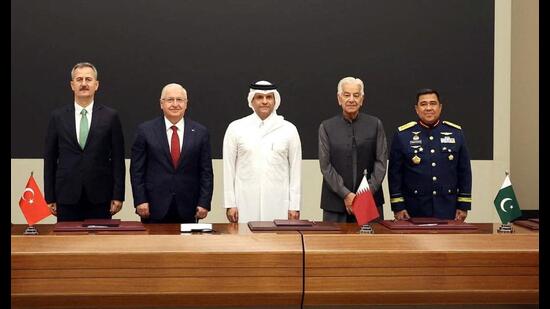
On October 21, the defence ministers of Pakistan, Turkey, Qatar, and Indonesia signed the Badr Memorandum of Understanding, a project to jointly develop defence equipment. It caps a year of several geopolitically important moments for Islamabad. Recall that in August this year, Pakistan, Saudi Arabia and Turkey signed the Mecca Joint Defence Agreement, which treats an armed attack on one as an attack on all three, even if, so far, only on paper. And last week, the Maldivian President spent three days in Islamabad, the first visit to Pakistan by a head of State of the island-nation in 11 years. Further, Pakistan and its army chief, Asim Munir, continue to be US President Donald Trump’s favourites.
It would seem, then, Pakistan is doing extremely well geopolitically, and India is on the back foot. But that may be a short-sighted take.
To be fair, let me acknowledge the obvious first. These agreements do carry some geopolitical weight. The Mecca pact has already moved beyond the signing ceremony: The three countries have agreed to activate deterrence measures and deploy forces to Saudi Arabia against the Houthi attacks, and Turkey has sent the pact to its Parliament for ratification. The symbolism of the pact, too, has its uses — for signalling relevance, drawing in money, and, surely, complicating India’s planning and preparedness. The next time there is a crisis on the Line of Control, New Delhi will have to account for the Saudi treaty commitment to Pakistan that did not exist two years ago. Saudis may or may not come to Islamabad’s aid, but that’s not the point. The point is that New Delhi can’t afford to ignore it. In that sense, the treaty makes the unlikely less unlikely.
And yet, it is important to ask what exactly gives Pakistan the ability to get what it does from time to time. The answer is its geographical location. Located at the intersection of South Asia, West Asia, and Central Asia, with a large army and a nuclear arsenal, it does have some utility for its partners — at least, on the face of things. So, when the US is at war with Iran and Gulf monarchies are under fire, Pakistan’s stock has risen. In other words, Pakistan’s real value is also a function of other people’s crises, and, therefore, it falls when those crises end.
{{/usCountry}}And yet, it is important to ask what exactly gives Pakistan the ability to get what it does from time to time. The answer is its geographical location. Located at the intersection of South Asia, West Asia, and Central Asia, with a large army and a nuclear arsenal, it does have some utility for its partners — at least, on the face of things. So, when the US is at war with Iran and Gulf monarchies are under fire, Pakistan’s stock has risen. In other words, Pakistan’s real value is also a function of other people’s crises, and, therefore, it falls when those crises end.
{{/usCountry}}Pakistan has had moments of geopolitical relevance like this before. In the 1950s, for instance, it joined SEATO and the Baghdad Pact when India decided to stay non-aligned; three decades later, the war against the Soviet Union in Afghanistan brought it American money and arms (as well as social rupture within Pakistan); it became an important part of America’s war on terror after 9/11. To be clear, Pakistan’s stocks rose when the region was not in peace. Very little of such opportunities was converted into building an economy at home, though. Pakistan has never been able to become — or even seen as — an important stabilising power in the region because it rides on the back of chaos, not prosperity. In a peaceful world, Pakistan’s geopolitical importance diminishes.
This is where Pakistan’s contrast with India becomes sharper, and it must be noted by those in India who feel uneasy about what Pakistan has been able to supposedly achieve. India has been doing things more slowly, thoughtfully, and more consequentially. Let me highlight three features.
The first is the time horizon. India’s major engagements of the past two years, to take a similar time frame, are investments meant to mature over a decade or more. Trade agreements take years to create dividends, defence co-production takes longer still, and minilaterals take time to identify areas of mutual interest and work on them. None of them produces dramatic photographs or moments or the attention received by, say, the Mecca agreement.
The second feature is the choice of India’s partners. India’s FTAs are with the UK, New Zealand, the EU, Australia, and the US, among others. Qatar, Turkey and Indonesia matter in their regions; India’s partners are nations/blocs that will shape the future of the global economy.
The third feature is the foundation of India’s power. India’s defence exports reached a record ₹38,424 crore in 2025-26, up 62% from the previous year. GE Aerospace and Hindustan Aeronautics will produce the F414 fighter engine in India, itself one of the most ambitious technology-transfer arrangements India has negotiated with the US. Companies commit to co-production in a country when they expect to be around for decades. These things compound over time, eventually becoming a country’s strategic weight.
You might ask, and rightly so, that if India’s ties with the US and others are now much deeper, why is Washington warming to Islamabad? This is likely why: In a crisis, the country that is useful in the immediate context and geography gets attention and is courted — Pakistan has always been very good at making itself useful in a crisis. Durable economic ties and defence production partnerships cannot find themselves in every news cycle.
That said, India should also be careful not to oversell the importance and weight of such ties and partnerships because it continues to be a net importer of arms and its trade agreements will take time to deliver.
However, a State can only build lasting influence on what others need from it over time, not immediately. It is that kind of influence and power that India is building, even if unevenly.
So, while we focus on how a Saudi commitment to Pakistan would play out in an India-Pakistan crisis, and whether the Badr brothers end up sharing what they learn about Indian systems, we should keep our nerve and resist the temptation to match Islamabad’s headlines. Pakistan likes to be on the right side of events. India should build power to be on the right side of history.
Happymon Jacob is the author of India After Nonalignment and editor, INDIA’S WORLD magazine. The views expressed are personal