Can fashion give us the theory of everything? (Stop reading if you happen to be a fashion denier. Or maybe swallow your pride and go on!) The answer is a resounding, enthusiastic yes. How and why people clothe themselves is not just a matter of vain curiosity; it tells us everything about the arts and the science of their life and times. Human beings are storytellers first, and everything else follows. Sartorial choices and compulsions, therefore, are stories written on bodies.
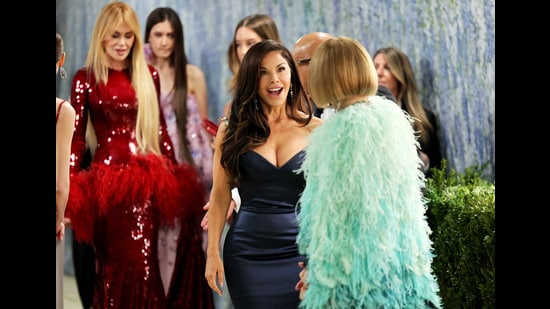
The fashion press is still recovering from two global events — the Met Gala and the Cannes Film Festival — which draw even the most uninterested towards the clothes conversations. The unaffordability of what is displayed on the red carpet may appear to be a weapon for the fashion denier, but that’s exactly the story of our times. Many of us are aware that those who grace the red carpet rarely pay for the outfits they wear. It’s part of their glamour perk. Those who admire the “looks” on their screens will likely pay through their noses, setting in motion the economic wheels. Such is the power of fashion: visual, aspirational, erotic. The bodies of the red carpet celebrities exist in the domain of desire. When the luxury house lends the outfit, the algorithm amplifies the paparazzi image, and the fast-fashion factory produces the approximation within weeks, desire comes full circle in the embrace of capitalism. They become a power couple.
French sociologist Pierre Bourdieu is very clear about the power of the elite being manifested through “taste”. Taste, for Bourdieu, is never innocent. It is the elite’s most elegant weapon, presenting social domination as natural discernment, almost bordering on eugenics. Being tasteless is a crime in aesthetics, not law, leading to exclusion. But why do we still have very “badly dressed” billionaires?
{{/usCountry}}French sociologist Pierre Bourdieu is very clear about the power of the elite being manifested through “taste”. Taste, for Bourdieu, is never innocent. It is the elite’s most elegant weapon, presenting social domination as natural discernment, almost bordering on eugenics. Being tasteless is a crime in aesthetics, not law, leading to exclusion. But why do we still have very “badly dressed” billionaires?
{{/usCountry}}Because only they can afford to. They cannot be excluded by the gatekeepers because they are what the gates are leading to. There was a meme not so long ago on Instagram that declared, “You are not ugly, just poor”, highlighting how money makes ugliness vanish. From surgeries to treatments to makeup and attire, there’s everything on the shelf that a Cinderella — of any gender — needs for their transformation. But some do not need this fairytale because they are the ones facilitating it.
Long before the UK tumbled down from its influencer status in the world, the royalty could be seen wearing darned clothes, nonchalantly repeated at high-profile events. The coat does not need to be new when the castle is centuries old. Jay Ravitz, the new boss in the Devil Wears Prada universe, can afford to strut around the legendary fashion magazine in polyester workout clothes because, yes, he can. He doesn’t thrive on Noam Chomsky’s idea of manufactured consent. It is the opposite. It is the deliberate withdrawal from the consensus, possible only for those whose position requires no sartorial proof. Old money, old influence doesn’t need to signal novelty. It moves around commanding reverence with an old face, atop an old body dressed in old clothes.
There have been broadly two categories of people shopping at flea markets and thrift stores: those who can’t afford anything at a luxury store and those who can buy the entire store. A third category is emerging steadily — those who can afford a scarf here or a shoe there, but must build entire wardrobes of luxury for signalling purposes. This aspirational middle is perhaps the most revealing category of all. People belonging to it are the most anxious. They are neither secure enough to dress down nor wealthy enough to dress without consequence. They must hide their backgrounds, just like their unfashionable parents. Fashion, for them, is a continuous proof of arrival in a world that keeps moving the finish line.
Taking Roland Barthes’s idea of fashion being a language, therefore, let’s conclude that it is a language of belonging and mobility. If one is not a native speaker, this language must be acquired anyhow.
Nishtha Gautam is an academician and author. The views expressed are personal