Monet Roy Saha, the 43-year-old director of the Bengali film Prakriti, is a sculptor and filmmaker based in Mumbai, Kolkata and Agartala, Tripura, his hometown. The artist’s eye in every frame of Prakriti is unmistakable.
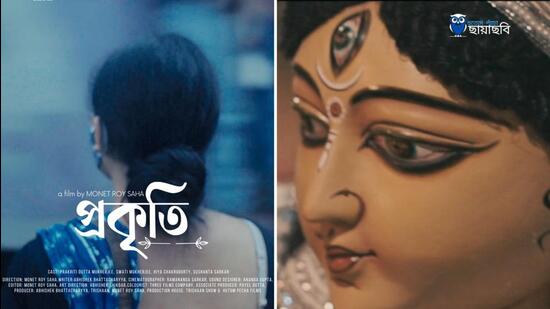
Last leg of the pandemic. Instead of the usual frenetic bustle and high-decibel street noise of Kolkata, there is a gentle return to normalcy. Masked-up humans are still the norm. The film opens with a languorously pretty montage of Durga idols being carefully crafted by
Monet Roy Saha, the 43-year-old director of the Bengali film Prakriti, is a sculptor and filmmaker based in Mumbai, Kolkata and Agartala, Tripura, his hometown. The artist’s eye in every frame of Prakriti is unmistakable.
Last leg of the pandemic. Instead of the usual frenetic bustle and high-decibel street noise of Kolkata, there is a gentle return to normalcy. Masked-up humans are still the norm. The film opens with a languorously pretty montage of Durga idols being carefully crafted by male hands, before we enter the home of the protagonist Aditi (Prakriti Dutta Mukerjee). Another montage of still frames — neat, silent and still, until a violent noise interrupts the house’s eerie stillness. We see Aditi, a school teacher, with scars — physical, and in turn, emotional. While taking her online class, she has to grapple with a question one of her adolescent students ask: Who is a criminal? Her answers lead her to the principal’s office.
Abuse, torment and silent tolerance of male abuse — these themes unravel through this short film in an unhurried, restrained language. The visuals are as eloquent as Aditi’s expressions and words. The backdrop of preparing to welcome the goddess with devotion and fanfare is a contrast tool in the screenplay written by Abhishek Bhattacharyya. Ramananda Sarkar’s cinematography soaks up the urban sensorium that is a Kolkata autumn.
Saha, who has been collaborating with Bhattacharyya since their school days in Tripura (Bhattacharya has a corporate career), says, “The idea came from what human beings universally faced during the pandemic: relationships started breaking down. There are official numbers to prove that domestic violence cases peaked during the pandemic. And the stress and anxiety levels of teachers were also very high. We wanted to combine both those realities in this film.”
Saha had his primary art education as a sculptor — both his parents are Agartala-based sculptors too — at Kolkata’s Rabindra Bharti University which housed Jora Shanko, the home of Tagore. “It is my favourite city, and after the pandemic I had to be there. While there, I spent a lot of time at Kumartuli, the place where Durga idols are made. We filmed there without any structure or plan,” Saha says.
Prakriti Dutta Mukerjee, a Kolkata-based actress, took two the script with enthusiasm and brought her own energy into it, and the filming was done with a Sony digital camera over a few days inside a home and on the streets of Kolkata.
Saha’s art education at Rabindra Bharti University and the Delhi College of Art, followed by a degree in animation from the Film and Television Institute of Indian (FTII), Pune, perfectly coalesce in Prakriti — a painterly eye, and minimalist storytelling. The film has been screened in Mumbai and other cities, and at the Delhi International Film Festival in 2024.
Saha’s next is a bi-lingual feature film (Bengali and Kokiborok, a tribal language of Tripura) releasing in November 2025 — about a freedom fighter who gets displaced in his own country. At home in Kolkata as well as Mumbai, Saha’s signature is highly cinematic — a rarity and a thing of great value in the age of AI.
“Kolkata is a city of craft, Mumbai is about opportunity and hope. I need both, although Kolkata is still my inspiration,” Saha says.
Prakriti is an ode to his inspiration. In a short span, Kolkata comes alive in several evocative frames in Prakriti.
DETAILS:
Producers: Abhishek Bhattacharya, Trishaan & Monet Roy Saha
Budget: ₹2.25 lakh
Language: Bengali
Running time: 16 minutes
Short Stream is a monthly curated section, in which we present an Indian short film that hasn’t been seen before or not widely seen before but are making the right buzz in the film industry and film festival circles. We stream the film for a month on HT Premium, the subscription-only section in hindustantimes.com. Sanjukta Sharma is a Mumbai-based writer and film critic. Write to her at sanjukta.sharma@gmail.com.
One Subscription.
Get 360° coverage—from daily headlines
to 100 year archives.
Archives
HT App & Website