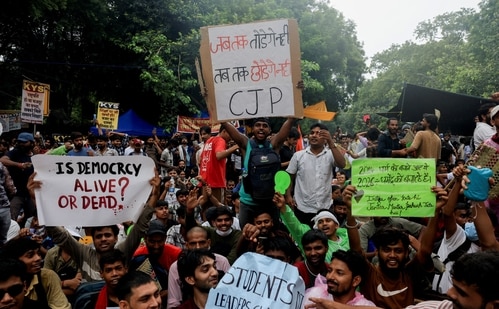
Now that the streets of the Jantar Mantar neighbourhood are no longer reverberating with sounds and sights labelled obscene and unacceptable by some, it’s a good time to analyse the politics of hurt sentiments and sensibilities. Both supporters and decriers of the Gen Z protests against the NEET paper leak have underscored the novelty of the protests — the chants, memes, and dances that used ridicule effectively to make a point. Enough has also been said about the essential hypocrisy of those using the excuse of foul language to discredit the protest.
Profanity and literature
Let’s first shine a spotlight on the deployment of obscenity in this protest’s language. And let’s start from antiquity, since we are all talking about The Odyssey, even if we haven’t read a word of the poem. One of the most powerful anti-war pieces of literature, Lysistrata, was written by Aristophanes in 5th-century Athens, a city synonymous with culture and sophistication. One only has to flip through the pages of his various plays to understand how profanity has always been a legitimate form of protest, and everyone is fair game. Aristophanes did not spare even Socrates, one of the founding fathers of the Western intellectual tradition, and lampooned him along with other notables of Greek society. He had zero qualms about using vulgar language or sexual references and depictions in his work. Profane language, he rightly understood, is powerful; it is emotional as well as offensive. It allowed him to use absurdity as dissent. This old comedy of Aristophanes laid the foundation for the radical Theatre of Absurd — a movement against the limits of acceptability.
Even William Shakespeare used profanity liberally. Perhaps, if the protestors had used the Bard’s colourful language, they might have escaped scrutiny, as few would have understood the meaning. It’s the usage of vernacular expletives and colloquialisms that has irked the flagbearers of politeness. They may do well to look up the indigenous traditions of Nautanki in the Hindi heartland, a performing art at the forefront of the Independence struggle in India. The power of the folk invective was unleashed to propel dissent against the British. The audience clapped and cheered heartily whenever the colonisers were called names in a performance. Solidarity was built through a shared parlance of irreverence and ridicule.
The Jantar Mantar performance
{{/usCountry}}Even William Shakespeare used profanity liberally. Perhaps, if the protestors had used the Bard’s colourful language, they might have escaped scrutiny, as few would have understood the meaning. It’s the usage of vernacular expletives and colloquialisms that has irked the flagbearers of politeness. They may do well to look up the indigenous traditions of Nautanki in the Hindi heartland, a performing art at the forefront of the Independence struggle in India. The power of the folk invective was unleashed to propel dissent against the British. The audience clapped and cheered heartily whenever the colonisers were called names in a performance. Solidarity was built through a shared parlance of irreverence and ridicule.
The Jantar Mantar performance
{{/usCountry}}In addition to the verbal ridicule, the Jantar Mantar protest leaned on what celebrated playwright Bertolt Brecht called gestus — a powerful combination of body language, social attitudes, and linguistic tone. The majority at the protest may not have heard of either Brecht or gestus, but put up a successful epic theatre. The stylised expressions — physical, verbal, and tonal — were clear in their messaging, without evoking any deep emotional response.
Any protest is as successful as the neatness of its performance. The week-long theatricality of dissent had almost no loose ends. The intent, lampooning the powers that be, was conveyed and received effectively through a shared audio-visual vocabulary that transcended distance through digital media.
Why Jantar Mantar was successful
Some critics of this student protest have likened it to a mela, a carnival. And they are absolutely right. This protest indeed was a carnival, and that’s the reason it was successful. Mikhail Bakhtin’s concept of the carnivalesque was on full display here. A Babel-like space resonating with innumerable voices, the protest site was a meeting ground for diverse ideas, ideologies, and their respective expressions.
Even silence was a voice to be reckoned with. The very absence of a monolithic idea, a central control room, and order stopped this protest from turning into an ideological cult on the streets. The circus-like energy challenged everyone’s presuppositions on what seriousness achieves and to what extent it has already been rendered redundant by a system that becomes serious only selectively, sporadically.
The atmosphere of irreverence and a sense of play, a break from the general solemnity of protests, has also been criticised as a symptom of the trivialisation of important issues. But who dares banish joy from dissent? Laughter is a potent tool for registering protest. Nobel laureate playwright and actor, Dario Fo, one of the revivers of the ancient Italian commedia dell’arte, used laughter to resist any and all forms of authoritarianism. He also resurrected the spirit of the giullari, the medieval jesters, in his works to undermine hierarchies, both in politics and literature. One of Fo’s most controversial pieces was Isabella, Three Sailing Ships and a Con Man, in which he attempted to, in his own words, “dismantle a character who had been embalmed as a hero in school history books…who tries to keep afloat within the mechanisms of power, play games with the King and be cunning with power figures, only to end up reduced to a wretch”. Predictably, he received threats, and one of his performances was disrupted by a bomb scare.
Fo began his Nobel acceptance speech by saluting the purveyors of laughter, the jesters — calling himself one — who were once seen as such a serious threat by the enlightened state of Sicily that a law against them was passed in 1221. Fo said, “The law in question allowed any and all citizens to insult jesters, to beat them and even — if they were in that mood — to kill them, without running any risk of being brought to trial and condemned.” When speech is curbed with censorship, when jokes beget judicial action, and when comedy becomes a crime, laughter, indeed, becomes the most powerful weapon, especially for those who have nothing else to fight with. Fo’s Nobel acceptance speech could very well have been delivered from Jantar Mantar “This absent-mindedness on the part of the young has been conferred upon them by those who are charged to educate and inform them: among the absent-minded and uninformed, school teachers and other educators deserve first mention.”
Laughter strips power of its pretenses. Caricatures deflate figures of authority. Protests need not be solemn. Maybe what transpired in Jantar Mantar was a satirical farce, a form that rejects catharsis in favour of keeping the anger and the angst alive. The cause may be sombre, but how it is championed doesn’t have to look or sound that. Laughter is resistance at its best and, as demonstrated across time and space, quite effective. If it is offensive now it’s because for the first time in years, the monopoly over the profane and the offensive has been challenged. And how!
The views expressed are personal