
 E-Paper



Photos: On the front lines of climate change in the world’s northernmost town
In Svalbard, the fastest-warming has led an average annual temperatures increment by 4 degrees Celsius, with winter temperatures rising more than 7 degrees and Since 1979, the Arctic sea ice extent has declined by nearly 12% per decade, with the most pronounced winter reduction in the Svalbard and Barents Sea area. As glaciers are melting and temperature is rising people fear that the change in climate may be the end of humanity.
Updated on: Sep 05, 2019 10:52 AM IST

Share via


Copy link

1/10

 View Photos in a new improved layout
Updated on Sep 05, 2019 10:52 AM
Husky dogs pull a rig and musher Audun Salte through the town of Longyearbyen in Svalbard, Norway. Icebergs float liked doomed islands past the small boat as it makes its way through a fjord filled with the slush of a melting glacier. Occasionally, as the warming waters dissolve the bottom of one of the icebergs, it becomes top-heavy and does a somersault, as if it were playing instead of dying. (Hannah McKay / REUTERS)
2/10
 View Photos in a new improved layout
Updated on Sep 05, 2019 10:52 AM
The Wahlenberg glacier above the fjord naturally calves, sheering off icebergs into the water. But here it is happening at an increasing rate because of warming waters, says Kim Holmen, the international director of the Norwegian Polar Institute. (Hannah McKay / REUTERS)
3/10
 View Photos in a new improved layout
Updated on Sep 05, 2019 10:52 AM
Holmen, wearing a woollen hat with a hot-pink pom-pom against the chill of an Arctic summer day, has lived in the northern Norwegian archipelago of Svalbard for three decades. He describes the changes he’s seen as “profound, large and rapid.” “We are losing the Svalbard we know. We are losing the Arctic as we know it because of climate change,” he says amid the constant crackle and trickle of the ice dissolving. “This is a forewarning of all the hardship and problems that will spread around the planet.” (Hannah McKay / REUTERS)
4/10
 View Photos in a new improved layout
Updated on Sep 05, 2019 10:52 AM
A man looks at rugs for sale in a store in the town of Longyearbyen in Svalbard. Since 1970, average annual temperatures have risen by 4 degrees Celsius in Svalbard, with winter temperatures rising more than 7 degrees, according to a report released by the Norwegian Centre for Climate Services in February. The “Climate in Svalbard 2100” report also warns that the annual mean air temperature in Svalbard is projected to increase by 7 to 10 degrees Celsius by the end of this century. (Hannah McKay / REUTERS)
5/10
 View Photos in a new improved layout
Updated on Sep 05, 2019 10:52 AM
Interim Vicar, Ivar Smedsrod consoles Polish visitor Wieslaw Sawicki after a mass at the Svalbard Church. “As the permafrost thaws, things that are in the ground tend to be pulled up,” Smedsroed said. “That is happening more or less all of the time, so we might see that the graves literally come up, the coffins.” (Hannah McKay / REUTERS)
6/10
 View Photos in a new improved layout
Updated on Sep 05, 2019 10:52 AM
Rows of simple white wooden crosses cling to a hillside over Longyearbyen, a sparse cemetery that appears vulnerable even on a sunny day in August. There has been talk of relocating the graveyard after a landslide missed wiping it out by meters in October 2016. Nearly three years later, slabs of rock form a slash in the landscape just beyond the graves. (Hannah McKay / REUTERS)
7/10
 View Photos in a new improved layout
Updated on Sep 05, 2019 10:52 AM
Wieslaw Sawicki holds a photograph of his son 44-year-old Michal Sawicki who was killed by an avalanche in Svalbard earlier this year. “Unfortunately, there was a huge snow cornice which looked like it was part of the peak of the mountain,” says Sawicki, who was visiting Longyearbyen last month to meet with the governor of the archipelago. “It collapsed with them; they both fell into the abyss.”. He talks about how Michal would send letters home to Poland describing the beauty of Svalbard. (Hannah McKay / REUTERS)
8/10
 View Photos in a new improved layout
Updated on Sep 05, 2019 10:52 AM
Thawing permafrost isn’t just a problem for the dead, it has caused problems for current residents of Longyearbyen too. Houses in the valley are built on small wooden stilts instead of deep foundations. Softening ground can lead to collapses, landslides and avalanches, and the houses here are no match for them. On Dec. 19, 2015, an avalanche killed a man and a child in their homes. (Hannah McKay / REUTERS)
9/10
 View Photos in a new improved layout
Updated on Sep 05, 2019 10:52 AM
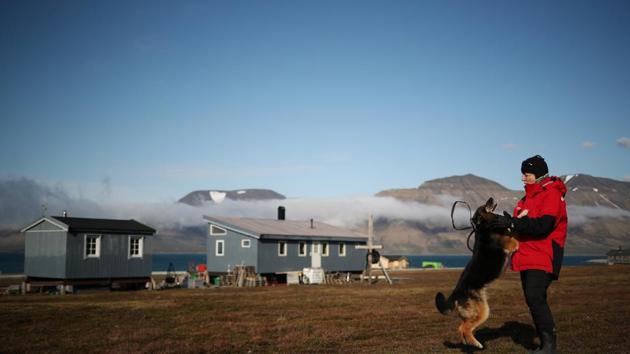
Erosion also threatens homes here. Three years ago, as winter approached, 13 meters of coastline fell away overnight, leaving Christiane Huebner’s cabin perilously close to the fjord. Huebner, her family of three and their husky dogs abandoned the home. “It was a wake-up call since it happened very quickly,” she says. They returned the following spring and had to relocate the cabin 80 meters from the shore. (Hannah McKay / REUTERS)
10/10
 View Photos in a new improved layout
Updated on Sep 05, 2019 10:52 AM


